Deliver Us From Evil

Our Father who art in heaven…

God is still in heaven and everything that happens is still within His all-powerful and omniscient grasp. Nothing escapes His notice and everything happens according to His Divine will even if it be only according to His permissive will. It is he who finally rules the nations as the Psalmist cries out ,

Let people confess to thee, O God: let all people give praise to thee. Let the nations be glad and rejoice: for thou judgest the people with justice, and directest the nations upon earth.

Everything that happens plays out as it was already decreed in His master plan. The results of the American 2016 election are no exception! He, as a loving father, has already decreed the election results and has arranged everything for the best for us His children.

Hallowed be thy name…

May the name of God be held holy in all hearts but especially in the hearts of those who prevail in political office. May all those in public service honor that name upon which they implicitly or explicitly took oaths when they began their public service. May the name of God continue to be the bedrock upon which elected leaders establish their service.

May those candidates for public office prevail who cherish the name of God. May those candidates prevail who will work to protect the right for the citizens they represent to invoke and praise that name not just in their homes, schools and churches but also in the marketplace and public square. May those candidates prevail who cherish religious liberty!

Thy Kingdom Come… 

Put not your trust in princes: In the children of men, in whom there is no salvation.

Image result for my kingdom is not of this world

We do not deceive ourselves with the thought that this or that public official will solve every problem. We do, nonetheless, entertain the hope that our political leaders will work towards the establishment of justice and the promotion of the common good. We at least refrain from supporting those candidates who place obstacles and barriers to the establishment of the kingdom of God.

Thy will be done on earth as it is in heaven…

The will of God is always done. We ask only that we perform it willingly and consciously. We pray that those candidates will prevail who will be instrumental in cooperating with God’s merciful will. That they will be instruments of God’s mercy to the poor and downtrodden. We pray that our political leaders will not be unknowing instruments of God’s wrath to punish us for our collective sins. For each political leader is a minister of God’s will knowingly or unknowingly.

For he is God’s minister to thee, for good. But if thou do that which is evil, fear: for he beareth not the sword in vain. For he is God’s minister: an avenger to execute wrath upon him that doth evil.

Give us this day our daily bread…

We pray for leaders who will advance just and fair laws, human industry and the dignity of human labor. Unlike those politicians that from time immemorial promise “panes et circenses” (bread and circuses) to cull favor among their constituency, we beg for leaders who understand and encourage policies that allow us to earn our own bread through dignified human labor.

Image result for panem et circenses rome

Keeping in mind the words of Saint Paul:

For also when we were with you, this we declared to you: that, if any man will not work, neither let him eat.

May those candidates prevail who understand the proper role of government in protecting the right for every citizen to engage in suitable daily work.

And Forgive us our trespasses as we forgive those who trespass against us…

We acknowledge the enormity of our sins and realize that we do not deserve God-fearing and wise political leaders. But we beg forgiveness and pray to God in the words of David,

The Lord is compassionate and merciful: long-suffering and plenteous in mercy.

He will not always be angry: nor will he threaten for ever.

He hath not dealt with us according to our sins: nor rewarded us according to our iniquities

with us according to our sins: nor rewarded us according to our iniquities.

For according to the height of the heaven above the earth: he hath strengthened his mercy towards them that fear him.

As far as the east is from the west, so far hath he removed our iniquities from us.

As a father hath compassion on his children, so hath the Lord compassion on them that fear him:

And lead us not into temptation…

Image result for temptations of Christ

We pray that we may not give into the temptation of crippling despair in the face of political leaders who appear to be incapable of promoting the kingdom of God. We pray for leaders who will not transgress righteous behavior and impartial justice because of their desire for human respect and widespread adulation.

But deliver us from evil…

Finally we pray that we be delivered from evil. May those candidates who seek public office and who do not acknowledge God’s holy will be defeated. May public officials who promote policies and laws contrary to the natural law be replaced with those who will advance the Kingdom of God.

May we be delivered from the leaders we deserve because of our own sins. May we be delivered from the ill consequences of electing bad leaders. May their plans fail and may their tenure in public office be ineffective.

Amen.


Posted in Lord's Prayer, Uncategorized | Tagged , , | 1 Comment

Learning in Election Time

Image result for cs lewis learning in wartime

In a sermon delivered in the Fall of 1939 titled Learning in Wartime , C.S. Lewis asserts,

every Christian who comes to a university must at all times face a question compared with which the questions raised by the war are relatively unimportant. He must ask himself how it is right, or even psychologically possible, for creatures who are every moment advancing either to Heaven or to hell to spend any fraction of the little time allowed them in this world on such comparative trivialities as literature or art, mathematics or biology

Now I can only guess about the anxiety and feelings of dread that Lewis was addressing among the student body at Oxford at that time. Bombs had not yet dropped on London as they would a year later during the German Blitzkrieg of 1940. I don’t know how his sermon was received at St Mary’s Church that particular evening in the Fall of ’39,  but I regret to say that my own sense for self-preservation would probably have precluded me from sticking around to the end of it should the bombs have started dropping a little earlier.

Nonetheless, I wonder if he might have delivered the same sermon during the 2016 election season here in the United States?

Granted there must be a difference between the feelings of those who faced possible enlistment, and consequently imminent death, and the feelings of a people whose presidential candidates are – shall we say – not ideal. Nonetheless, I think it is safe to say that C.S. Lewis would surely be empathetic with the terrible dread and anxiety of present-day thinking Americans, a dread arising from the direct confrontation with the possible collapse of Graeco-Roman-Judaeo-Christian culture.

I admit it. Having been a teacher for about 27 years now, I can’t think of a time when the study of Latin and Greek and Euclidean geometry seemed more insignificant. I can’t remember a time when teaching the liberal arts, the seven arts of the Quadrivium and the Trivium seemed, well…more trivial.

As Lewis asks his students,

why should we – indeed how can we – continue to take an interest in these placid occupations when the lives of our friends and the liberties of Europe are in the balance? Is it not like fiddling while Rome burns?

Yea, learning the liberal arts at the present time is in fact quite like fiddling while Rome burns! No, even more, it is not like fiddling… it is  fiddling.

Twenty-seven years ago I suppose I was thinking there was still enough time to spread liberal education throughout the land. There was still enough time, that is, to stop and put to rout the forces of modern barbarism.

I told myself that even a handful of classically minded teachers could affect the entire nation. If 12 apostles could spread Christ’s gospel throughout the world, then certainly several hundred liberally educated teachers could transform a single nation!

Student by student, family by family, what with the laws of exponential expansion and the magic of liberal education, I would participate in making small ripples which, though parochial as they were, would in a matter of a decade or so increase to a tsunami-sized deluge, transforming and disposing the hearts and minds of thousands and even millions towards an enthusiastic embrace of  Western Civilization!

Oh well, twenty-seven years later here we are. Standing on the brink of collapse. So much for hic, haec, hoc and qui, quae, quod!

What is the point of learning now? My efforts and those of a great many others do not appear to have transformed the culture. What a colossal waste of time to teach students how to conjugate a verb and decline a noun.

Arma virumque cano….whatever!

Image result for virgils tomb

But I ask myself “What would C.S. Lewis do?” “How would he respond to my despair?”

C.S. Lewis: Pipe-Smoking Biography | Smokingpipes.com

Well I think I know. He would say,  No! This way of thinking is nothing but Tomfoolery!  As if the primary purpose of pursuing a liberal education was to transform the culture in the first place! Hogwash! Yes, maybe liberal education is part of a solution for those who wish to transform the culture, but how insulting it is to assert that this is the purpose of such an education.

He would go on to point out that the present calamity that is the U.S. election of 2016 “creates no absolutely new situation”, as neither did World War II.

The war creates no absolutely new situation: it simply aggravates the permanent human situation so that we can no longer ignore it. Human life has always been lived on the edge of a precipice. Human culture has always had to exist under the shadow of something infinitely more important than itself. If men had postponed the search for knowledge and beauty until they were secure the search would never have begun. We are mistaken when we compare war with “normal life”. Life has never been normal.

When precisely, I ask, is a person supposed to pursue the excellence of soul for which he was created? We are not like the insects who as Lewis says, first seek

the material welfare and security of the hive, and presumably they have their reward. Men are different. They propound mathematical theorems in beleaguered cities, conduct metaphysical arguments in condemned cells, make jokes on the scaffold, discuss the last new poem while advancing to the walls of Quebec, and comb their hair at Thermopylae.

Like Archimedes in his beleaguered Syracuse and Boethius in his cell and Thomas More on the scaffold and James Wolfe on the Plains of Abraham and the noble Spartans who resisted the Barbarian at Thermopylae, we should not cease from the practice of truth, beauty, and goodness just because our own civilization appears to be collapsing.

Posted in catholic education, classical education, Liberal Arts | Tagged , , , , , | 2 Comments

What I Did on My Summer Vacation

I have often repeated the words of a wise teacher, who has now passed on from this dusty earth straight to heaven. (nonetheless I will still continue to send prayers up for his soul in grateful memory of the benefits I received from him.)

He said, “One can’t trust a thinker who lacks the ability to work with his hands.”

of perhaps he said,

“Beware of the thinker who has no experience with his hands.”

I like this second one better. Whether he said it precisely like that or said something else with even greater eloquence I cannot say. But the fact of the matter is that I have always attributed the idea to him, and he cannot deny it anymore.

Educators and intellectuals who have no ability to work with their hands in some practical way are to be suspected! I don’t say that those folks should be bodily banished or cast out or shunned completely. I merely assert that the ideas of philosophers and theologians who have not planted their feet firmly on the earth and who have never imposed order and form into things like wood, tile, and brick, (who have never even constructed say a wooden box or even a pair of saw horses!) will thereby merit a closer scrutiny than the ideas of thinkers who have some manual experience!

And this is, of course, why university and college professors and high-school teachers and students, and really just anyone who is of the academic persuasion, are granted an annual summer break which always appears appallingly long to the rest of the world.

In other words, lengthy summer vacations are necessary for teachers and thinkers.

Summer vacation provides a time for fledgling philosophers, like my students and me, to re-ground our teeming intellects in the raw ingredients, the base matter, the hard tactile “stuff” from which we might, as from a sturdy platform, soar to new and greater intellectual heights!

Now all this is especially true for the teacher at a prestigious secondary school devoted to imparting a liberal education to its students.

Summer is a time for gaining “manual experience.” And this summer I have tried to do that in at least two ways.

The first way is by playing the organ, many of which have three manuals mind you! And a pedal board to boot!

Here is a grainy photo of my organ and its three manuals!

organ.jpg

The king of instruments! The instrument most preferred by our Holy Mother the Church in all of her liturgical worship only excepting the human voice. But enough about this. Suffice it to say that every church organist ought to be granted a generous time allowance for private practice.

The second way I gained manual experience this summer was by actually using my hands to tear apart my kitchen; tearing down old dry wall, tearing down ceiling joists, tearing down cement, tearing down wire and pipe!

All this tearing down in order to recapture the kitchen space before it was besieged by the bourgeois renovators of the 1980s and 90s. All this tearing down in order to restore the original forms and integrity of the original kitchen before it was beset by the ugly but efficient forms of a more pragmatic yet less transcendent age.

The whole theme of tearing down in order to build back up is of course central to the Christian life. As Our Lord said in John,

Amen, amen I say to you, unless the grain of wheat falling into the ground die, itself remaineth alone. But if it die, it bringeth forth much fruit.

and again in Matthew we read,

And whosoever shall exalt himself shall be humbled: and he that shall humble himself shall be exalted.

In both passages I take it that Our Lord is very clearly affirming the idea that in order for there to be a building up, there must first be a tearing down.

For the home renovator, there must be demolition before there can be new construction.

My main attempt was to recover the original ceiling which was at least a foot and a half above the dropped ceiling that was installed probably in order to make the space more efficient.  Efficiency is more often than not something which is opposed to beauty, as my wife’s father used to say. Now I know that there are some of you that think efficiency should be held on a pedestal and worshiped. But not so did John Schmitt thus think!

I think it is safe to say that John Schmitt thought that the banner of “efficiency” is the hobgoblin of little minds, and probably a mantra originating from those in the pink insulation and vinyl replacement window business.

Here is a montage of the kitchen ceiling before we ripped it down.

Now let’s get the hammer out and start taking off all that dry wall! Rip it down! Cut it into small pieces and hide the remains in black plastic trash-bags! Always a mess! Who invented dry wall anyway? I hate drywall.

If you look carefully you will see that above the ceiling joists are the old thin flat strips of wood or “lath” from which the old horsehair plaster had already been stripped. That old wooden lath is a far more noble substance than drywall. One becomes aware of the fact that there used to be artisans who could mix and apply horsehair plaster and achieve a real interior wall with some integrity and substance. No one applies wooden lath and horse hair plaster to achieve some short term effect. No, those plasterers were thinking long term!

Well, after working for days, carefully removing those long ceiling joists one by one, pulling out nails, removing the lath and vacuuming the dust of a 100 years out of crannies and interstices, it was time to start thinking about a new lighting plan. And of course reinstalling the scary 220 outlet that goes to my fancy “dual fuel” oven. I did not take any photos of the work we did to move the gas line in the basement.

Interestingly, you will note that the upstairs oak flooring is nailed directly to the 2×8 ceiling joists! Now I really don’t understand why the builder back in the 1920s would do such a thing. One simply does not lay down a quality wood floor directly on joists. One always applies it to a sub-floor. I suspect that my builder was trying to get the job done quickly and had probably run out of sub flooring materials. Oh well.

Now let’s get the cold-chisel out and a hammer and start uncovering the chimney behind the wall. This was much more difficult than I expected given the inch thick mud/concrete layer covering the old brick! Good thing I had some help.

Those builders back in the 1920s thought nothing at all of covering brick with cement. I suppose they had their complete fill of brick and probably were all too happy to cover it up. On the other hand, I am still wondering if that cement also acts for some other useful end aside from hiding the brick.

Summer vacation is also all about the multiple trips to places like Lowe’s and Home Depot where one can just stand looking upwards at lighting fixtures for hours. After about 45 minutes of gazing ceiling-ward my neck cramps and forces me to come to a decision.

0712161412

I didn’t like any of them. But finally I saw these!

We installed two of the bell shaped pendant lights above the sink and five of the jar-shaped ones strategically around the ceiling. The new filament bulbs are expensive but very nice. Our kitchen now has a warm yellowish glow with all the lights on. As you can see, we started installing the bead board as well. I found a beautiful white pine 1x4x8 bead-board at Lowe’s which has nary a knot in it.

Actually I am kind of amazed at how nice the wood is and to be perfectly honest…I am not quite certain that it really is pine. Seems harder than the pine I am used to. Douglas Fir? I don’t know. Someday I hope to be a master in the field of lumber species recognition.

0728161704b

Now I should say that it took me exactly 30 seconds, trying to nail the bead-board up with some 1.2″ silver finish nails and a hammer, to determine that I needed a to buy a pneumatic air gun! 0805161406

I’ve never owned a nail gun before or even a compressor. These are the kinds of tools that everyone needs to own. I wish someone had told me to get one twenty years ago!

As a matter of fact if you don’t have one go get one right now! No more bending nails. No more denting the wood with incompetently aimed hammer strokes. No more incessant pounding and holding nails in one’s teeth!

No sir! The pneumatic nail gun will simply revolutionize your hammering experience and bring some joy back into your life!

Am I the very last person to have realized this? I don’t know.

As you can see, after we removed the dropped ceiling there were a couple of challenges to face in the form of some unsightly plumbing fixtures that had been installed after the dropped ceiling…or perhaps because they were the reason that a dropped ceiling had been installed. Fortunately I had a plumber come and move a couple of the water lines including one that had been dripping very slowly for the last ten or so years. But there was simply nothing that we could do with the 6″ PVC drain and trap. There was no re-routing option.

0729161256a

At first we were all for just leaving the pipes exposed and maybe painting them red or some prominent color. Then we thought that perhaps we should wrap them in rope-a very hip idea. Finally, we decided that we just had to sacrifice some of our newly discovered vertical space and employ a “dropped box” to hide the pipes. The following pictures show the “box” in various stages of completion (although it is still not complete!)

IMG_6973 0819161447a

0819161555

kitchen ceiling

You can see some simultaneous green board work in the background. The secret to obtaining a really smooth finish with dry wall and Spackle must always include multiple coats and generous sanding between every coat. But alas! I am just not willing to do all that sanding. I am not willing to abide the endless and insidious dust that it creates. (i.e. actually the dust is not “created” but is rather a byproduct of the sanding). Instead, I opt for the moist-sponge-method whereby all the bumps and irregularities in the dry wall are scrubbed off. And then this process of applying and scrubbing and applying a scrubbing just goes on forever.

I have never been satisfied with my own dry wall technique…nor that of anybody else for that matter. I hate drywall.

One interesting detail of this work came with the whole issue of installing a range hood for my oven. I had fortunately kept the original “range-master”  range hood in my garage for about five years, but I was really not certain how to hang it. But after an entire morning of thought and some lucky electrical circumstances ….voila!

Now of course the question is: How will I complete the duct work between the range hood and the pipe leading outside? Well, stay tuned! I happen to have a very special friend who is going to help me through that process with a nifty custom crafted stainless steel duct/pipe system that will be exposed- and in fact will be a very interesting conversation piece when it is finished!

IMG_6995

And so even though there is still work to do, I am ready to get back into the classroom. My students will know that they are in a class of a teacher who is not afraid to rip cabinets from the walls. My thoughts and teaching will be above suspicion because I spent my summer vacation working with my hands!

Posted in beauty, liberal education works, Sacred Music, slavery, summer vacation, Work | Tagged , , , , | 18 Comments

The Ability for Large Discourse

Today we shall content ourselves with a purely intellectual discourse.

Why?

Because you and I, my dear reader, both possess the ability for large discourse! And as we all know, reaching way back to the vestiges and remnants of learning from our bygone philosophical days,

“every ability desires its own act.”

Every ability desires its own act… I like that! Am I the first one to say that? And with such eloquent brevity?

Probably not. I must be merely parroting somebody else as I am wont to do.

Unravelling the mystery of parrot longevity | Max-Planck-Gesellschaft

The nice thing about parroting the wisdom of others is that, after a fair amount of time has passed, and after one has engaged in enough consistent parroting, one is apt to forget that all of one’s borrowed wisdom is borrowed.

To be perfectly honest sometimes I actually feel quite intelligent!

But let us return to our purely intellectual discourse that we intend to have – and by now you are probably wondering what “the ability for large discourse” is.

“What is the ability for large discourse?” you ask, and “who says we have such an ability?”

Good questions! And here is the answer to the second.

Who says?

Shakespeare says!

And he says through the mouth of none other than that incomparable brooder, Hamlet.

Image result for hamlet

What is a man,
If his chief good and market of his time
Be but to sleep and feed? a beast, no more.
Sure, he that made us with such large discourse,
Looking before and after, gave us not
That capability and god-like reason
To fust in us unused.

I have emboldened the appropriate words for you to see the more easily.

And so the point is settled.  You and I have a god-like ability for large discourse; we have an ability for looking before and after. We have something called reason, and Hamlet has done nothing other than to tell us precisely what this thing is; he has, against all odds, defined the distinctively human thing that distinguishes man from the beasts.

And by golly, let’s not let this ability fust in us unused!

Let’s go ahead and engage in some of that large discourse right now!

We shall do so with no apology. We shall not attempt to persuade anyone of the usefulness of the enterprise. We shall not make an attempt to sweeten our discourse with honeyed speech. There will be no effort to lure you, the reader, in to the discussion; no catchy lead in, no clever rhetorical hook, so to speak.

I think we are all above that now, don’t you?

If a thing is interesting in itself then we may just let the thing speak for itself. Let us not engage in the silly enterprise of trying to coax one another to see that something is interesting if it is already interesting. How childish!

And further, if a person cannot engage in large discourse, looking before and after, from time without making apologies then what’s the use?

Every other creature gets to do what it was made to do without defending itself. Take a mountain for instance. Do you hear it making apologies for what it does???

No you don’t. The last thing you would ever expect to hear from a mountain is an apology of any kind!

Oh yes, but you are thinking,

“of course mountains don’t make long apologies for what they do, because mountains don’t do anything. They just sit there!”

You are quite mistaken!

Even though Mountains appear to be just sitting there (which is in fact doing something, that’s what I am doing right now, for example!) you should be aware that mountains are really doing a great deal more than just sitting there. Obviously you did not read this. Shame on you!

Now let’s get on with it. Let’s begin our large discourse! And what could be more appropriate than to engage in large discourse about the very word large!

Would it surprise you to know that Hamlet’s use of the word “large” (in the passage above) can be understood in at least six different ways?!?

Let us enunciate these ways briefly and perhaps we shall find an occasion to speak about them at greater length as the muse instructs (or, if you prefer, you might just go ahead and read about it from the very text itself, by that quintessential philosophical mind Duane Berquist, right here! Otherwise, if you prefer secondary sources stay right here.)

And before we distinguish the six ways, in which Hamlet intended us to understand the word large, in his marvelous definition of reason, I think it would be fitting if we all took a moment to revel in the fact that six senses of the word large is a rather large number when it comes to the senses of a word, and we should clap our hands at the very fact that in distinguishing these senses we are engaging in large discourse already!

Ok here we go. When Hamlet says that reason is the ability for large discourse, here is what we should understand.

Large discourse can be large in the sense that it is about the large.

So for example suppose I say something like the whole is greater than the part. Is it not obvious to everyone that I have made a very large statement (i.e. universal statement)? Just think about that for a while.

How many kinds of wholes can you distinguish? And guess what…every kind of whole is greater than its own part. We could go on for ever trading examples of the truth of this large statement. That would be fun. Maybe fodder for a future post! I can’t wait.

What about this? What if I make a statement about a very large (or important) thing? What if I say something about the largest thing there is, namely, God? Nothing is bigger than God and consequently when I say something true about him I am therefore making a very large statement. Right? I think so! Similarly, we might engage in reasonable discourse about other large things. Like the purpose of life, the soul, angels, the state, virtue…and may I even say reason itself? In other words “large discourse” is not small talk!

Now, let’s see, is there a third way that our ability for large discourse can be large? What about in its limits? Just as every line has two endpoints (no apology to you modern geometers who falsely insist that lines are infinite!), so does our reason.

Our reason has a beginning, a very large one. You see ordinarily when we set forth a proposition, like “I know boys, and I can tell you that boys can be a load of trouble!”

Image result for dickens boys

That statement is no small thing. That statement is probably based on a very wide experience of boys (i.e. an induction from a large experience). A very large experience.

And similarly, at the other end of our reason, when we consider a large truth we might understand very many things that fall under this truth, so to speak (i.e. we understand many applications or deductions from one truth). So for example when God considers Himself he understands ALL THINGS!

Now here is a fifth way that our ability for large discourse can be large. have you ever read a lengthy blog post? Granted that this blog post is not exactly like a longer proposition in the Elements of Euclid, nonetheless anytime someone makes an argument that takes a long time, I think that qualifies as large discourse (i.e. a discourse in which there are many steps (i.e. a large number of steps). But all the more so when the discourse is bound together with continuous syllogisms (or witty jokes?).

Finally, the ability for large discourse can be large in the sense that reason is able to make connections between things which are very far apart. In other words reason is able to cover large distances. Imagine uttering a statement like “God is my rock!”

Now who on earth, but someone with reason, would ever think of seeing a connection between God Himself,  the almighty, omniscient, all loving Being, and a rock!?! To make such a connection requires covering a very large distance…an infinitely large distance!

And so, there we have it! Reason is the ability for large discourse.

Posted in Shakespeare, Wisdom | Tagged , , , , | 2 Comments

Summer Somnolence

My inner sense tells me that it might be a good time to start thinking again.

You see, the end of July is precisely the heart of the season when the mind of the academic, the mind of a teacher, and the mind of the student (although more so the student!) is most apt to fall into a hazy intellectual summer somnolence. Gradually lulled into a mental slumber throughout June, the mind is not able to withstand the daily incremental rise in temperatures, the incessant summer sunshine, the dripping wet humidity, the somniferous chirping of birds and the song of the cicada.

The collective soporific forces of summer overwhelm the senses, and every human body must succumb to the need for shade and rest.

And as the body goes, so too goes the mind. Didn’t someone once say,

Ubi corpus est ibi mens!(?)

Or perhaps that is just another one of those “ubi…ibi” statements that it is very well to commit to memory early in life to save oneself the later trouble of thinking through tough logical connections.

At any rate, I do sometimes grumble at the soul-body connection that appears to be at the heart of so many human difficulties. You know, as Our Lord said somewhere towards the end of Matthew,

vigilate et orate ut non intretis in temptationem spiritus quidem promptus est caro autem infirma.

Or was that Shakespeare?

Nonetheless, the spirit indeed is willing but the flesh is weak.

Why couldn’t it have been otherwise? Why not,

“The spirit is willing and guess what… SO IS THE FLESH!”?

That’s the way I would have designed things if I were the Creator.

Oh, wait a second…now that I think of it, that was the way things were supposed to have been. That was reportedly the way it was with Adam before the unfortunate thing happened about which I would prefer not to speak here.

But just think about it. When Adam wanted to get up in the morning, the dialogue between his soul and his body was probably something like:

Adam’s Spirit: I think its time to wake up and get out of bed to face another day of naming all those animals, plants, rocks, minerals, insects, and what not.

Adam’s Flesh: ABSOLUTELY! Let’s do this! I can hardly wait!

Spirit: But first let’s do some jumping jacks and push ups!

Flesh: Oh Boy! I love push ups and jumping jacks!!! How about a five-mile run as well?

Spirit: Easy does it Flesh. Let’s not over do it. Remember, we need to have a healthy breakfast and then we can do our run later in the evening.

Flesh: Quite right, quite right. You’re absolutely in charge! I wouldn’t want to do anything unreasonable!

Spirit: That a boy, flesh! And remember “all things in moderation!”

Flesh: Yes, I know you have instructed me well in those wise words since the very beginning. And I just love them. Nothing too much or too little. I especially hate excess!

At any rate, summer is a perilous time, to be sure! It is a time of sleepy forgetfulness for both teachers and students, and it is well-known that July is the time when one’s stock of knowledge decreases by at least 20-25%. Just think of that! In four years one would literally forget everything he knows were it not for putting up a valiant struggle for at least 9 months of each year in that blessed institution which we call school.

Ah, the classroom! The place of alleged intellectual stimulation and progress and awakening. Ah, the lectures. The mostly one-sided intellectual discourse, in which apparently every great teacher must excel.

There is nothing quite like the exhilaration that a teacher feels when confronted with a classroom of sleepy compliant students, knowing that for the next hour one has a captive audience to which he can talk, shout, and lecture and make manifest the scintillatingly interesting subtleties of his own magnificent mind!


Posted in ad libitum, education, Homer, summer vacation, Uncategorized | Tagged , , , | Leave a comment

The Close of Another Year: A Dialogue

Lion: You seem a little down lately, Ox. What’s the matter?

Ox: Do I? I guess I am a little dispirited. I hope it’s not obvious to everyone.

Lion: Well, you have been lying around in the grass for the last several days sleeping, and when you do move you mope and lumber about lethargically, with more than your usual vacant stare. Seems like the only energy you have is for eating.

Ox: Well I have just been thinking about how sad the end of the academic year is. Everything ends and then one is left with an empty feeling. The students leave. The halls and classrooms are empty. The silence is pervasive. No discussions. No arguments. No intellectual progress.

Lion: Of course, Ox! It’s Summer break and it happens every year.

Ox: I think it’s a waste of time. And it’s counter productive. Just when the students start making sense, just when they are beginning to make progress, just when-after so many false starts and so much stubborn resistance – they finally begin to show signs of intellectual life…wham!….the year ends and everyone goes home for three months. And then what? We begin the whole process again the next year. What an idiotic system!

Lion: Summer vacation is loved and cherished by everyone but you. Those poor students worked so hard. They deserve a break! It was precisely the thought of this long summer vacation that kept their hearts cheerful back in the cold days of February. For the last nine months those poor students fended off despair-a despair occasioned by all the Algebra, Latin, and History assignments given them by merciless teachers-they kept their hope alive through the frequent recourse to the world of imagination. And what did they imagine? They imagined weeks and weeks of fishing and biking and canoeing and sailing and climbing trees and going to the beach! They imagined discussing life while reclining in Adirondack chairs with cups of cold lemonade.

Dozing away blissfully in a hammock between two birch trees.

Swinging gently this way and that under the clear blue sky listening to nothing but the songs of the Blue Jay, Gold Finch, and Cicada. Ah Summer!

Ox: Ha! You really believe that?! Kids don’t do those things anymore. They spend all their time in front of screens playing games or talking about nothing on social media. Humpf! What a lot of nonsense. Climbing trees….fishing….as if!

Lion: Ox, you are too negative. So what if they do spend a little time playing computer games? That’s not so bad is it?

Ox: Not so bad? Well if the wholesale collapse of western civilization doesn’t bother you then I guess not. Lion, you need to wake up!

Lion: Me wake up? You’re the one that has been sleeping this past week.

Ox: Well that’s because I am temporarily depressed. And it is only because I have a clearer vision than you about the true state of affairs. Just give me a little time to shake off my annual end of the year disappointment. Soon it will be July, and then August and the September and then…

Lion: And then what?

Ox: And then we shall have those students back in school where they belong!

Posted in ad libitum, classical education, summer vacation | Tagged , , | Leave a comment

Resurrexit! 2016

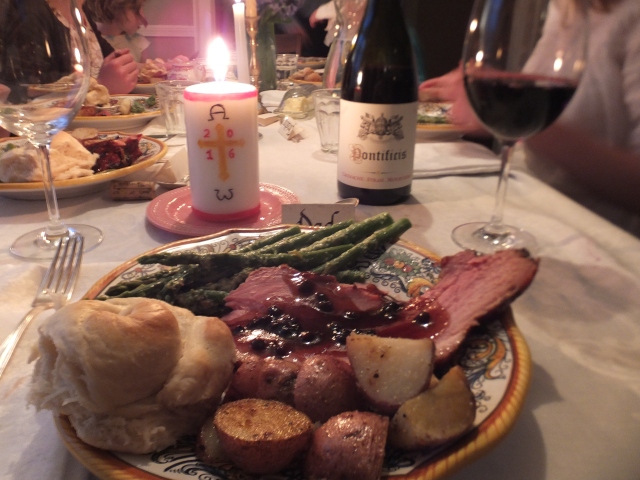
Happy Easter 2016!

DSCF6123

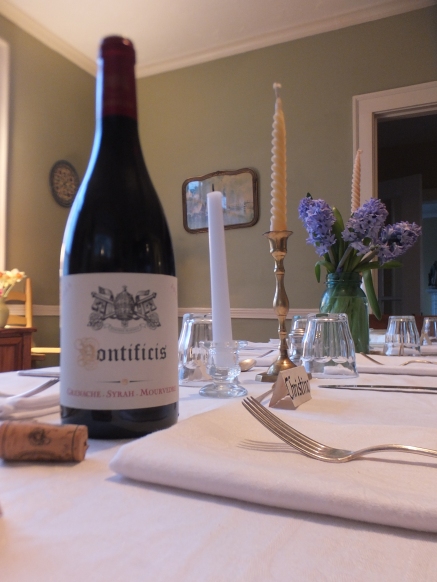
Pontificis, a blend of Grenache and Syrah-a bold match for the Ham!

DSCF6133

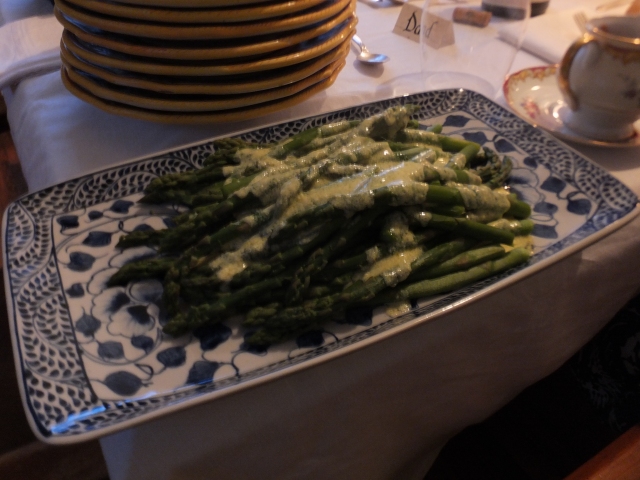
The classic side- asparagus married to Hollandaise!

DSCF6128

quartered red potatoes of course!

DSCF6139

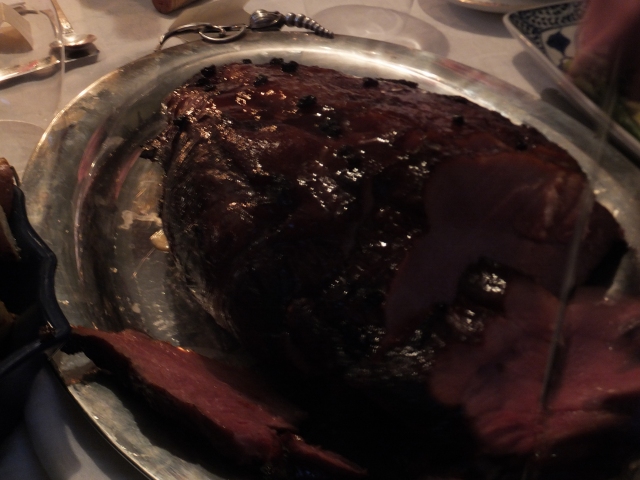
The “master carved” ham with a clove garnish.

DSCF6143

all on one plate with a big buttery warm puffy roll.

DSCF6153

Finally-a very simple “fool” made from fresh blackberries and whipped cream.


Posted in beauty, Dinner, Easter, Feasts, Uncategorized | Tagged , , , | Leave a comment

An Easter Joy Crowns the Lent of Life

Sorrow! Sorrow!

Very few days pass but that we don’t hear of some new sorrow. A job is lost, a troubled marriage…a near relation passes away, serious illness falls, dashing promises and hopes…a calamity strikes affecting the national interest…a friend loses his track and ceases to practice the Faith.

And of course the Christian is beset with a consciousness of his own daily sins and failings.

Herodotus relates that a certain tribe among the ancient Thracians celebrated births and deaths in an unusual way.

When a child is born all its kindred sit round about it in a circle and weep for the woes it will have to undergo now that it is come into the world, making mention of every ill that falls to the lot of humankind; when, on the other hand, a man has died, they bury him with laughter and rejoicings, and say that now he is free from a host of sufferings, and enjoys the completest happiness.

Life must have been pretty difficult for those ancient Thracians.

But sorrow is universal as the psalmist testifies…or rather sings!

I have laboured in my groanings, every night I will wash my bed: I will water my couch with my tears.

and keeps on singing,

My tears have been my food day and night, While they continually say unto me, Where is thy God?

Our lives carry on in their allotted paths, beating out their own rhythms and music and certainly moments and prolonged stretches of happiness but punctuated every now and again with the refrain of sorrow, the song of sorrow.

If that sorrow is not our own it is that of another whom we love, and therefore it is our own.

Behind all the smiles, under the surface of the laughter is the sure refrain of sorrow and tears and pain. None but the young, or those who are sleeping, could be unaware of this.

Time, the incomparable and inexorable teacher, teaches one lesson consistently. It is this: The Song of Sorrow.

But those who are fortunate enough to have been nurtured in the hopeful climes of the West, who have basked their minds and hearts in the rays of the Mediterranean sun, who have suckled their souls on the milk of pagan poets…they know that the song of sorrow does not end with sorrow.

Aeschylus chants through his chorus of elderly Athenians,

αἴλινον αἴλινον εἰπέ, τὸ δ᾽ εὖ νικάτω. 

Sing a  song of sorrow, a song of sorrow, but the good prevails!

Aeschylus, the great tragedian saw a glimpse of Easter joy five hundred years before Christ conquered death. Aeschylus knew through a glass darkly that an Easter Joy prevails and crowns the Lent of life.

The Blessed John Henry Cardinal Newman (by antonamasia, The Apostle of Liberal Education) saw more clearly than anyone how the oracles of nature prepare the Christian mind for the Gospel of grace.

Newman  in his Apologia, writes about the influence of the ancients in his life,

their teaching, magnificent in themselves, came like music to my inward ear…pagan literature, philosophy, and mythology, properly understood, were but a preparation for the Gospel. The Greek poets and sages were in a certain sense prophets; for “thoughts beyond their thought to those high bards were given.”

When I read the bard Aeschylus it is clear to me that God inspired him with thoughts beyond his thoughts; thoughts about man’s fallen state, his life of suffering, the natural law…and God. They are Pre-Evangelists. They are “oracles of nature and of truth!”

Aeschylus’ chief role is not primarily that of an instructor. No, he makes us feel the things about which he instructs. He orients our hearts rightly about those things, as is the aim of any good poet.

We are all like the watchman in Agamemnon,

I pray the gods to quit me of my toils,  to close the watch I keep, this livelong year; for as a watch-dog lying, not at rest, propped on one arm, upon the palace-roof of Atreus’ race, too long, too well I know the starry conclave of the midnight sky… And if at whiles, for the lost balm of sleep,  I medicine my soul with melody  of trill or song-anon to tears I turn,  Wailing the woe that broods upon this home…

And we learn that the meaning of our suffering is not suffering but the meaning of suffering is truth!

Zeus has led us on to know, the Helmsman lays it down as law that we must suffer, suffer into truth.

or as another translator has it

Tis Zeus alone who shows the perfect way of knowledge: He hath ruled, men shall learn wisdom, by affliction schooled.

And St. Paul teaches the fullness of this in Hebrews when he says,

For whom the Lord loveth, he chastiseth; and he scourgeth every son whom he receiveth. Persevere under discipline. God dealeth with you as with his sons; for what son is there, whom the father doth not correct?

and a little later

Now all chastisement for the present indeed seemeth not to bring with it joy, but sorrow: but afterwards it will yield, to them that are exercised by it, the most peaceable fruit of justice.

Aeschylus’ Orestaia begins as a song of sorrow but ends not only with justice but the very establishment of the first tribunal of Justice in Athens. Through the will of the gods the law of revenge is abolished and the ancient Furies are transformed into Eumenides, the kindly ones.

The student of nature knows that sorrow is the school of wisdom. The disciple of grace knows that sorrow is the school of Joy.

Nature is reflection and sign, a sacrament of sorts, of the invisible things of grace.

To those who are inattentive to nature and grace life must be nothing but a song of sorrow.

But to those who embrace this sorrow life is a song that ends in triumph!


Posted in aeschylus, Newman | Tagged , , , | Leave a comment

Father let this chalice pass from me

The Fourth century saint and doctor of the church, St. Hilary of Poitiers, has a lovely insight – or perhaps I should say – a somewhat different take on Our Lord’s prayer in the garden.

And going a little further, he fell upon his face, praying, and saying: My Father, if it be possible, let this chalice pass from me. Nevertheless not as I will, but as thou wilt.

Saint Hilary “the Hammer of the Arians” does not interpret the passage in the usual way. Granted that Sacred Scripture is manifold in its meaning as St. Augustine points out in his De Doctrina Christiana. 

The usual way to interpret the passage (which is recorded in Matthew, Mark, and Luke but not in John!) is that this prayer demonstrates that Christ was not only true God but he was also true man.

True, there are many passages in Scripture where we encounter incontrovertible evidence that Christ was true man. I am thinking particularly of all the passages that show us that our Lord ate food.

Nothing reminds me that I am a genuine corporeal being so much as the times I find myself eating.

Our Lord’s prayer at Gethsemane might also serve the same purpose. The body has a natural repugnance, even a fear, for death, and so Our Lord was demonstrating his humanity when he prayed in the garden. His body had such a repugnance for death and suffering that he even sweat blood!

When it comes to Matthew 36:29 or Mark 14:36 or Luke 22:42  an angel would not make this prayer. An angel would not sweat blood and make a prayer saying

“Father let this chalice pass…”

Pure spirits do not flinch at the prospect of a painful crucifixion.

But in order to prepare you for St. Hilary’s interpretation just consider with me for a moment. Here is a man who was born with a mission. Christ is the very Word of the Father incarnate among men. And when he came down among us 2000 years ago he did so for a very special reason – a reason that He spent His life teaching us.

Didn’t Our Lord know about His mission? Didn’t he realize what His Father’s plan was? Isn’t His will one with the Father’s?

Christ is a man who beyond anyone else in history knew what he was doing. Christ was a man who more than anybody was prepared and trained for the battle that he was to fight.

Why then would Jesus say “Father Let this Chalice pass” at the official “kick off” of the Passion in the Garden at Gethsemane?

Was he scared? Was he reluctant about undertaking His mission? I think that we could say

“On the contrary, if there was ever a solider eager for battle, if there was ever a knight eager to fight a dragon, if there was ever a hero eager to undertake a mission against seemingly impossible odds, it was Our Lord.”

Of course in His case those seemingly impossible odds were seemingly impossible to everyone except Him. In other words Christ did not begin His passion by praying to His Father to make it all go away.

So what was Our Lord saying when he prayed,

My Father, if it be possible, let this chalice pass from me. Nevertheless not as I will, but as thou wilt.

Well, I would never have discovered St. Hilary’s interpretation if it were not for St. Thomas Aquinas and his marvelous work -that most exquisite source of instruction-that immeasurably edifying tome of wisdom… the Catena Aurea!

And here it is that among the wise and holy scripture exegetes that St Thomas “chains” together-is none other than the the cheerful Hillary of Poitiers!

…He says not, Let this cup pass away from Me, for that would be the speech of one who feared it; but He prays that it may pass not so as that He should be passed over, but that when it has passed from Him, it may go to another.

Christ does not say “Let this chalice pass me by.”

To pass from is not the same thing as to pass by. Interesting how a little knowledge of prepositions can help! No wonder Grammar is a Liberal Art!

In other words, one cannot pray that a chalice pass from oneself without first intending to receive that chalice.

Hillary continues,

His whole fear then is for those who were to suffer, and therefore He prays for those who were to suffer after Him, saying, Let this cup pass from me, i.e. as it is drunk by Me, so let it be drunk by these, without mistrust, without sense of pain, without fear of death.

Let this chalice pass from me to those who love me. Let this chalice pass from me to all Christians and let them drink it as I drink it. That is, let them drink this chalice without fear. Let them drink it with faith and without any mistrust.

Again Hillary,

That He says, Not as I will, but as you will, He would fain indeed that they should not suffer, lest their faith should fail in their sufferings, if indeed we might attain to the glory of our joint inheritance with Him without the hardship of sharing in His Passion. He says, Not as I will, but as you will, because it is the Father’s will that strength to drink of the cup should pass from Him to them, that the Devil might be vanquished not so much by Christ as by His disciples also.

Rather than voicing a prayer expressing fear, Our Lord prays that we, his disciples-indeed all Christians, will embrace the cross as he did. Out of love for us he prays with an infallibly effective prayer to the Father that we his friends will not fail to follow his path.

He prays that we will drink the chalice from which he drinks. That it will pass from Him to us. He prays that we will not fail to take up the cross and join with him in the salvation of our souls.

Posted in Catena Aurea, Easter, Uncategorized | Tagged , , , | 28 Comments

The Secret to Beautiful Liturgy: Leave it to the Kids!

This morning I attended a simple daily Mass along with 60 students in grades 6-12. Let’s see, that places them somewhere between the ages of 11 and 18. So given that there were only 70 people in the church – students and a handful of adults- I would say that the average age of the congregation was somewhere between 16 and 17.

The Lenten day Mass was just like any other Mass except that it was at a side altar in our rather “baslica-esque” church and Father faced “ad orientem.”

Somewhere during the Mass I found myself thinking: What is going on here? This is absolutely beautiful! I don’t think these kids are even aware of what they are accomplishing!

And what was it that they were accomplishing?

They were accomplishing, in an unassuming and unostentatious manner, the very thing that every Church Musician, every Liturgist, every Pastor, every Bishop…nay even the Fathers at the Second Vatican council wanted to accomplish when they wrote Sacrosantum Concilium.

They were accomplishing full and active participation in the sacred liturgy. And they were accomplishing this through beauty!

Mother Church earnestly desires that all the faithful should be led to that full, conscious and active participation in the ceremonies which is demanded by the very nature of the liturgy.” (Constitution on the Sacred Liturgy )

Granted that active participation does not mean the same thing as actual participation, nonetheless these kids were demonstrating active participation to the greatest extent that I can imagine.

Let me give you a quick overview of what happened.

The Mass opened and the kids sang the simple chant “Attende Domine et Miserere” (Hear us, Oh Lord, and Have Mercy). The doleful sounds of the chant imploring Gods’ mercy especially during Lent-and perfect for this Jubilee Year of Mercy to boot!- put me in the proper frame of mind for the penitential rite. No organ accompaniment. No cantors…just the voices of average kids blending together in chant. But don’t confuse average with mediocre. I am here to tell you that the average voice is a beautiful voice with just a little coaching.

Then the kids chanted the Kyrie from the Mass for Advent and Lent (Missa XVII). So singable, so lovely! What is it about Gregorian chant anyway? The words are melded so perfectly with the melody that the two become one… like body and soul.

I don’t know how the Holy Trinity could refuse when invoked by voices in such a way!

After the readings and the Homily, the kids sang Felice Anerio’s “Christus Factus Est Pro Nobis” (Christ Was Made Obedient For Us) at the Offertory. The best sacred polyphony is of course rooted in chant- perhaps imitative of the chant in its mode and mood, even echoing various motifs and intervals at times. No wonder sacred polyphony is second only to chant in its identity as Sacred Music. As the students sang those jarring first intervals  of the Christus Factus I realized that Anerio was reminding us about the jarring truth of Christ’s obedience unto death- even death on the cross!

The Sanctus  from Mass XVII with its soothing descending intonation followed by an immediate spirit lifting symmetrical ascension is a perfect preface for the Eucharistic prayer. The final Hosanna soars aloft but then glides down for a graceful landing on the word “excelsis.”

For many of these students, the chant was brand new. For all of them it was never rehearsed. I suppose some of the older students knew it and magically imparted their knowledge to the younger. The power of emulation! But that’s the way it is with those Gregorian mass settings…you hear them once and can join in the second time. Even if you are just, say 14 or 15.

I love the Agnus Dei. All of the settings, of course, have some repetition – yet some variation. Doleful and ethereal, the chant communicates the pleading of the words. The melody said the the same thing “Lamb of God….have mercy..”

That of course gives the full meaning of “bis orat qui cantat” (he prays twice who sings!).

At Communion they sang the beautiful, though slightly sentimental, “Adoramus Te Christe” by Dubois. The perfect Lenten communion song!

Mass ended with the Hassler (harmonized by Bach) “O Sacred Head Surrounded” for a recessional. Kids love this song. As a matter of fact, so does everyone.

Now, in the interest of full disclosure I will reveal that these students do all attend a school where, in addition to their regular studies, they are compelled to attend choir practice. According to this school everybody can sing. Everybody has a voice and every voice has a place in the choir! And in cultivating this talent each soul is given an important tool- a tool for actively and consciously participating and cooperating in the most sacred act possible!

I looked around discretely from time to time to see if the kids were aware of what they were doing. Yes- I know they knew what they were doing, as far as youth knows…but were they really aware of the profound beauty that they had cooperated in producing? Were they fully aware of their cooperation in so sublime an act of worship?

By the appearance of their youthful and carefree expressions I don’t think so. For them it was an ordinary experience – another school Mass. But in my hidden tears I knew it was nothing of the sort.


Posted in beauty, catholic education, Sacred Music, Sacrosanctum Consilium, The Mass | Tagged , , , , | 1 Comment