Pakistani Beef Stew

PIMA
This was an absolutely fabulous stew complemented beautifully by a cold bottle of California Chardonnay and homemade garlic bread!

While I am at it- I don’t know how this stew looks to you but it was absolutely fabulous. My wife is an expert at homemade curry particularly of the yellow variety. This dish apparently is a well known Pakistani dish simply called “Pima.”

For anyone who loves curry and beef this stew is for you. The potatoes were cooked al dente and the peas mixed in gave it just the right balance. Nice as a single dish for a late dinner, although we followed it up with a fresh garden salad topped with a garlicky white Greek dressing!

Wonderful!


Posted in Uncategorized | 2 Comments

Oriare!

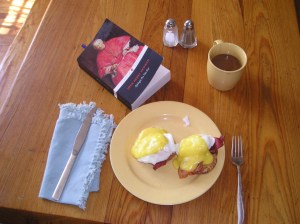
The Perfect Breakfast Eggs Benedictus!


What better way to return to our discussion of classical Catholic education than with an image of the perfect breakfast.

And I figure that this photo of a culinary masterpiece might also stand up competitively with some of Fr Z’s very best work- while driving my readership to new heights!

You will note the very simple Eggs Benedict atop bacon and English Muffins. The delicious coffee fresh ground Medium Roast from an oily bean brewed in my – now broken espresso/cappuccino maker (the “frother” handle snapped off-but the coffee still brews) – stands on the right and Cardinal Newman’s Apologia sits on the left. You can see that  I set the table in a hurry in my failure to consider the proper placement of the knife and fork. The truth is that I really don’t like cold eggs.

I have read bits and chunks of the Apologia before but am now making a full scale attempt to read it cover to cover. Very enjoyable, especially when he speaks about the role of pagan literature as being a sort of precursor to the Gospel. I love that. And of course his frequent quotations from Virgil are deeply stirring!

A close up of the Hollandaise sauce

Posted in breakfast, Newman | Tagged , , , | Leave a comment

Recapitulation

Before discussing what liberal education frees us for,  it is a good time to recapitulate what Liberal education what if frees us from  as well as how it frees us from the things that it free us.

First we say that it frees a person from intellectual slavery  (see  slavery)

Which we divided into four kinds  (see  A division of the four kinds of slavery from which Liberal education frees us.)

Then we introduced catharsis, the method by which liberal education frees a person from slavery. Catharsis is most apparent with the slavery to passion. (see Catharsis)

Next we defined the first kind of slavery- the slavery to passion (Slavery to Passion)

Then we discussed catharsis a little more, dividing it interestingly into three kinds!(Three Cartharses)

The second kind of slavery is slavery to fashion (see slavery to fashion) and expanded upon (More on Fashion)

Then we introduced the third kind of slavery.( Slavery to Custom)

which we quickly divided into three kinds:

  1. Temporal Custom
  2. Geographical Custom
  3. Political Custom

Finally we addressed the fourth and final form of intellectual slavery and gave six causes for it. (see Slavery to Error)

Now we can turn our attention to what liberal education frees us for.

Posted in classical education, slavery | Leave a comment

Slavery to Error

Liberal education proposes ultimately union with Christ the Truth who will set us free. But it proposes that we achieve this freedom in the order of grace through achieving, insofar as we are able, freedom in the order of nature. Gratia supponit naturam!

As we have said before, freedom is a two fold proposition. There is a freedom from certain things (e.g. freedom from four kinds of intellectual slavery that we have already spoken about ). There is also a freedom for certain things (e.g. the freedom for engaging in the pursuit of the things to which man is ordered by nature). These are the things that St Paul has in mind when he says in his letter to the Philippians:

For the rest, brethren, whatsoever things are true, whatsoever modest, whatsoever just, whatsoever holy, whatsoever lovely, whatsoever of good fame, if there be any virtue, if any praise of discipline, think on these things.

But before discussing the way that liberal education frees us for these things we still have one more kind of intellectual slavery from which liberal education frees us- namely the slavery to error.

Unfortunately, slavery to error has many causes, and it so happens that the first three types of slavery (i.e. slavery to passion, fashion, and custom) can be the causes of this final type of slavery. As if that was not enough, there are also three other causes of slavery to error (pride, false imagination and bad logic) making six in all.

The Six Causes of Slavery to Error

  1. Errors in thinking, then, can be caused first by following one’s passions. For example, our passions might induce us to think that happiness is living a life of pleasure and power. Those who habitually follow the direction of their passions will naturally (or unnaturally) begin to adopt intellectual views which rationalize their habitual behavior. It is not surprising to hear people argue the merits of an intellectual position which unsurprisingly mirrors the kind of life they lead. In these cases we might suspect that the root cause of the intellectual mistake they make is nothing more than the fact that they are lead by their passions.
  2. Similarly, errors in thinking likewise might be caused by following fashion If we are given to always acting according to what is in vogue or currently fashionable, we will necessarily involve our minds with the errors that stem from the fluidity of group thinking. We will begin to act and think according to however the majority happens to act and think at any given time. We will find ourselves defending an ever changing world of opinion. Our thought about right and wrong will be determined by consensus, and specifically by the most recent consensus
  3. Those who think erroneously that every idea is equally valid might think this because they are slaves to a political custom. As Alexis De Toqueville points out, in democracies everything tends towards equality.  It is one thing to defend the glories of Democracy as a political order that recognizes the fundamental dignity of every human life, but it is quite another to maintain that animals and even plants are equal to man in dignity! I suspect that those who maintain that the life of the spotted owl is equivalent to the life of a human being are fundamentally slaves to political custom.
  4. That slavery to error is caused by intellectual pride is easy to see insofar as pride encourages one to stick doggedly to his opinions. Who really wants to see his own arguments and opinions go down under the withering fire of someone else’s superior logic? The fear of seeing one’s thoughts or pet ideas suffer a severe scrutiny under the unbiased gaze of an unsympathetic antagonist can sometimes prevent us from seeing the logic in his critique. Ideas are a lot like children. No affectionate parent can comfortably watch as his own child is rigorously dealt a thorough beating or some other humiliation. For the intellectually proud, it is more humiliating to be beaten in an intellectual argument than in a fist fight. To the extent that intellectual pride causes us to cling to our false ideas, we are indeed slaves to these ideas. If coming to know the truth involves sitting humbly at the feet of a teacher, or reverently reading the works of great authors, then indeed pride is an obstacle to this enterprise.
  5. Slavery to error, may also be caused by false imagination. Our thoughts are so bound up with the imagination that errors in the way that we imagine things often lead to errors in the way that we think about things. For example, we imagine God as an old man with a beard. Now there may be many good things about imagining God in this way, but there are all sorts of things that we can not understand about God if we imagine Him in this way. God is not old, nor is He a man, and He most certainly does not have a beard. We imagine that the soul is a sort of shadowy ghost, a wispy tendrilous ether, entrapped in our bodies, and that if we were to lose a limb, our souls would quickly recede into the rest of the body. We imagine that men are descended from something worse than men. I think everyone has seen a picture of the evolution of man; from orangutan to orator. First there is a drawing of a monkey crouched over as monkeys are wont to do, then a monkey with less hair crouched over, and so on until by incremental imaginative degrees we have a well and fully formed man! It still surprises me that the mere force of the imagination is able to convince so many of something which is contrary to sound reason and science in so many respects.The imagination should be at the service of reason and not reason at the service of the imagination.
  6. The sixth and last cause of slavery to error is perhaps the first that would have suggested itself, namely an inability to think well. Without a doubt, illogical thinking is a cause of error; what could be more clear? It is common to hear teachers brag that they encourage their students to think for themselves. This of course is a laudable goal, provided that students are first taught how to think. No one ought to encourage another to think for himself if such a one has been given no tools for the enterprise. It would be like encouraging someone to jump in a river who has not been taught to swim. Among students there is a common assumption that every one knows how to think well; after all what else does one do most of the time but think? This view goes a long way in explaining why many students do not see the significance of coming to school. Teachers are always trying to convince them that they need to learn to do something that they have been doing for years, or so they think. It is difficult for them to see that just as swimming has its own techniques and principles that must be adhered to if we are to keep out of harm’s way, so too thinking is governed by its own technique and principles that must be mastered if we are not to risk drowning in a veritable ocean of false conclusions. Aristotle compares ‘thinking well’ to archery. There are many ways of missing the mark, but only one way to hit the bull’s-eye.


Posted in classical education, education, slavery | Tagged , , , , , | 2 Comments

Political Custom

Posted in History, slavery | Tagged , , , , | Leave a comment

Geographical Custom

I am finding it a little difficult to give an exhaustive description of each of the three kinds of slavery to custom (that we mentioned here). For example it is difficult to make a distinction between the customary ideas we have because of the specific time that we live in from those ideas that we have by virtue of the fact that we live in this or that specific place.

being able to identify the ideas that are associated with a specific place may depend on a person getting out of his own place for a time and traveling to other places. We are generally interested in hearing travel stories and particularly stories that illustrate how people act or do things differently in other places. We find these stories curious.

When we do things (or think things) a certain way for a long time those things become customary. And when a thing becomes customary it seems to become natural to us- or perhaps we should say it becomes “second nature.” And when a thing becomes second nature to us, then it seems to be the right way to do a thing. To act or think against such things seems unnatural and wrong. And when we think or do things for no other reason than that it is our custom to think or do these things- we are in that respect slaves to custom.

But the object of this discussion is to identify the ways in which we might be slaves to that custom which specifically arises from the place that we customarily inhabit. Does our place have a widespread influence on our actions and thoughts?

Well, just off the top of my head I can think of some very superficial differences between what people do depending on where they happen to live:

  • I hear that some people actually sit on the floor when they eat dinner.
  • In America dinner is ordinarily the largest meal whereas in Europe they tell me that lunch is the most significant meal.
  • In England they apparently set great stock in a thing that they call “tea time” at which they eat things like small pastries and cucumber sandwiches.
  • In Italy everyone takes a “riposo”. The whole country shuts down for several hours right when we Americans really start working.
  • In Europe the salad is generally served after the main course whereas we generally serve the salad first.
  • Apparently Europeans have longer vacations than Americans.

I suppose the broad minded among us will not make a judgement about whether eating salad at the end of dinner is better than at the beginning. Nonetheless what do the ‘broad minded’ actually do themselves – and do they not show us what they really think is best through their actions? I think so. Let’s not listen to their self professed non judgementalism. We know what they really think.

It is clear to me that eating while sitting at a chair is in fact the best and most proper way for a human being to eat dinner – AND salad should definitely come after the main course at dinner!

Posted in education, slavery | Tagged , , , | 4 Comments

Temporal Custom

Posted in classical education, slavery | Tagged , , , | Leave a comment

Let’s pretend we’re all scientists!

Anyone who has studied history or philosophy will necessarily have become aware of various curiosities affecting the way people have spoken and expressed themselves in various times. I am not speaking about the various languages that people speak but rather the manner in which they think they must present ideas. For example when the early natural philosopher (or natural scientist) Empedocles spoke in the 5th century BC, people had a great respect for poets. And so Empedocles who wished to communicate his ideas about what everything is made out of (something we might call a ‘scientific subject’), wrote his science under the guise of poetry:

“Hear first the four roots of all things: bright Zeus, life-giving Hera, and Aidoneus, and Nestis who moistens the springs of men with her tears.”

Now what is he talking about? Well, he is simply communicating his discovery about the physical universe. Everything is made out of the four simple elements Earth, Air, Fire, and Water. As a matter of fact Empedocles is  arguably the father of Chemistry (eat your heart out Lavoisier – you’re about 2000 years too late!). Just check out Empedocles’ formulas for the production of bone, flesh, and blood if you doubt it.

But my point is, why would Empedocles, the father of chemistry, feel compelled to write his purely scientific thoughts under the guise of poetry? The answer is quite simply that if one is going to convince and teach another, whose mind is under the influence of the prevailing intellectual custom of the day, well then, one might be inclined to speak to that person in the mode of that custom.

And I shall tell thee another thing. There is no substance of any of all the things that perish, nor any cessation for them of baneful death. They are only a mingling and interchange of what has been mingled. Substance is but a name given to these things by men.

Sounds to me like he is talking about, among other things, the law of conservation of matter. The elements sometimes come together and sometimes separate. But it sounds like poetry, and Empedolces evidently thought that he had to write in a poetic mode, because of the great respect the Greeks of his time still had for all the poets like Hesiod and Homer and even the illustrious poets of his own day.

Now contrast that with this passage from an article in USA Today entitled “Kids better off in two parent families”

Staying together for the sake of the children might not be such a bad idea after all, a report suggests.

Children from two-parent families are better off emotionally, socially and economically, according to a review of marriage research released Tuesday in The Future of Children, a journal published jointly by the non-partisan Brookings Institution and Princeton University’s Woodrow Wilson School.

Only in recent years has research shown the benefits of couples staying together; long-term studies on the children of divorce were not available earlier. But Census data show that single-parent families have increased while two-parent families have decreased.

Now, who in their right mind would ever doubt the assertion that children are better off when they are raised in a family with two parents? If someone, however, pressed me to prove the point, I have to admit that it would not have occurred to me to argue the point with any kind of empirical research. On the contrary, it seems to me that arguing from research is the weakest way of arguing this point. It would be far more compelling to prove this assertion though the much stronger ground of the common experience of all mankind, than to suggest that the truth of the assertion is based on the relatively flimsy research of private individuals. Certainly empirical research has a place. Aristotle taught us the importance of collecting experience and “data” from careful observation. He taught us the importance of research long before Francis Bacon. But is every question a matter of empirical research? NO!

We happen to live in an age in which everyone needs to pretend to be a scientist much like the way Empedocles pretended to be a poet. The intellectual custom of our age is not a custom of poetry but rather of “science.” In order to be heard and respected one must adopt a Math-y -science-y” way of speaking.

“Religion is good for people because research has demonstrated….”

“Long term studies have demonstrated that eating vegetables is actually good for….”

“Studies have shown that smiling is beneficial…”

“Recent longitudinal studies have confirmed that spending time with your children has positive….”

Someone is a slave to custom when they allow custom to limit their thinking. If a person refuses to be convinced about the truth of any matter without being shown a longitudinal study- he is a slave to custom.


Posted in classical education, Mathematics, Science | Tagged , , , , , | 1 Comment

Slavery to Custom


I have to admit that of the four kinds of slavery that prevent us from thinking well and thinking for ourselves, slavery to custom is absolutely my favorite. The problem is that 75% of everything we say is said because of custom and not because we have thought out the truth for ourselves. (DISCLAIMER: I have not actually verified this percentage through the customary “scientific” study- so I am willing to admit that the percentage is much higher- say 90%)

If nothing else Descartes was very sensitive to the ideas which he held through the force of custom when he said in his first meditation,

For those old and customary opinions perpetually recur– long and familiar usage giving them the right of occupying my mind, even almost against my will, and subduing my belief.

Apparently it was his keen awareness of this fact – that his mind was full of thoughts held through custom and not through reason- that led him to perform the remarkable feat which I refer to as the “catastrophic Cartesian Brain Dump”

this is what he is talking about when he opens his unholy Meditations by saying

“SEVERAL years have now elapsed since I first became aware that I had accepted, even from my youth, many false opinions for true, and that consequently what I afterward based on such principles was highly doubtful; and from that time I was convinced of the necessity of undertaking once in my life to rid myself of all the opinions I had adopted, and of commencing anew the work of building from the foundation…

and then he proceeds to throw the baby out with the bathwater!

it will be sufficient to justify the rejection of the whole if I shall find in each some ground for doubt.

And he proceeds to enunciate his doctrine of universal doubt or what we now embrace in our day as an intellectual virtue called ‘critical thinking.’

Rather than following Descartes’ (Descartes’s?) example, let us make the attempt to sift through our own ideas with a fine toothed comb to discover the things that we think merely because of custom rather than through reason. We might add that there is such a thing as right custom. Not all custom is bad. Nonetheless- wherever possible it would be nice to begin to know ‘what we ‘know’ and distinguish that from ‘what we don’t know.’

Perhaps one way to begin this sifting process is to make an attempt to distinguish the various kinds of custom. How many kinds of custom are there? I can think of at least three.


Posted in education, slavery | Tagged , , , , | 1 Comment

One World in Common

The waking have one world in common, whereas each sleeper turns away to a private world of his own.

I think I need to write a song with that title. Sounds like a perfect song for some sort of world championship rugby game or something.

But isn’t that a terrific line. Heraclitus is the man! What a thinker. Given that he has been called the “central thinker” in all human history as well as “the father of the progress of the human mind,” one would think that his writings would be worth at least a semester of study.

We should let ourselves be guided by what is common to all. Yet, although the Logos is common to all, most men live as if each of them had a private intelligence of his own.

When Heraclitus says that “most men live as if each of them had a private intelligence of his own,” I think his statement that “each sleeper turns away into a private world” provides us with a very powerful analogy for understanding what he means. What happens in sleep is private to oneself. Those who sleep are not living in the world that is common to all. Sleepers live in a dreamy world all by themselves. And so it seems to me that a paraphrase of all this might be ‘most men live as if sleeping.’

But Heraclitus tells us

“One should not act or speak as if he were asleep.”

Liberal education is about waking up and staying awake.

But you ask “Who is it that is asleep?” How about people who have never had the opportunity, or even worse, have refused to consider the world in which they live? Imagine living a life in which you never took a significant amount of time to examine the world that we have in common. UGGGGH! Isn’t that a terrifying thought?

But you say “well, who doesn’t consider the world in which they live? Everyone knows as much as they need to know about the world by the time they graduate from high school?”

Ahhhhhh! But do they really? That is the question.

Isn’t it more likely that a person will live his life heeding the advice of the majority of those around him when they say things like “it would be nice to sit around and think about life and the world, but, man, you have to get practical. You have to make a living. And in order to make a living you have to get going right now!”

Who is really going to take the time to  seek out good teachers with whom one might spend a few years reading books about say “the soul.” Sure would be nice to figure out what a soul is wouldn’t it? After all, everyone apparently has one, well at least that’s what they tell us…

Or how about things like ‘motion’ and ‘change?’ I think there is such a thing as ‘change’ isn’t there? What is it? The pre-socratic philosophers seemed to think that every change could be boiled down to change of place. And come to think of it- I think that is what many in the scientific community are saying now. Things don’t ever come to be or pass away– just a mixing and un-mixing of eternal particles. This is what I tell people at funerals. Come to think of it, I haven’t been to a funeral in a long time.

How about ‘time’ and ‘place?’ What are these things? aren’t these things included in the world that we have in common? One would think that it would be good to actually know what these things are given the relatively short time we have to live in this place.

But most men have never and will never take the time to examine these insignificant realities. Maybe they have become discouraged by those who have tried and have apparently failed to get anywhere (wherever and whatever ‘anywhere’ means!).

Better to just get a job and live in this world unknowing the world in which we live. Better to live in the world asleep? Hmmmm…..

Posted in classical education, education, Liberal Arts | Tagged , , , , | 11 Comments