Glimpsing God’s Grace Off Broadway

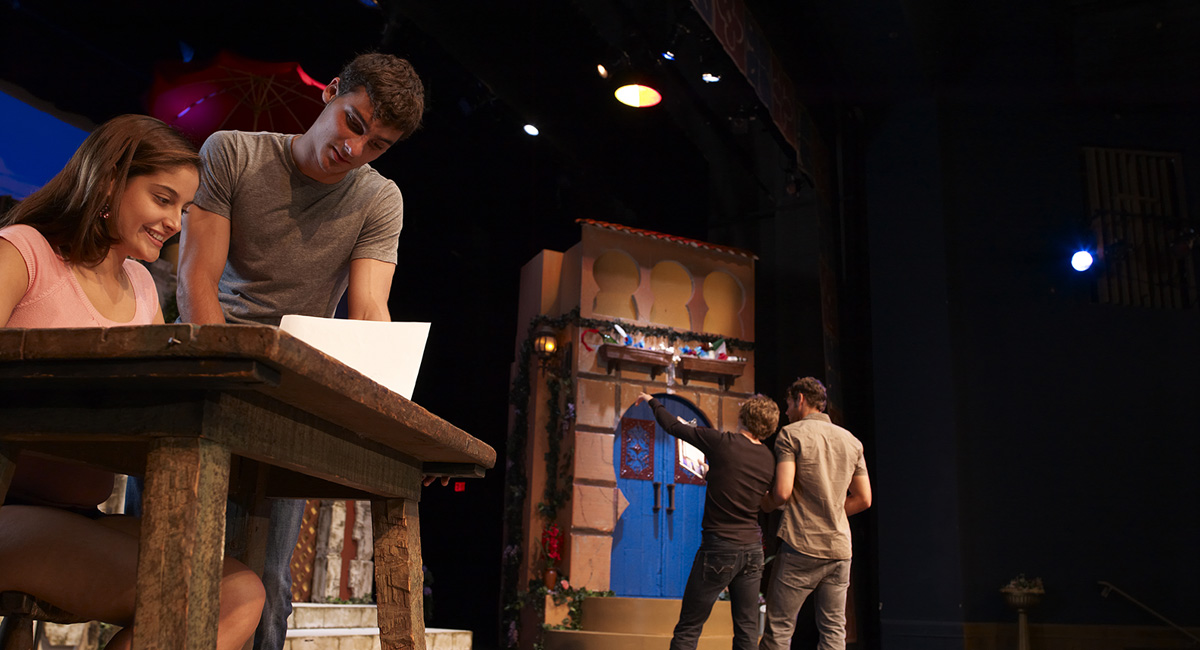
Last weekend my wife, Stephanie, and I found ourselves sitting in the Manhattan Theater Club on West 55th Street in New York City.

Why?

Well, to watch John Patrick Shanley’s (of Tony, Academy Award, and Pulitzer Prize fame) latest Off-Broadway hit about my wife’s parents! Why else!?!

To tell you the truth, I still haven’t quite assimilated the reality of the experience. You see, it is not often that I go to New York City. (I have been there once before). It is not often that I see a Broadway show…or an Off-Broadway show…or even an Off-Off-Broadway show.

Call me a Philistine, but I will just go ahead and admit that I have never seen a show in New York. Not until last weekend that is!

You see, the fact of the matter is that aside from acting in a couple of high-school plays and starring in Arthur Sullivan’s one act play “Cox and Box” (I was Mr. Box)…aside from these minor dalliances with theater, I have never really been a big fan of Drama.

But when it became clear to me that my wife’s parents (both of whom passed away in the last several years) were going to be depicted on stage, that John and Louise Schmitt (Grandmum and Granddad!),  were going to be acted out on the world’s stage… how could I refuse to drive my wife the 495 miles to New York City to watch it?

For many of you, I know, a trip to New York City is par for the course, but, for a pair of country-mice, such a trip requires a fair amount of courage and chutzpah.

It also requires a few dollars!

So there we were, getting settled in the packed theatre, trying to compose ourselves after what might be described as an exciting or even exhilarating (perhaps crushing) sensory overload- the  sensory overload that is the experience of walking through Times Square on a Friday evening.

We made a futile attempt to settle ourselves into the proper frame of mind conducive for watching a play.

But how does one do this when the play is about your family? When the characters are none other than your own parents? Parents whom one has recently mourned, but here they are again resurrected and in the spot light?

Impossible! As a mere son-in-law my mind was swirling and my heart pounding. As for my wife and her brothers I am certain that the experience punctuated by the haunting original music of Paul Simon was surreal.

The play itself, Prodigal Sonwas masterfully written, beautifully acted, and gut-wrenchingly cathartic.

Author John Patrick Shanley happened to have attended Thomas More School in New Hampshire; a boy’s Catholic boarding school that John and Louise Schmitt founded in the 60’s and ultimately closed after ten years. Confessedly modeled after Shanley’s own experience, the plot portrayed the role that the school played in the redemption of 17 year old “Jim Quinn” (played by Timothee Chalomet).  Quinn, a way-ward son from the Bronx, having been thrown out of other schools and at the mercy of his passions and self-destructive habits, is given a chance at Thomas More.

As the play unfolds we discover that the headmaster and his wife, Mr. and Mrs. Schmitt (played by Chris McGarry and Annika Boras), share a well concealed sorrow, a sorrow caused by the tragic death of their own son. This sorrow becomes the source of Quinn’s redemption. Their hearts softened by grief, and harrowed by suffering, impel them to see the good in Quinn, despite his many expellable indiscretions, and they are able to see him through to the end – drawing out his hidden talents and mercifully allowing him to graduate – thus providing him with a sense of self worth and new opportunity. Indeed  Quinn is born anew.

Prodigal Son is about the mysterious role that suffering plays in life – even the seemingly senseless suffering and heartbreaking pain that comes with the death of one’s own child, one’s own son.

The play revealed a hidden chapter in the lives of John and Louise Schmitt. The events occurred when my wife was only a year old. Perhaps strangely, yet somewhat typical of many in that generation, Stephanie’s parents did not air their personal lives. They never spoke about these events to me and rarely if ever to their own children. In point of fact, John and Louise Schmitt suffered through not just one, but the tragic deaths of two of their children. Nonetheless, they did not give the impression that God had singled them out for any special suffering. As far as I ever knew (from the time I was eleven when I first met them), John and Louise Schmitt considered themselves blessed and displayed a quiet joy withal.

As we wept (discretely) in our seats, I know that Stephanie and her brothers were grateful for the gift that Shanley had given them through this play. I know that my wife and her siblings were grateful to have an answer about the mysterious workings of God’s grace in the deaths of their siblings, and in particular for the death of their little brother. Deaths whose explanations until now had been consigned to the inexplicable mysteries of God’s Divine plan.

But sometimes God reveals a glimpse of His plan…even after fifty years. 


Posted in beauty, Fine Arts, Uncategorized | Tagged , , , , | 4 Comments

The Purpose of Classical Education – An Unintended Dialogue

Every so often we need to remind ourselves of the point of a classical education. As readers of these pages know, the phrase classical education is just a clever way to cloak our real meaning which is Liberal Education. But present fashions dictate that we avoid this hateful phrase and speak about it under the veil of a more acceptable one,  namely classical education. And so we ask: What is the point of a classical education?

Lion: Pardon me, I hate to interrupt, but why don’t you just go ahead and say Liberal Education if that is what you mean?

Ox: That’s a silly question Lion. Everyone knows why Langley avoids uttering the words Liberal Education. He just told us that the present fashion frowns upon these words. What more do you need to know?

Lion:  This is most disingenuous. Appalling! I am disappointed! Why doesn’t he say what he means? I think he insults his readers by this kind of intellectual subterfuge.

Ox: Lion, it doesn’t surprise me that your mind lacks the subtlety to see his clever teaching method. Langley doesn’t use words that he knows will upset people and strike dead the attention of his readers at the very outset.  He always proceeds wisely and slow.

Lion: he would be far more clever if he could only say what he means with succinct brevity!

Ox: sometimes teaching requires a little finesse, Lion. Sometimes a teacher has to employ Rhetoric – which is chiefly an art concerned with persuasion; an art that enables one to attract others towards accepting a position through sweetened language. Something which you may not be able to appreciate. Think about that for a moment Lion…persuading others…. Teaching is not just a matter of throwing around muscle and bombast like some people do.

Lion: I know that, Ox.

Ox: Rhetoric enables the speaker to communicate with words most suitable to persuading this or that audience. Sometimes, we, like Langley, need to speak about things indirectly.

Lion: Does the rhetorician ever get to his point?

Ox: Lion, teaching is not simply a matter of posturing and bellowing as is perhaps your own custom.

Related image

Lion: Bellowing? Why, Ox, this is the pot calling the kettle black!

Well as I was saying, the point of a classical …

Lion: If you want to speak about the point of liberal education, then just go ahead and say liberal education.

Ox: Lion you are so naive! You have no sense. No sophistication. Think for a moment. What do people think when they hear the phrase Liberal Education?

Lion: Well I don’t know and frankly, what do I care?

Ox: That is just the problem with you. I will tell you what they think since you are evidently so dull, so out of touch with the “sensus populi,” so unfamiliar with common parlance.

Lion: Please do–and I would prefer an explanation from you without your usual condescension and ad hominem attacks. Personally, I find your manner offensive and your arrogance intolerable.

Er…excuse me gentle-beasts, no need for any unpleasant altercations between you. I could simply use the phrase Liberal Educ…

Ox: No, no, Let me clear up this matter with Lion quickly and then you may proceed as you had first planned.

Well as you like Ox, I don’t mean to stand in the way–just wanted to proceed with my point before we lose sight of it altogether.

Ox: Lion is simply too used to the discussion method to sit still and listen. He feels that he must always say something.

Now listen to me Lion, in the first place the phrase liberal education is widely misunderstood and associated with things that it is not.

For example people often confuse liberal education with the liberal arts.

And to make matters worse, people often confuse a liberal education with an education in the so-called humanities. And what are the humanities? Pray tell me.

The humanities appear to cover just about anything that is produced by humans. Literature, the arts, history, you name it. There are many who assert that the highest sciences and even Theology are included in the humanities as if they were no more than human products.

There are many who simply think that liberal education is a phrase that signifies any sort of non career oriented, non practical general study; liberal education amounts to no more than general studies.

In other words, liberal education is the education for people that have no specific interests. An education for people who have no direction in their lives except to be professional students perhaps.

Under these mistaken views liberal education is a sort of education for losers.

It is an education with no practical value which is another way of saying the same thing.

As if that wasn’t enough Ox, the phrase liberal education is fraught with other pejorative connotations like ‘an education for snobs’, ‘an education for armchair philosophers’, ‘an education for jacks of all trades but masters of none’.

As if America needs more of those to be competitive in the global economy. No wonder a leading presidential candidate has spoken against liberal education.

And I won’t even mention the fact that the leading colleges and universities that espouse liberal education have also seemingly been co-opted by those who espouse so-called liberal politics or liberal ideologies. Hence liberal education is the education for liberals.

And so I think Langley is very clever to avoid all reference to liberal education whenever he can, even though it appears to be the second love of his life.

These days we must be clever as fox….er..I mean clever as Oxes!

Lion: Ox, you have spoken for a long time and I lost you somewhere in the beginning.  I still think Langley should say what he means in the clearest terms possible without compromising to those who are mistaken. If he means liberal education then let him say liberal education!

Ox: Lion, it is precisely thinking like you do that has kept your species in the inferior intellectual position that you occupy. No wonder Konrad Lorenz thinks that your entire race is so lazy!

My friends, I am sorry to have introduced the subject today. Let’s discuss the purpose of a libe…I mean a classi…or rather a lib… or perhaps a…Classeral…..

Lion: liberal education

Ox: Classical education

Lion: liberal education

Oh what’s the point? Let’s change the subject.

Posted in classical education, discussion, Liberal Arts, Newman, Shakespeare, truth for its own sake | Tagged , , | 1 Comment

Reading Dickens-Dombey and Son

I finally finished my summer reading, Dombey and Son, clocking in at 1040 pages! That is, if you read the Penguin Classics edition.

The Wordsworth Edition that I read was only 808 pages, but if felt like 1040 pages.

Don’t get me wrong. I enjoyed every minute of it, but it didn’t go quickly.

As I mentioned elsewhere I like to read a Dickens novel each summer. For teachers and students, summer is just the time for a big,thick Dickens novel. I guess the rest of you will just have to squeeze it in whenever you can.

Now, I will not say that Dombey and Son is my favorite Dickens novel. (As it was for one reviewer-click on the link for a very good synopsis.)

I enjoyed David Copperfield, Bleak House, Little Dorrit, A Tale of Two Cities, Great Expectations, Oliver Twist, Nicholas Nickleby, and Hard Times more.

But I did enjoy Dombey and Son and am glad to have added it to my Dickens repertoire. Next summer I will either read Martin Chuzzlewit or The Pickwick Papers or perhaps re-read Nicholas Nickleby. For those of us with poorer memories, having already read a good book is no obstacle to re-reading it. Of course this is even more true with an excellent book.

For those of you who enjoy a heartbreaking story, Dombey and Son will not disappoint. I won’t give away the plot- but Dickens again proved himself the master of character portrayal. Of particular significance is the novel’s heroine, the long-suffering and saintly Florence Dombey. Florence, or “Miss Floy” is the personification of blessed meekness and piety.

‘Miss Floy,’ said Susan Nipper, ‘is the most devoted and most patient and most dutiful and beautiful of daughters, there ain’t no gentleman, no Sir, though as great and rich as all the greatest and richest of England put together, but might be proud of her and would and ought. If he knew her value right, he’d rather lose his greatness and his fortune piece by piece and beg his way in rags from door to door, I say to some and all, he would!’ cried Susan Nipper, bursting into tears, ‘than bring the sorrow on her tender heart that I have seen it suffer in this house!’

But all of his characters are unforgettable. Time and again, Dickens manages to present a perfectly vivid cross-section of humanity; he describes in colorful and memorable detail the rich and the poor , the beautiful and the ugly, saints and devils, and everything in between.

How does he do it? How is it possible to present the entire world of men with such precision? He must have experienced all of it to some degree to know it so well.

Oddly, Dickens appears to be no friend of classical education. He describes the forlorn students at Dr. Blimber’s school studying the dead languages with no veiled contempt.

In the confidence of their own room upstairs, Briggs said his head ached ready to split, and that he should wish himself dead if it wasn’t for his mother, and a blackbird he had at home. Tozer didn’t say much, but he sighed a good deal, and told Paul to look out, for his turn would come to-morrow…Paul, who lay awake for a long while, and often woke afterwards, found that Briggs was ridden by his lesson as a nightmare: and that Tozer, whose mind was affected in his sleep by similar causes, in a minor degree talked unknown tongues, or scraps of Greek and Latin.

Dr. Blimber lived in order to squeeze knowledge of things classical into the minds of students.

Whenever a young gentleman was taken in hand by Doctor Blimber, he might consider himself sure of a pretty tight squeeze. The Doctor only undertook the charge of ten young gentlemen, but he had, always ready, a supply of learning for a hundred, on the lowest estimate; and it was at once the business and delight of his life to gorge the unhappy ten with it.

In fact, Doctor Blimber’s establishment was a great hot-house, in which there was a forcing apparatus incessantly at work. All the boys blew before their time. Mental green-peas were produced at Christmas, and intellectual asparagus all the year round. Mathematical gooseberries (very sour ones too) were common at untimely seasons, and from mere sprouts of bushes, under Doctor Blimber’s cultivation. Every description of Greek and Latin vegetable was got off the driest twigs of boys, under the frostiest circumstances. Nature was of no consequence at all. No matter what a young gentleman was intended to bear, Doctor Blimber made him bear to pattern, somehow or other.

Poor little Paul, the son of Dombey, dies in fact, and another older student, Toots, has apparently lost his mind through the rigors of premature mental exertion. I hope this doesn’t happen to any of our students, although some of them do give the impression that their studies are a sort of cruel and unusual punishment.

I don’t know anything about Dickens’ own schooling, but I am not certain that he wrote a complete novel without making one or two disparaging comments about the study of Latin and Greek. I forgive him. The schools of his time must have been absolutely horrific.

Perhaps they are worse now?

It’s probably a good thing for teachers at schools that focus on classical learning to keep Dr. Blimber’s school in mind. I know I will the next time I find myself try to cram the heads of my students with material, squeezing into their brains as many pages of Herodotus and Thucydides, and the Aeneid, and chapter after chapter of Algebra, and Greek and Latin vocabulary.

Poor students. One sometimes wonders whether they should be in school at all. If only they could just get enough sleep and perhaps work on a farm for several years eating fresh meat and vegetables and lots of raw milk.

But let us return to the point. For everyone who loves the idea that people can be pure and noble and loyal and lovely and guileless and beloved and wholesome and winning and … then Dickens is the man to read.

Although he took a generally dim view towards churchmen and organized religion, his heroes are always Christlike in their love for others.

And what about his death scenes?

I find myself weeping at every one. Dickens has thought deeply about death and especially those last moments that each of us must face.  Apparently when Dickens wrote the installment that included little Paul Dombey’s death all England was prostrate with grief. I am still grieving.

For an instant, Paul looked at her with the wistful face with which he had so often gazed upon her in his corner by the fire. ‘Yes,’ he said placidly, ‘good-bye! Walter dear, good-bye!’—turning his head to where he stood, and putting out his hand again. ‘Where is Papa?’

He felt his father’s breath upon his cheek, before the words had parted from his lips.

‘Remember Walter, dear Papa,’ he whispered, looking in his face. ‘Remember Walter. I was fond of Walter!’ The feeble hand waved in the air, as if it cried ‘good-bye!’ to Walter once again.

‘Now lay me down,’ he said, ‘and, Floy, come close to me, and let me see you!’

Sister and brother wound their arms around each other, and the golden light came streaming in, and fell upon them, locked together.

‘How fast the river runs, between its green banks and the rushes, Floy! But it’s very near the sea. I hear the waves! They always said so!’

Presently he told her the motion of the boat upon the stream was lulling him to rest. How green the banks were now, how bright the flowers growing on them, and how tall the rushes! Now the boat was out at sea, but gliding smoothly on. And now there was a shore before him. Who stood on the bank?—

He put his hands together, as he had been used to do at his prayers. He did not remove his arms to do it; but they saw him fold them so, behind her neck.

‘Mama is like you, Floy. I know her by the face! But tell them that the print upon the stairs at school is not divine enough. The light about the head is shining on me as I go!’

The golden ripple on the wall came back again, and nothing else stirred in the room. The old, old fashion! The fashion that came in with our first garments, and will last unchanged until our race has run its course, and the wide firmament is rolled up like a scroll. The old, old fashion—Death!

Oh thank GOD, all who see it, for that older fashion yet, of Immortality! And look upon us, angels of young children, with regards not quite estranged, when the swift river bears us to the ocean!

‘When my own time comes I hope it is just like that!

I certainly will not want to die in the horrific manner that he describes the arch villain of the story, whose death is mixed up with a train!

Little Paul Dombey’s death is particularly moving because of Dickens’ understanding and appreciation for children. He reveals wisdom through their mouths whereas many of his grown-ups are silly and foolish… nay, even childish imbeciles. Dickens loved children and that makes me like him even more.

There’s no question that Dickens was a great author. He achieved timeless beauty in his writings. The words of the great Democritus, that fifth century B.C. father of the atomic theory, come to mind,

What a poet writes when possessed and inspired by the gods is most beautiful. (Democritus, DK 18)

It is fair to say that Dickens wrote under the inspiration of the gods. Where else did he obtain his genius?

As much as it makes me blush to make the comparison, Dickens certainly achieved some approximation of what Homer himself achieved

Homer, obtaining by fate a divine nature, built a cosmos of all kinds of verse. (Democritus, DK 21)

Dickens also built a cosmos in his writings. He delivers an entire world into the minds of his readers. He makes me want to live in it. And while educating me about the evil to be avoided, and its consequences, he makes me aware of the beauty of human virtue and inspires me to emulate any one of his noble heroes.

Posted in classical education, Dickens, Homer Sightings, Literature | Tagged , , , | 1 Comment

Concrete Thoughts

Liberal education works!

I have been thinking about this for several weeks as I renovate the second floor kid’s bathroom, and the thought provides me with no end of pleasure (and humor) when I think about the two senses in which it is true.

The first sense is that liberal education succeeds in its aim. That is, liberal education is the only kind of education that produces an educated person, a free person, a person who perhaps one day might be wise. As Blessed John Henry Cardinal Newman says,

This process of training, by which the intellect, instead of being formed or sacrificed to some particular or accidental purpose, some specific trade or profession, or study or science, is disciplined for its own sake, for the perception of its own proper object, and for its own highest culture, is called Liberal Education…

By inference we may justly conclude that all other types of education amount to only a training in this or that specialty. They amount to an education where the human mind is “sacrificed to some particular or accidental purpose, some specific trade or profession.” ugh! Education based upon electives and specialties produce  trained specialists, not educated people.

But the second sense of the phrase “liberal education works” is the one that can be spotted at the fast food joint. As the joke goes, of two people in a fast food restaurant how can you spot the one who has the liberal education?

Easy. He’s the one who says “Would you like fries with that?”

And so rather than sitting down to eat his lunch with the professional it is the liberally educated one that is serving the lunch. But this joke is beneath us. We will not even make a response.

Nonetheless, perhaps there are some of you that are prone towards the thought that liberal education tends to produce a person who is good for nothing except an arm-chair existence and heady abstractions. Perhaps some of you think in your heart of hearts that the liberal artist disdains getting his hands dirty with real work.

I say au contraire!

It is not at all unusual for the liberally educated man to work with his hands. As a matter of fact the liberally educated man will often be the very one for whom working with his hands becomes a necessity.

“Why?” you ask.

Well there are two reason for this.

The first is that the liberally educated man naturally seeks the things that are above. The liberally educated man studies natural philosophy in order to know something about the soul, and he studies the soul in order to know something about angels and he studies angels in order to know God!

In other words the liberally educated man’s thoughts tend upwards.

Now anyone who has worked with a ladder knows that he had better place that ladder on a very firm and stable surface. He had better be very sure that his ladder is planted firmly in an immovable spot. That’s important when he is standing aloft in the breezy heights, equipped with a hammer in one hand, a mouth full of nails, and a piece of gutter in the other, so that he doesn’t take fright when a hornet or a bat suddenly pops out from behind a shutter.

It is no different for the man whose thoughts climb towards the heavens. That man needs to have his feet and hands planted firmly in the solid and tactile world around us. The liberally educated man has a special need for what is purely practical; he has a need for tangible and sensible things. He has a need for hard things like Durock!

0725151340

and “Wonderboard!”

0725151333b

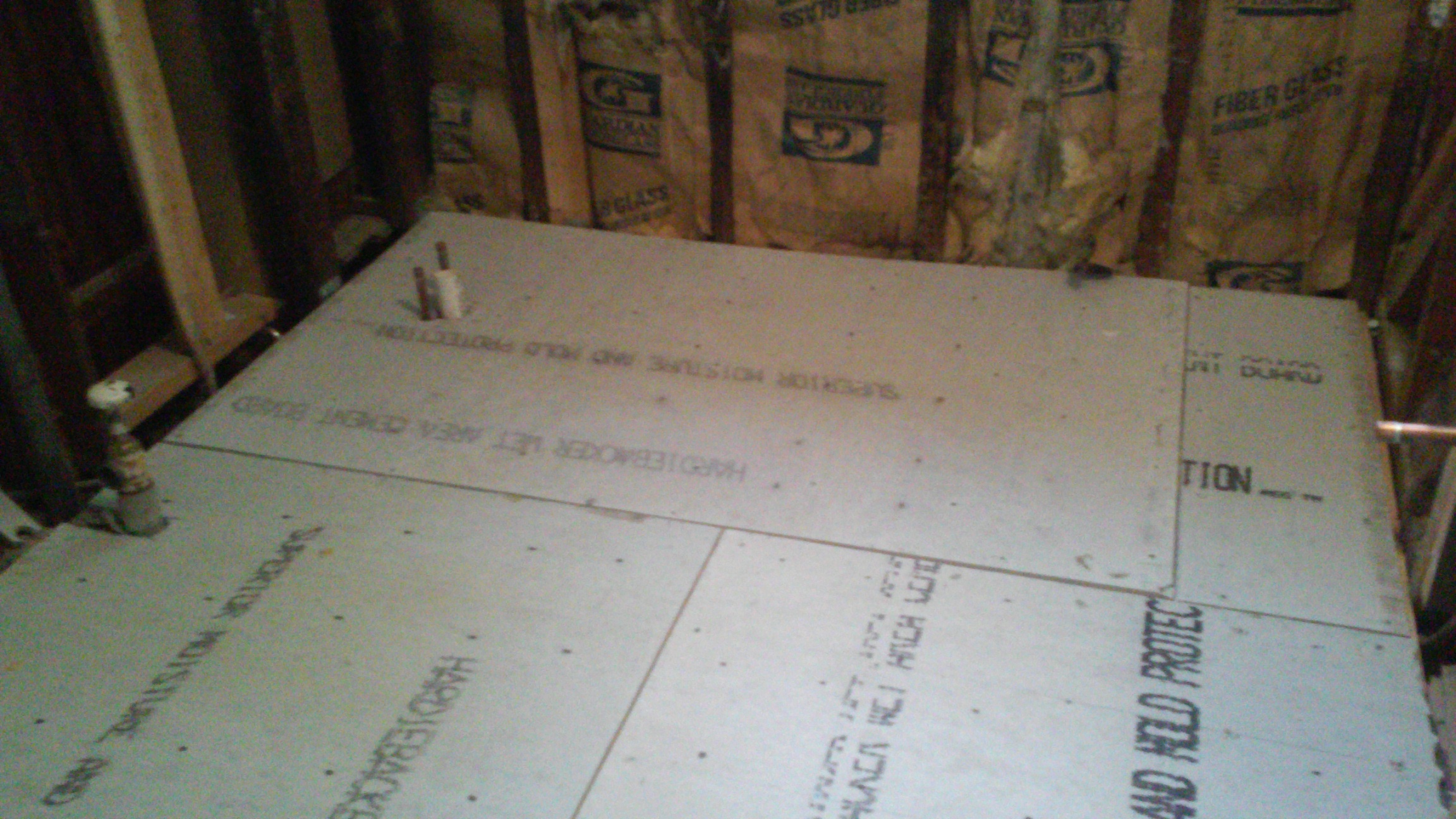
and best of all….old Hardiebacker!

In hindsight I think I should have used Hardiebacker for everything. But wow... It is tough to cut!

In hindsight I think I should have used Hardiebacker for everything. But wow… It is tough to cut!

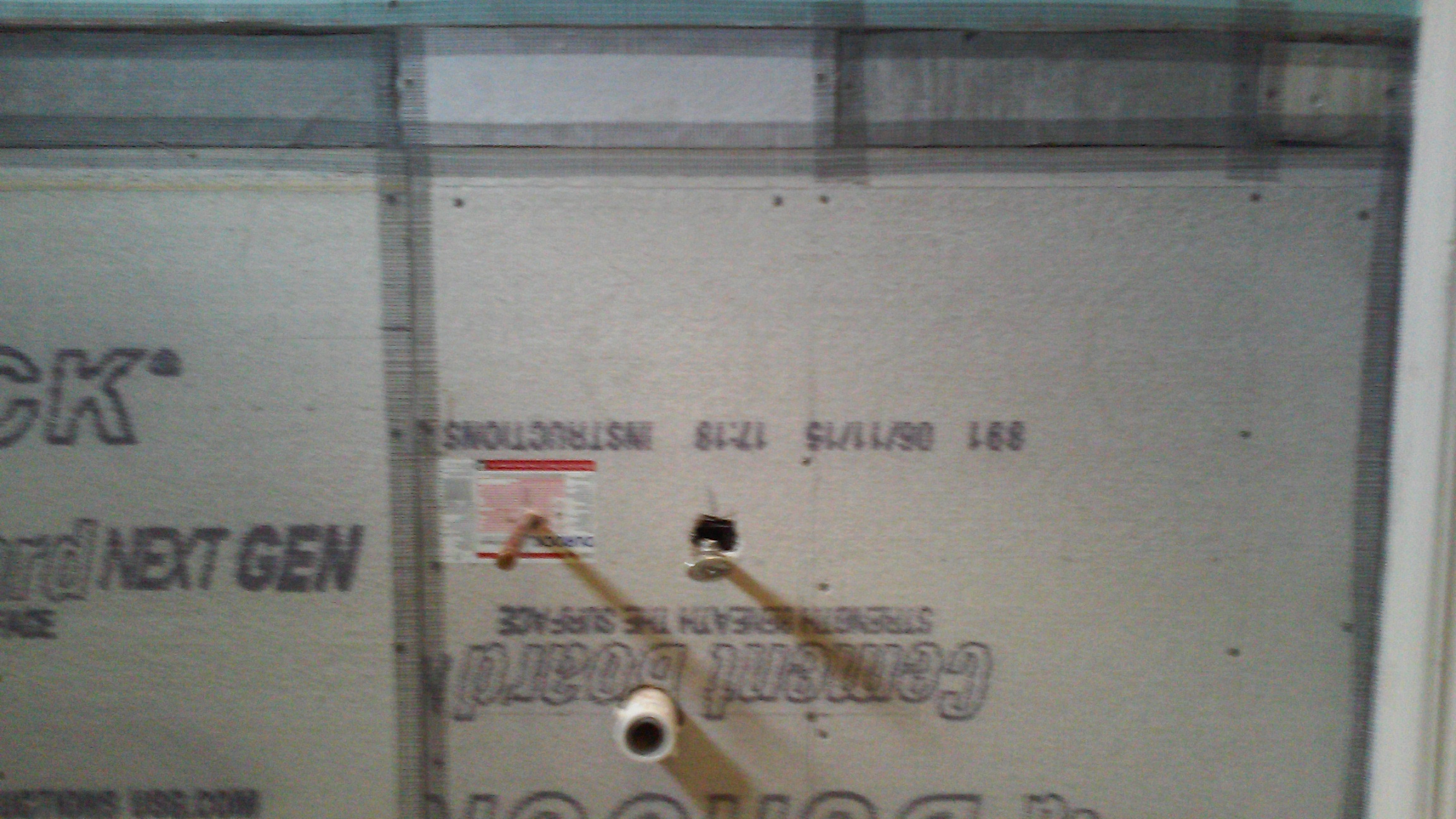
Not the cleanest cut outs for the plumbing.

Not the cleanest cut outs for the plumbing.

And he needs to experience the wonders of thin-set!

0717151543

When the liberally educated soul works with these kinds of things his soul is improved. When he makes the attempt to do the near impossible, when he tries to cut through Hardiebacker with nothing but a dull utility knife, when he attempts to make a level surface or a square corner out of reclaimed fragments of 2X4 pine and cement board and screws, all of these works provide his mind with solid ground to ascend the Heights! All of his work with plywood and cement will provide  a solid base upon which he might later launch his thoughts towards the heavens!

That is the first reason why the liberally educated man needs to be rooted in the practical. It grounds his thoughts in reality.

The second reason is a little more simple.

Since his thoughts tend in an upwards direction, since he places more significance in things of form than he does in things of matter, since he prizes the things of the mind more than things of the body, he will tend, therefore, to have very little…

money.

Not that this is a necessary result. Mortimer Adler, as did his predecessor Thales of old,

demonstrated very well how the liberally educated man is able to produce wealth if he so desires.

Just how many collections of these books have been produced?

I have never done a longitudinal study on this precise question. I would wager that the liberally educated person on the whole does in fact make more money than the non-liberally educated person. But this will only be because he has specifically chosen to lay aside his philosophy for a time, as did Thales, and devote himself whole-heartedly towards making money.

Nonetheless, the liberally educated man loves self-sufficiency! He loves autonomy!! He loves to join form back with matter in a manner which he secretly thinks is imitative of the Divine Being. And thus it is that I say, again, liberal education works.

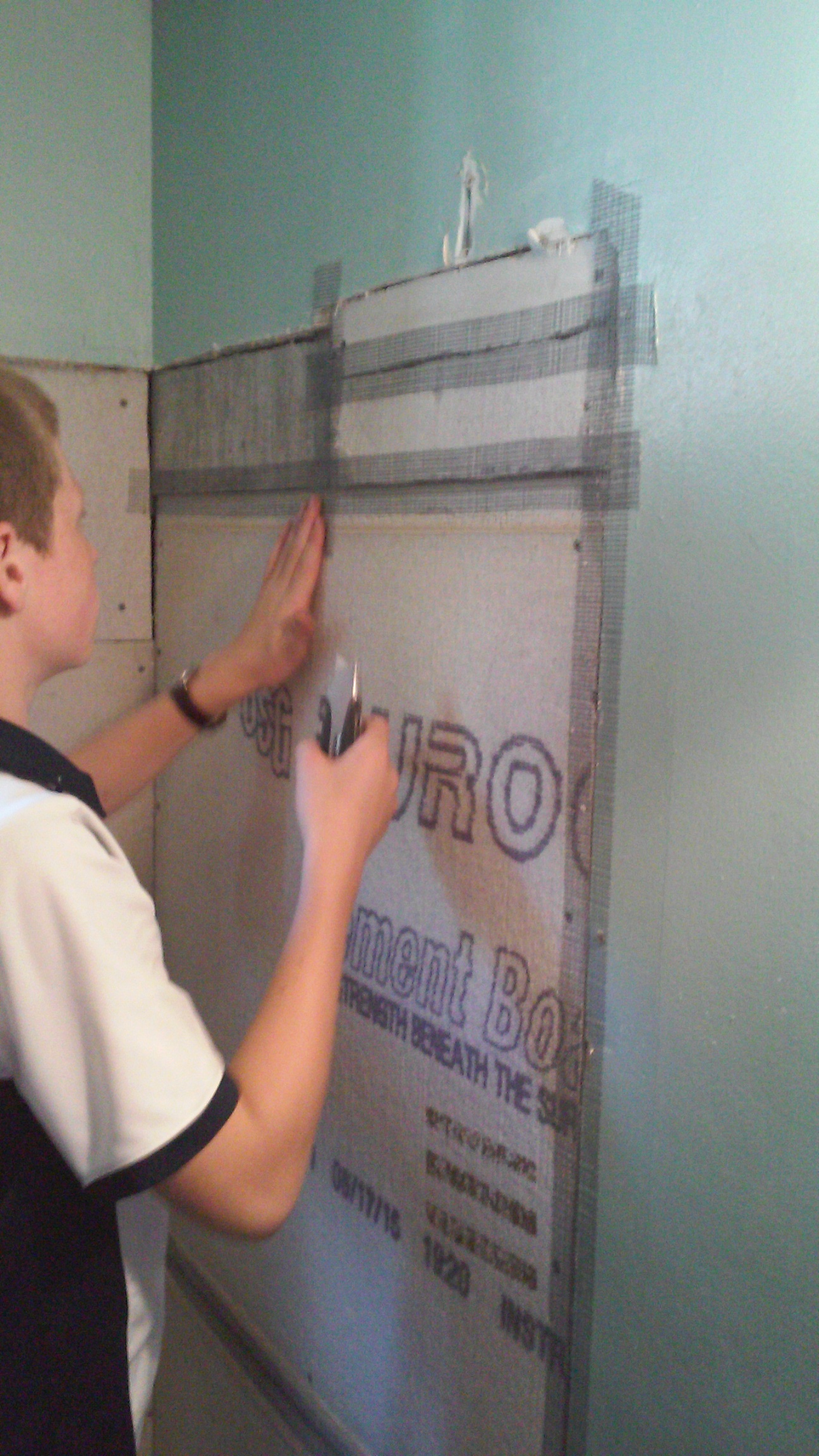
The liberally educated man in his youth...  taping the joints

The liberally educated man in his youth…
taping the joints

Posted in bathroom restoration, classical education, education, liberal education works, Work | Tagged , , , , , | 1 Comment

Liberal Education Works Vol: 17

Ahhhhhhhhh…..Summer 2015!

And what is it that the liberally educated man does during those lazy hazy days of summer?

Does he spend his summer like a Greek or a Roman?

Does he sip iced tea, reading Aristotle’s Ethics reclining in a deck chair on the veranda?

Does he doze in his gently swinging hammock, pondering about the soul, peacefully dreaming between two glistening birch trees?

Or does he reach for his 50 lb Hitachi demolition Hammer and his old Milwaukee Sawzall with which tools he will bring that second story bathroom back to its primordial beginnings: earth … rock… dust… powder?

Now as sometimes happens, what began as a simple plan to replace the shower bathtub diverter valve,

suddenly became a full scale effort to re-tile the “bath-tub-shower-surround.”

I thought I was just going to do a simple tile project around the shower.

I thought I was just going to do a simple tile project around the shower.

But then what happened? Well I guess I just got carried away by zeal. I mean when one has a demolition hammer and a Sawzall in hand, there is only one inevitable result.

Complete demolition! Complete tear out! A complete return to prime matter!

My six-year-old Peter and I must have carried out over a thousand pounds of debris.

Two layers of ceramic tile over a 3-4 inch mud-concrete base! After removing all that weight from the house one would think that the mysterious laws of physics would respond in kind.

Isn’t there supposed to be an equal and opposite force counteracting all that stuff?

When will that hidden force know that I removed its diametrically opposed opposite?

Is it going to wake up in the middle of the night and take the starboard side of my house through the ceiling?

Two layers of tile over a three inch bed of concrete. Couldn't of done it without the aid of my friends demolition hammer.

Two layers of tile over a three-inch bed of concrete. I love that classic hexagonal tile. One wonders why it was ever covered up.

Well, after purchasing a cheap new wet-dry vac, and some strategically placed new “sister joists”, the space looked like this:

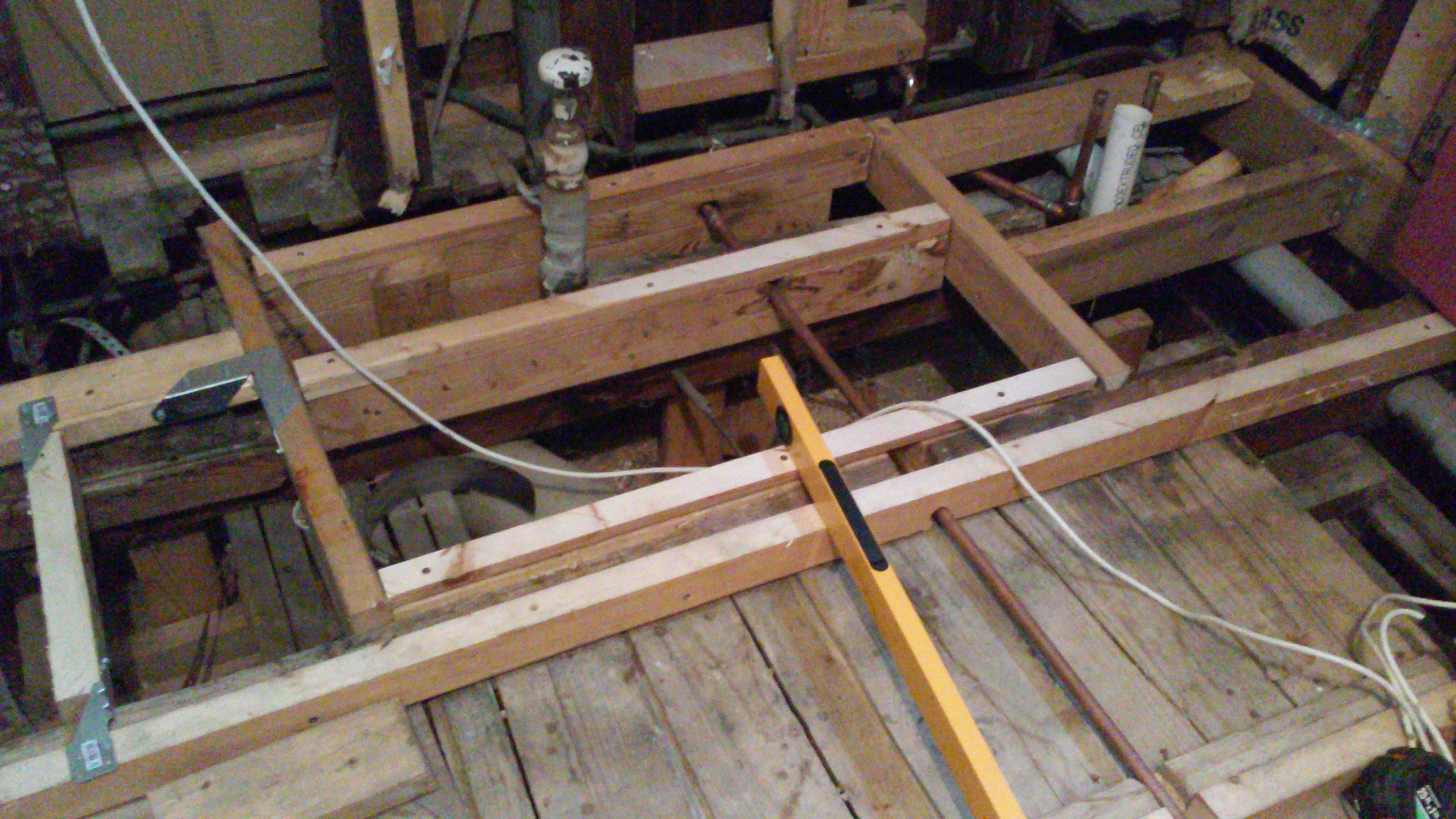
New structural support to help those old floor joists.

New structural support to help those old floor joists. Note

I should have inserted even more horizontal blocks

I should have inserted even more horizontal blocks.

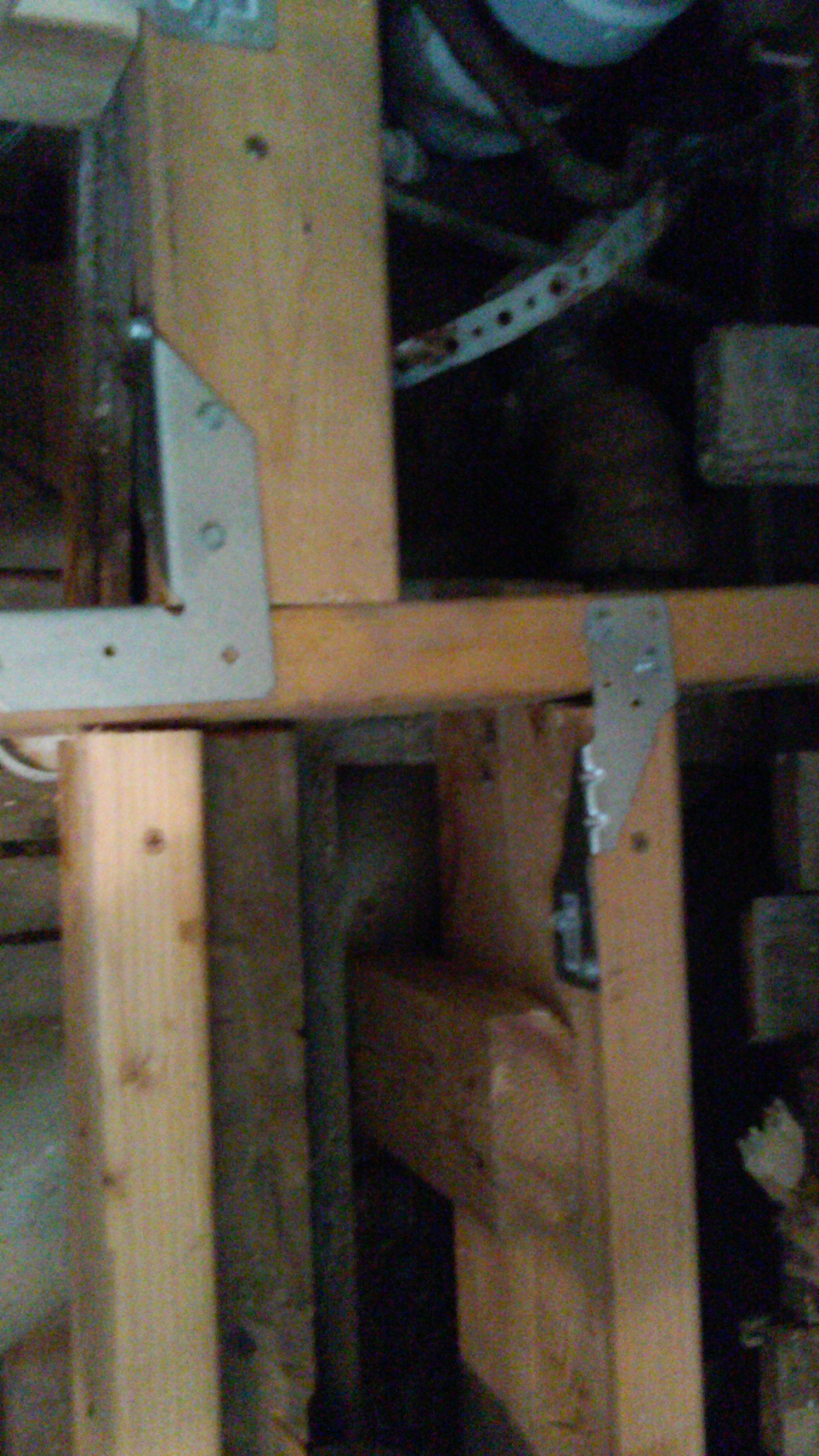
Unfortunately, these old spaces were not designed to assist the enterprising renovator. And so I had to do my best to “sister” new floor joists onto the old ones not only to make the floor level, but also to provide new flat surfaces upon which to attach the new plywood.

I love the metal joist hanging technology. There is a tie for every situation.

The hurricane tie. Love em!

The hurricane tie. Love it!

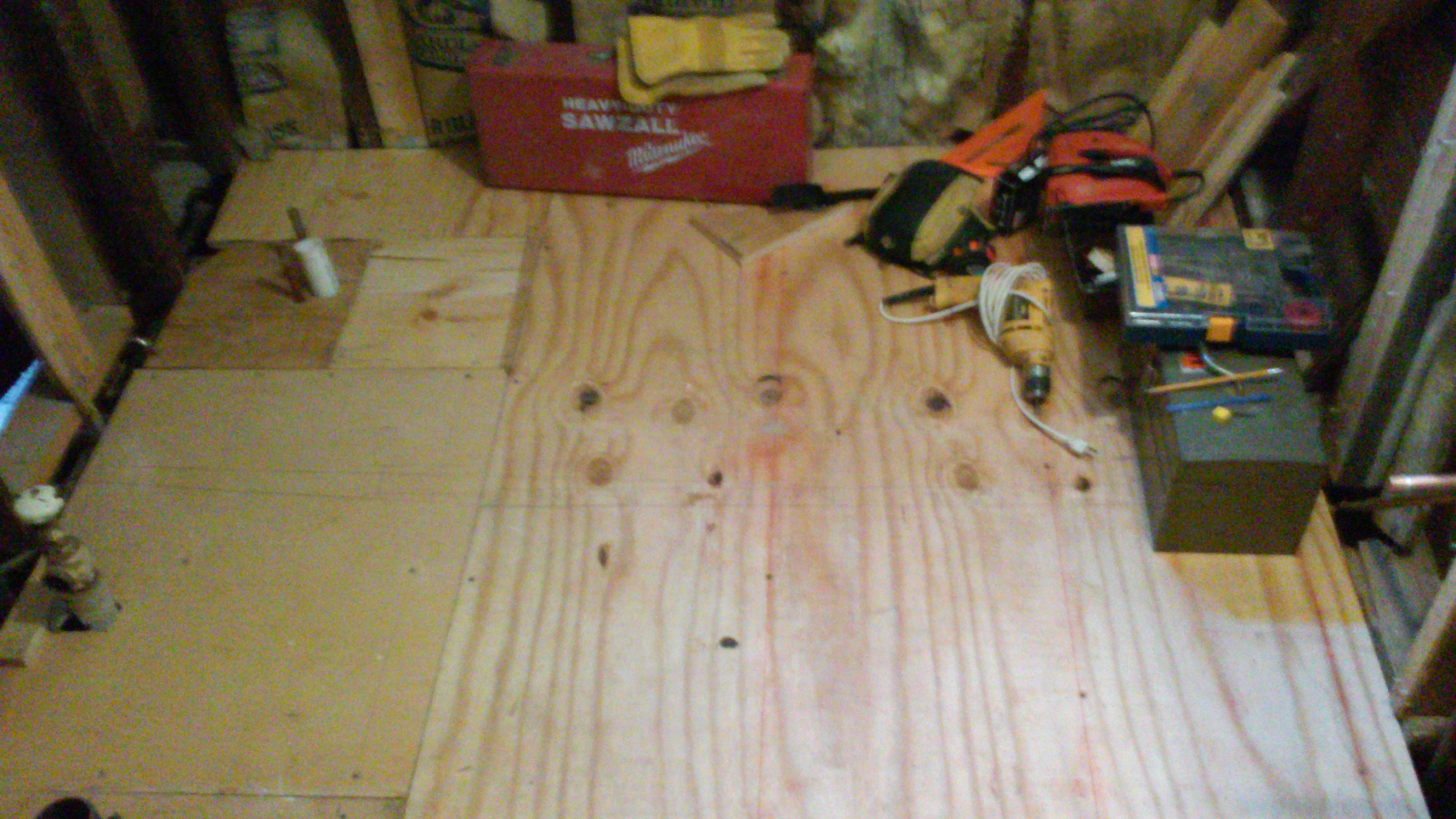
After convincing myself that the new floor joists were as strong and immovable as possible, I set down the 3/4″ plywood.

Achieving a level surface....cant be done!

Achieving a level surface….cant be done!

I just knew it was worth hanging on to all those old scraps of 3/4 plywood for the last ten years.

I just knew it was worth hanging on to all those old scraps of plywood for the last ten years. Let that be a lesson to all of you neat freaks with clean tidy garages. I saved at least twenty bucks!

Sometimes the liberally educated carpenter is treated to a geometric delight. After salvaging an old scrap of an oddly shaped polygonal plywood, to my amazement I discovered an equilateral triangle. Naturally a thrilling moment for an erstwhile teacher of Euclid!

To my delight I discovered an equal lateral triangle existing outside of my imagination.

An equilateral triangle existing outside of the imagination!

The legendary Milwaukee Sawzall. The solution to most problems.

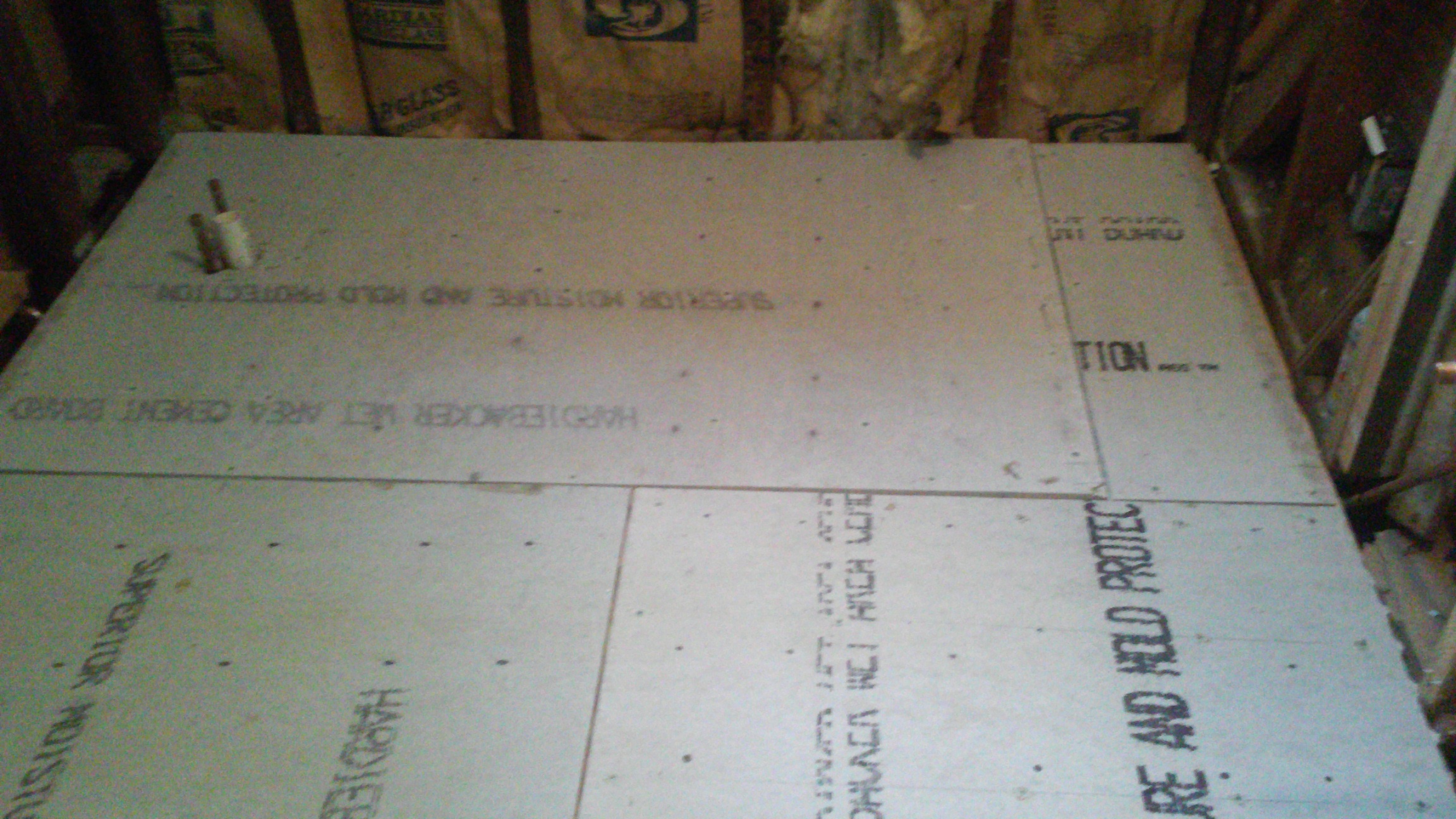
Now that we have a firm foundation, things start getting exciting. Time to set down the cement board! First we cut it to size and dry fit it, then we mix up some mortar and screw it down.

Durock!

Hardiebacker!

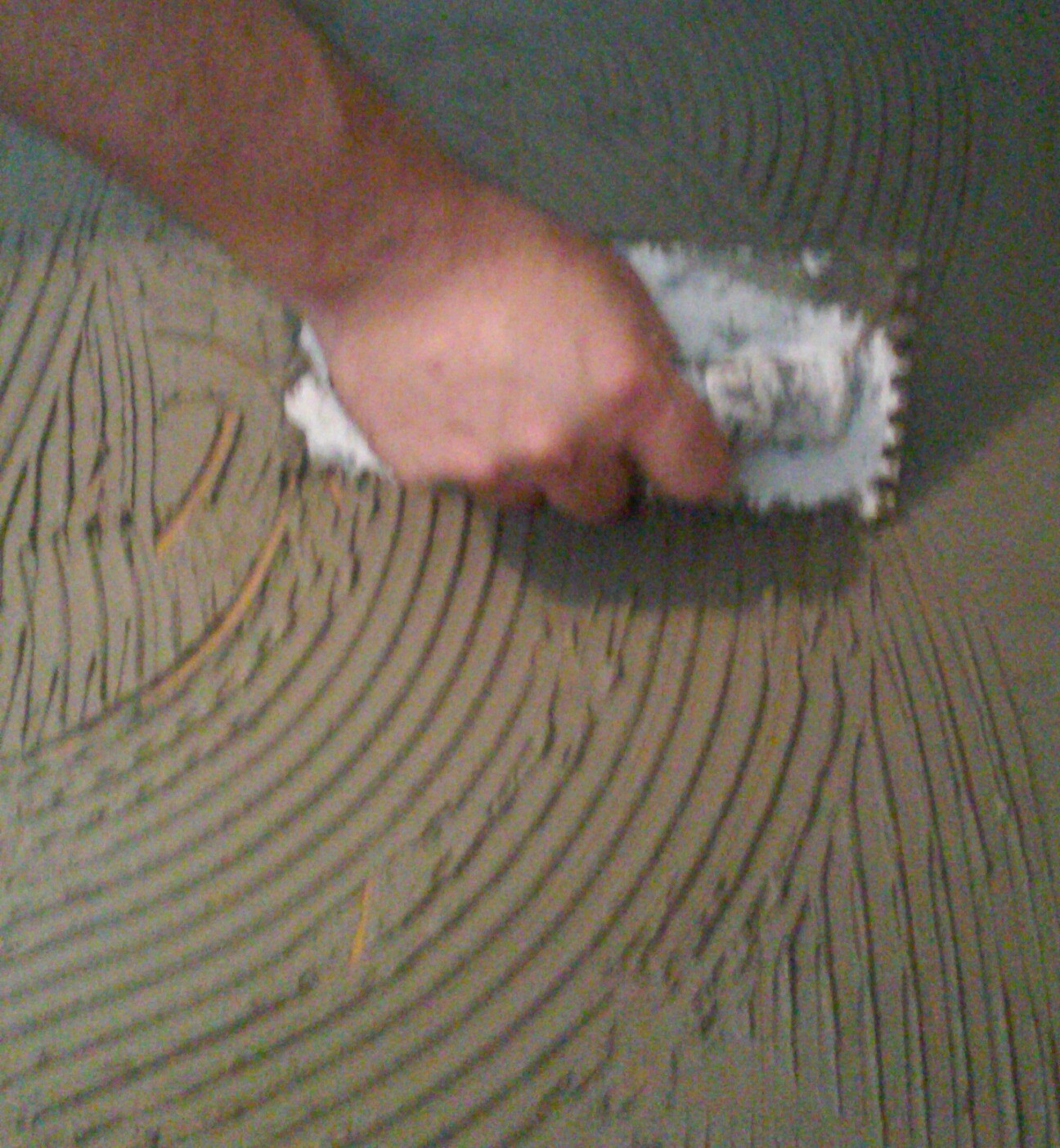
never quite certain about the precise ratio of water to thinset....but I figure if it looks like peanut butter than we're OK.

Never quite certain about the precise ratio of water to thin-set….but I figure if it looks like peanut butter then we’re OK.

One piece at a time.

0717151553c0717151555~2

Finally the floor is set and we are ready for the walls…hmmmm…maybe I should have reversed the order.

0717151540b

I guess the whole project smacks of a Roman enterprise, particularly when one is working on plumbing projects.

After all – as they say,

The Greeks gave us brains. The Romans gave us drains!  

Posted in bathroom restoration, liberal education works | Tagged , , , | 1 Comment

My Apology to The Supreme Court of The United States of America

I, Mark Langley, apologize to the Supreme Court of The United States of America.

I, Mark Langley, apologize to the Supreme Court of The United States of America.

I meant to have written this little post several weeks ago before the Supreme Court announced its decision in Obergefell v. Hodges. Obviously, the nation had a right to know what the ancient pagan Greeks would say about Marriage, and I am feeling like I let everyone down by not publishing their views earlier – their collective views, that is, as articulated, distilled, and clarified by their chief exponent and spokesman, Aristotle.

But first let me state unequivocally that I am deeply aware of the fact that a profound apology is owed by me to the majority of the Supreme Court. What embarrassment I could have saved them if I had only posted the definition of marriage three weeks ago!

I mean….any court would bow to the wisdom of the Greeks. For sure! Wasn’t it Athena and Apollo that instituted the first real court of any significance? Remember that whole ordeal with Orestes?

And so here it is… a frank apology to the majority of the Supreme Court for not publishing the definition of marriage sooner:

I apologize to Ruth Bader Ginsburg and Stephen Breyer and Sonia Sotomayor and Elena Kagan and Justice Anthony Kennedy.

Please, dear Justices of the Supreme Court of the United States of America, please accept my profound apology. I know that I failed you, and in failing you I have failed my country. But I will do my best to make up for this failure by spreading the words and thoughts of the ancient pagan Greek philosophers about nature and the natural law and the nature of man and the state and the common good and God and Justice and  … well, frankly, their views about everything.

And further I will continue to share ancient pagan Greek ideas with everyone as far as possible. But, mind you, I will not give offense. I will help to spread pagan Greek philosophy with a cheery smile and without being obnoxious!

I know that you will accept my apology. You know that I was not keeping the thoughts of the ancient pagan Greeks about marriage a secret from you on purpose.

No, I was simply resting from the important and demanding work of this little blog for a while.

I falsely assumed that the world could go on smoothly for a while without the little bits and pieces of wisdom that it is my pleasure to bring to your attention from time to time in these humble pages. A foolish assumption on my part, and again I apologize!

I never imagined just how significant this little corner of the internet was to you and the nation! A humbling thought for me. A humbling thought for lionandox.com!

But I am ready to work again!

Lion and Ox are ready!

We are ready to get back to work and will continue to re-build civilization one definition at a time!

There we go. I hope that is a sufficient apology. It can be difficult to swallow one’s pride and look people in the eye and say “I’m sorry,” but lionandox is never too haughty to confess when it knows it has made a mistake.

Now what exactly are Aristotle’s thoughts on Marriage?

The great thing about having a genuine Liberal Education is that one is able to state the thoughts of one’s teacher as if they were one’s own thoughts. As a matter of fact, if they are true and one agrees with them, then they are one’s own thoughts. Truth is a common good!

Sure. Liberal Education is about thinking for oneself. But that does not exclude the fact that the majority of one’s thoughts will happen to coincide with practically everything that Aristotle said.

To the unobservant, thinking Aristotle’s thoughts might not appear to be thinking for oneself. Thinking and speaking about triangles and polygons in the precise manner that Euclid thought and spoke about them might appear to be some sort of servile weak-minded docility.

Nonsense!

Nothing could be further from the truth.

Sometimes a thought has been expressed in such a manner that no improvement upon its expression is possible. Sometimes a truth has been articulated so ably by a teacher that to think about that truth well requires thinking about it with the precise articulation of the teacher.

Now the definition of marriage provides an excellent example of this very thing.

I will set forth what marriage is precisely as Aristotle would have said it had he taken the time to do so – but did not, because he clearly thought the concept was too easy.

Aristotle was anything but pedantic.

How would Aristotle have defined marriage?

Well, as marriage is an institution that comes to us from nature, that is, since marriage is nature’s handiwork, and furthermore, as Aristotle demonstrates to us in his book on nature (which he appropriately titled Nature, or better, Hearings about Nature, or perhaps Natural Hearing, or even Physics) there are precisely four beginnings or four causes from which Natural things are said to be.

And what are they?

The four causes are:

  1. the formal cause….perhaps the shape…the form…or the “what it was to be.”
  2. the material cause…the ‘that out of which something is’ ….like metal or plastic.
  3. the making cause…who put it together, sometimes we say the “efficient cause” to sound more professional.
  4. the purpose or final cause…..what it’s for.

And so when we define some natural thing we can always develop a very pretty definition if we are careful to include some attempt at mentioning each of these four causes. As a teacher in a so called “classical school” I never go anywhere without a couple of these kinds of definitions in my back pocket. 

Now the definition of marriage provides us with an excellent example of how wonderful Aristotle’s causes are in helping us to understand the natural world.

Here goes:

“Marriage is a stable union, between a man and a woman, by mutual consent, for the sake of children”

Isn’t that a fantastic definition? Isn’t that clear as a bell? What a work of brilliance! What a concise and beautiful formulation! The thing cannot be said any better than that.

Only 19 words total if you count the 3 articles.

It’s precisely that kind of articulation that makes me appreciate the beauty of the human mind in knowing things outside of itself. It is this kind of definition that makes me appreciate human speech.

And of course you see the four causes in it? We better bring Lion and Ox out to discuss this openly.

Lion: What is marriage, Ox? I mean What kind of thing is a marriage? Is it a fruit? a vegetable? Is it an animal? Is it a time or a place? Is it a relation? To what category does it belong? In other words Ox, what is the formal cause of marriage?

Ox: Marriage appears to be a union, Lion. I figure some subset of the category of relation.

Lion: Good enough, Ox. But is it a permanent union or a temporary one?

Ox: Lion, we all know that marriage is not a permanent union because, should one of the spouses, heaven forbid, pass on to another world, then that leaves the other spouse free to marry again.

Lion: Ok. So it is a temporary union?

Ox: Well, I hate to say that Lion. It is not as temporary as say a tennis association, or a reading club. Marriage appears to have more permanence than the word temporary suggests.

Lion: Ah! well perhaps we should then say that marriage is a stable union.

Ox: That’s it. I think “stable” does the job quite nicely. Marriage is not permanent. it is not temporary. But it is a stable union.

Lion: What is it a union between Ox?

Ox: Lion, are you looking for the material cause of marriage? or the ‘out of what’ that the union is made?

Lion: Yes, precisely Ox. What is the material cause of marriage?

Ox: That’s a great question Lion. Ordinarily material causes are the easiest causes to see. People who cannot grasp the material cause of a thing are not likely to see much further.

Lion: You forget Ox, this is a pretend discussion. I am not actually ignorant of the material cause as you suppose. I am simply asking the question to provide a completeness to our discourse.

Ox: Yes quite right Lion. Forgive me. You are not as ignorant as I was beginning to think. Well then, let me remind you that  when searching for a material cause we might first ask ourselves what the final cause of  marriage is. If we can answer that question first very often the material cause will pop out at us.

Lion: Really? That is very interesting.

Ox: Yes it is. Shall I exemplify?

Lion: Yes, I think an example would be marvelous. Exemplify away!

Ox: Well, let’s say we did not know what the material cause of a knife was.

Lion: OK…. how would we find it?

Ox: Lion, what is the purpose of a knife?

Lion: Well, clearly a knife is for the sake of cutting or stabbing. The purpose of a knife is to cut.

Ox: If the purpose of a knife is to cut, then it follows that a knife must be made out of some material which is capable of cutting. Doesn’t that follow?

Lion: As the night does the day! 

Ox: Perhaps there are a variety of materials that we could employ for making a knife? Would this bother you if a knife could be made out of a number of materials, or would you prefer just one matter for all knives?

Lion: I see your point. I don’t mind having a variety of materials as possible candidates for fashioning a knife. Perhaps even plastic.

Ox: Well then, what is a marriage for? What is the final cause of marriage? Why is there a union? What is the union for? Is it for playing tennis? Is it for reading books? Is it a business enterprise of some kind?

Lion: No, Ox. Quite clearly marriage would appear to be the one peculiar association that is ordered to production and generation of new citizens for our blessed republic.

Ox: Marriage is for sake of children then?

Lion: Quite so.

Ox: Are you able to provide a reason, or are you simply asserting this as a fact?

Lion: No, I can also provide a reason for why Marriage is for the sake of children.

Ox: I would be most obliged if you would.

Lion: Certainly, you would agree, would you not, that every society or association or group or institution must have some mechanism whereby it provides for its own continued existence?

Ox: What do you mean?

Lion: I only mean that no natural organization wants to see its own destruction. Nothing wants to go out of existence.

Ox: What about the case with suicide?

Lion: Well, I would argue that even the suicide does not wish to end his existence, he merely wishes to exchange his existence for another…but that is another question. Shall we leave that for another time?

Ox: I take your point, and I agree that no natural organization wishes its own destruction or termination.

Lion: Well then, the state is a creation of nature is it not?

Ox: yes it is.

Lion: And therefore it must needs have a mechanism for its own preservation and perpetuation?

Lion: Yes.

Ox: Shall we call this mechanism marriage? Or would you prefer another name?

Lion: No, I agree. Whatever you call it, there must be an institution whereby the state is able to maintain itself and perpetuate its own existence.

Ox: Then this is what marriage is ordered to, namely the generation and education of children?

Lion: Quite so. Thank you for providing a reason.

Ox: Well then, let that be. And shall we see if we now know the material cause?

Lion: Yes, I think we are ready. And it is clear to me that if marriage is for the sake of generating new citizens, then the stable union must be that which exists between a man and a woman.

Ox: Well said, Lion. Then we might say,  a marriage is a stable union between a man and woman for the sake of children?

Lion: Yes.

Ox: But have we left anything out Lion?

Lion: Seems like a pretty good definition to me.

Ox: But Lion, we are leaving something out. Do marriages grow on trees? Are they mined out of mountains like coal?  Where do marriages come from? Who makes the marriage?

Lion: Ah quite right Ox! My apologies. Well I like to think that no one can be forced into a union although perhaps you might adduce some historical examples to the contrary. But I am going to stick with the claim that it is the agreement or consent of the man and the woman themselves that makes this union.

Ox: And I will not fight you about this claim, Ox. I like that view. It is a view which sees dignity in both spouses. An agreement implies a mutuality. It also implies freedom to consent.

Lion: Then we are done, Ox. We have completed our examination of the definition of marriage and have examined it in all of its four causes.

Ox: Quite so, Lion. A very fruitful and delightful interchange too!

Lion: Yes, for we now have a wonderfully succinct, accurate and philosophically grounded definition of marriage, have we not?

Ox: Yes we do Lion!

Ox that I am, even I can appreciate that! If we combine the various elements of our discussion together… then voila! We have a complete definition of marriage!

Marriage is a stable union between a man and a woman by mutual consent for the sake of children!

Lion: You’re certainly no dumb ox!

Ox: Well even an Ox has sense enough to listen to pagan philosophers in attempting to understand nature and natural things!

Lion: You would think every rational animal would do the same.

Ox: Lion….

Lion: What is it Ox?

Ox: An Ox is not a rational animal.

Lion: What?! Are you kidding me? Don’t animals have an equal share in dignity and equal liberties with their two footed fellows? Why I can even imagine the day when we animals will enjoy the right to vote, marry, and enjoy all the benefits that are our due and which have been denied to us for too long!

Ox: Uh oh…. we better settle this question before it makes its way to the Supreme Court!  Quick let’s see what the Pagan Greek philosophers had to say about it before we do anything else!

Lion: Good idea. There is no time to be lost!
Posted in catholic education, classical education, Philosophy of Nature, Socrates | Tagged , , | 6 Comments

The Die is Cast

Catholic Liberal Education presents an interesting dilemma that sooner or later presents its most enthusiastic proponents with a stark choice. It is the kind of dilemma that Julius Caesar faced in 49 BC before he crossed the Rubicon with his army.

A decision must be made that forces a certain set of actions and outcomes that must be one way or another. No middle ground. No compromises.

What is this dilemma?

The dilemma is this:

Given that there is a difference between excellent intellectual formation and the intellectual formation that is widely considered excellent, what then should the educator, to whom genuine excellent education is sacred, choose?

Isn’t this a tough one? Should educators choose to educate students in the education that seems excellent or the education that is excellent?

Perhaps you think we are raising an unnecessary opposition? You are thinking, why can’t we choose an education that both appears excellent and is excellent?

As if you might say to Julius Caesar,

Wait a second Julius…no need to throw the die!

But the Catholic educator does need to throw the die.

Consider for a moment. What is the the education that appears excellent?

Well, quite simply,the education that appears excellent is the one which prepares a student for successful admission to Harvard University…or to any one of the so called “Ivy League schools.”

Harvard University is the universally accepted standard of educational excellence. Harvard University is the exemplar, the paradigm of secular education. Every school and college must do its best to measure up to the Harvard standard at the peril of being thought inferior, or substandard, or unattractive.

Therefore, because it wishes to appear excellent, every college preparatory school, every secondary school and therefore every primary school bows and genuflects to the Harvard standard.

Is this too simple? Am I exaggerating? Would you prefer that I substitute the name of some other secular institution? Or perhaps you think I should replace Harvard with the name of some prestigious Catholic University? The University of Notre Dame? Georgetown?

I suppose it is an example of the sheer power of custom and fashion that dictates our obsequious homage to these Universities; fashionable schools which have abandoned their missions and mottoes decades ago.

We need not attempt to illustrate this point on a case by case basis. The University of Notre Dame and Harvard share the same measure of excellence, namely Harvard’s.

And the united force of these universities, almost as if by explicit compact, in league with one another, have set the standard of excellent education for entire generations of Catholics and non-Catholics alike.

Isn’t there something disturbing about this?

Shouldn’t the Catholic, when confronted with the realization that his own ideas of intellectual formation are in no way different than the ideas of the purely secular man, be at least a little suspicious that something is amiss?

Now these considerations bring up a question. Suppose there is something called “Catholic liberal education.” Suppose that an excellent Catholic liberal education is something different from the education that the world proposes. Is it possible to obtain such an education or to impart such an education with half-hearted dedication?  Is a Catholic liberal education achievable as a mere add-on to a secular education?

As if we might say,

 Catholic liberal education is essentially the same thing as what the world considers an excellent education. But it is different insofar as the Catholic education adds a “faith dimension.”

This is what I call a secular education with a Catholic veneer. Skin deep in Catholicity, the body of such an education is thoroughly secular, thoroughly materialistic, thoroughly servile.

Catholic liberal education is not the same thing as a secular education with the sign of the cross.

Is there an alternative? Is there an excellent education that exceeds that which is proposed by Harvard University?

I propose the following:

There is something that is called wisdom, to which all men are ordered by nature, and in the possession of which happiness consists. And further, in order to obtain wisdom one must pursue it for its own sake.

Real education recognizes this.

In order to obtain wisdom, one must not place it as a close second to something else, one must not even place it parallel with some other goal.

Could this be an alternative?

Or must Catholic educators always have to pay lip service to Goodness, Truth, and Beauty while they really bend all their efforts towards getting students accepted at Harvard University, or Princeton, or Cornell, or Notre Dame, or any one of the myriad “seconds” to which their SATs will allow?

Catholic liberal education is something radically different from what the world proposes.

Catholic liberal education is worth promoting and defending. And given the fact that there is a radical difference between excellent education  and the education that appears excellent, the Catholic educator must make a choice.

At some point he must cast the die.

As for me…

Image result for rubicon caesar


Alea Iacta Est!

Posted in catholic education, classical education, Custom, fashion | Tagged , , , | Leave a comment

Easter and Beef Wellington.

Easter is a red meat celebration.

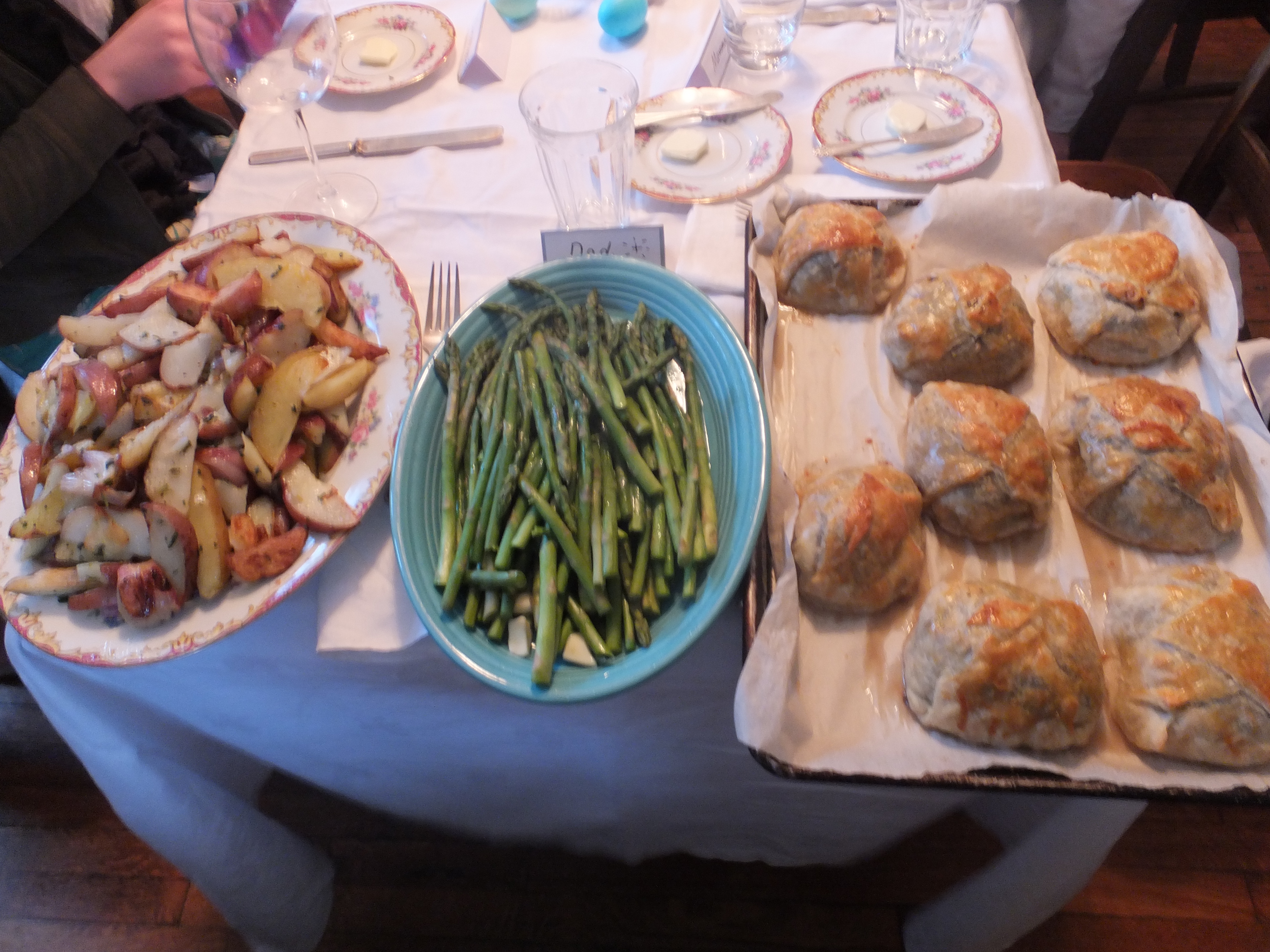
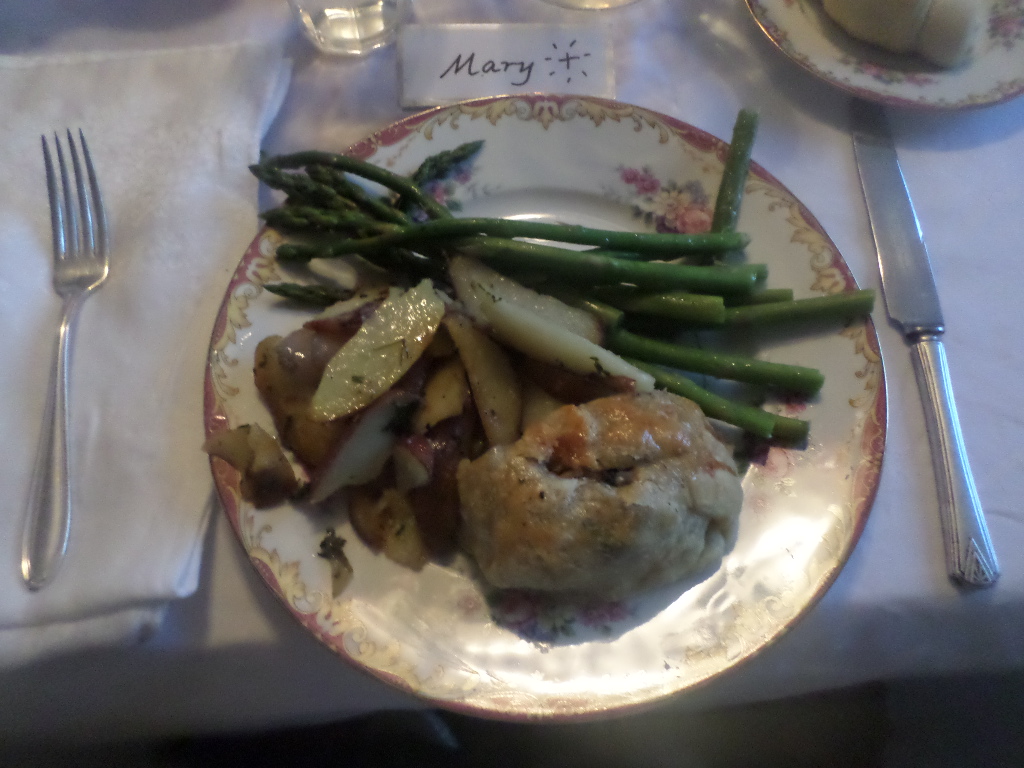
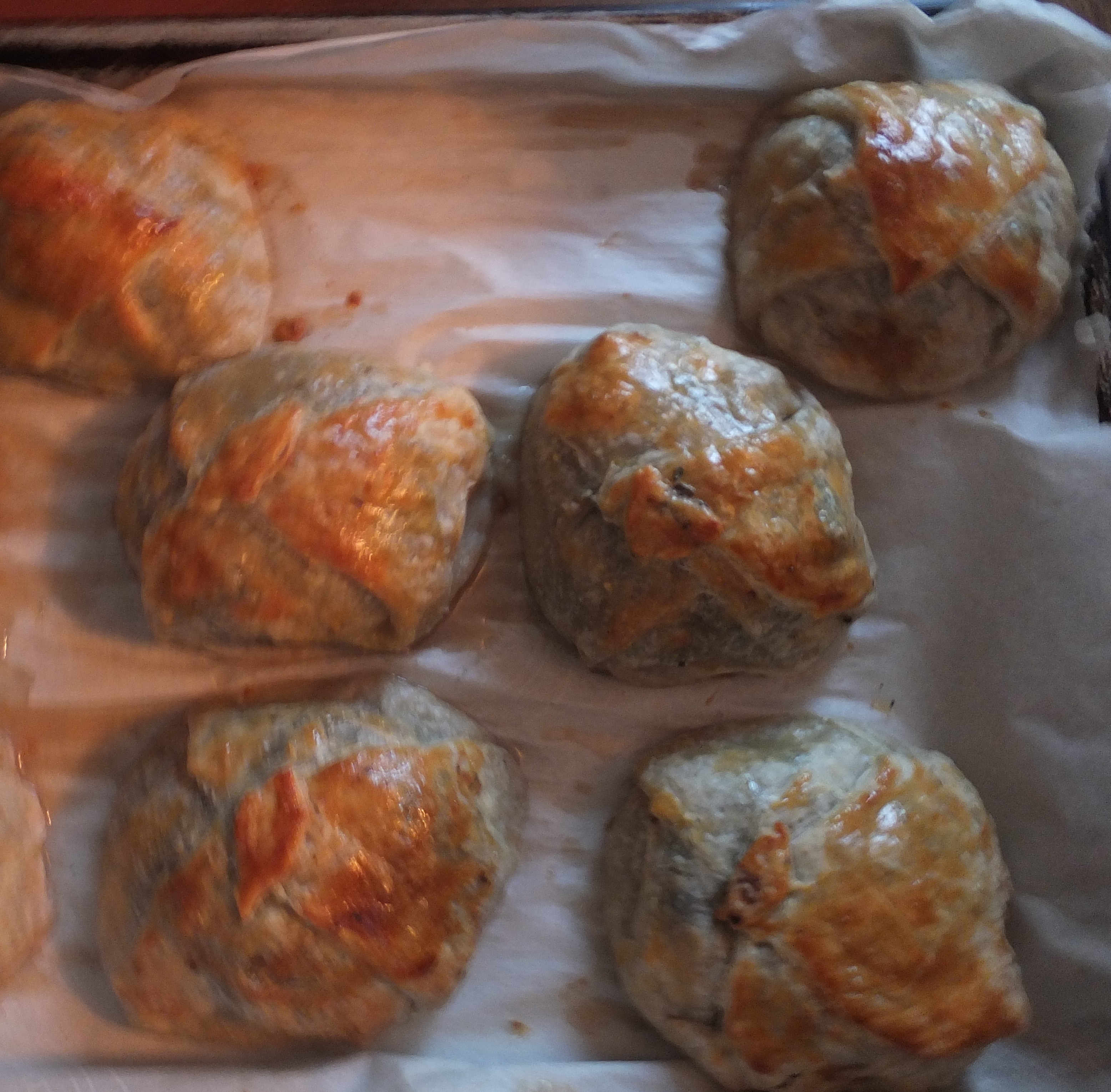
And what food could be more indicative of Christ’s Resurrection from the dark tomb than Beef Wellington – in which a delicious thick succulent tenderloin is hidden inside a beautiful puff pastry phyllo dough crust baked to a golden brown?

Beef Wellington

Beef Wellington

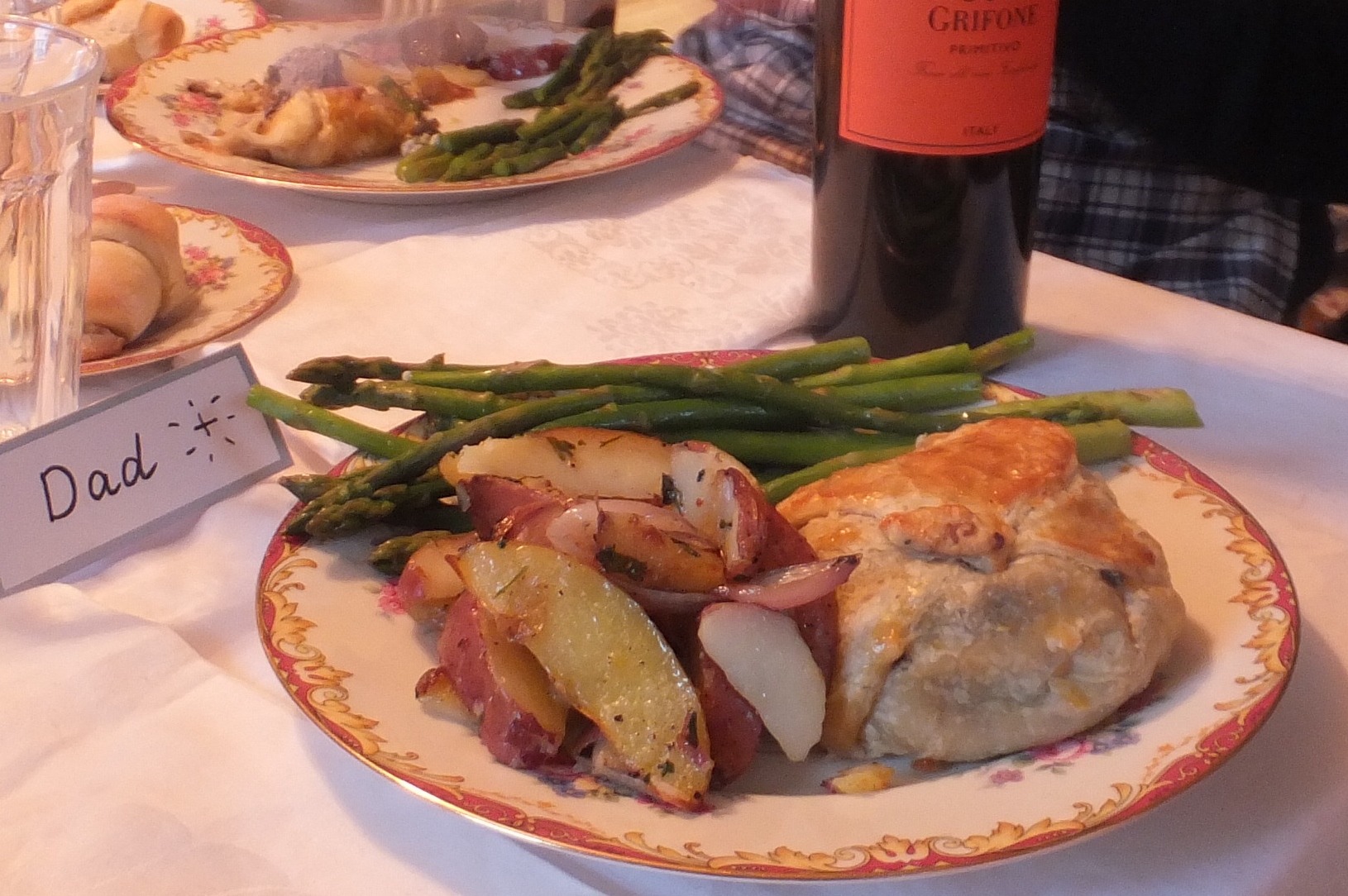
This is actually a photo of the Beef Wellington from the next day - I re-heated it and therefore sacrificed some tender rarity! Nonetheless still delicious with a shallot mushroom chives and cheese layer between the top and the pastry.

This is actually a photo of the Beef Wellington from the next day – I re-heated/overcooked it and therefore sacrificed its red juicy tender rarity! Nonetheless still delicious with a shallot mushroom chives and cheese layer between the top and the pastry.

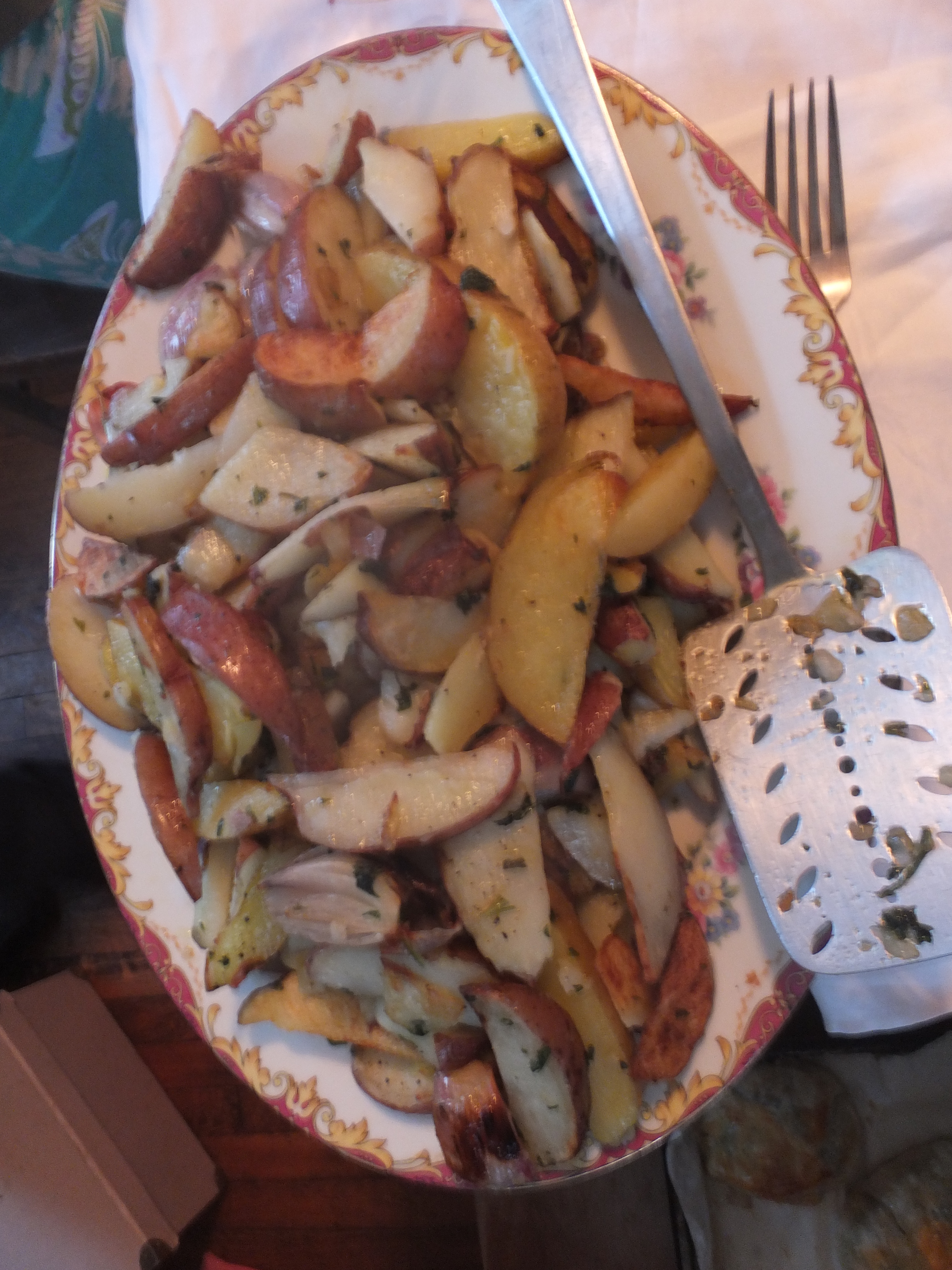
Add a side of oven-roasted red potato wedges.

DSCF4560

And some asparagus!

I love asparagus-steamed to the perfect degree- these have to be watched like a hawk!

I love asparagus-steamed to the perfect degree- these have to be watched like a hawk! I am very happy that this perfect trio did not end up on the floor!

An inexpensive meaty full-bodied Cabernet from Trader Joe’s made a perfect complement to the meal.

DSCF4579

SAMSUNG CAMERA PICTURES

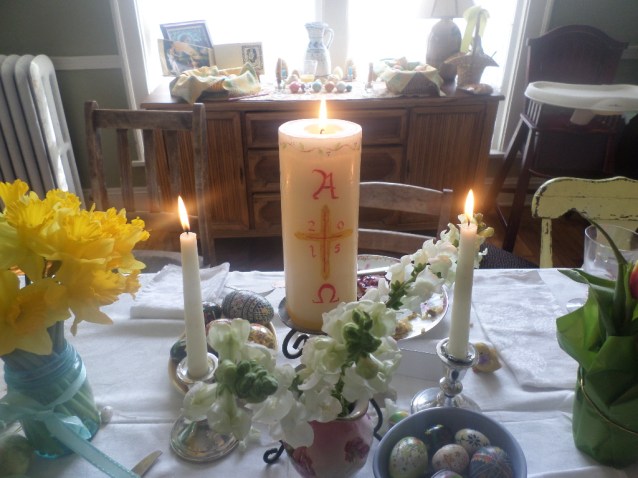
Don’t forget the flowers and candles!

SAMSUNG CAMERA PICTURES

Resurrexit!
Posted in beauty, Dinner, Easter, Feasts | Tagged , , | 2 Comments

Easter Brunch – Resurrexit!

Happy Easter to all!

Easter Brunch 2015!

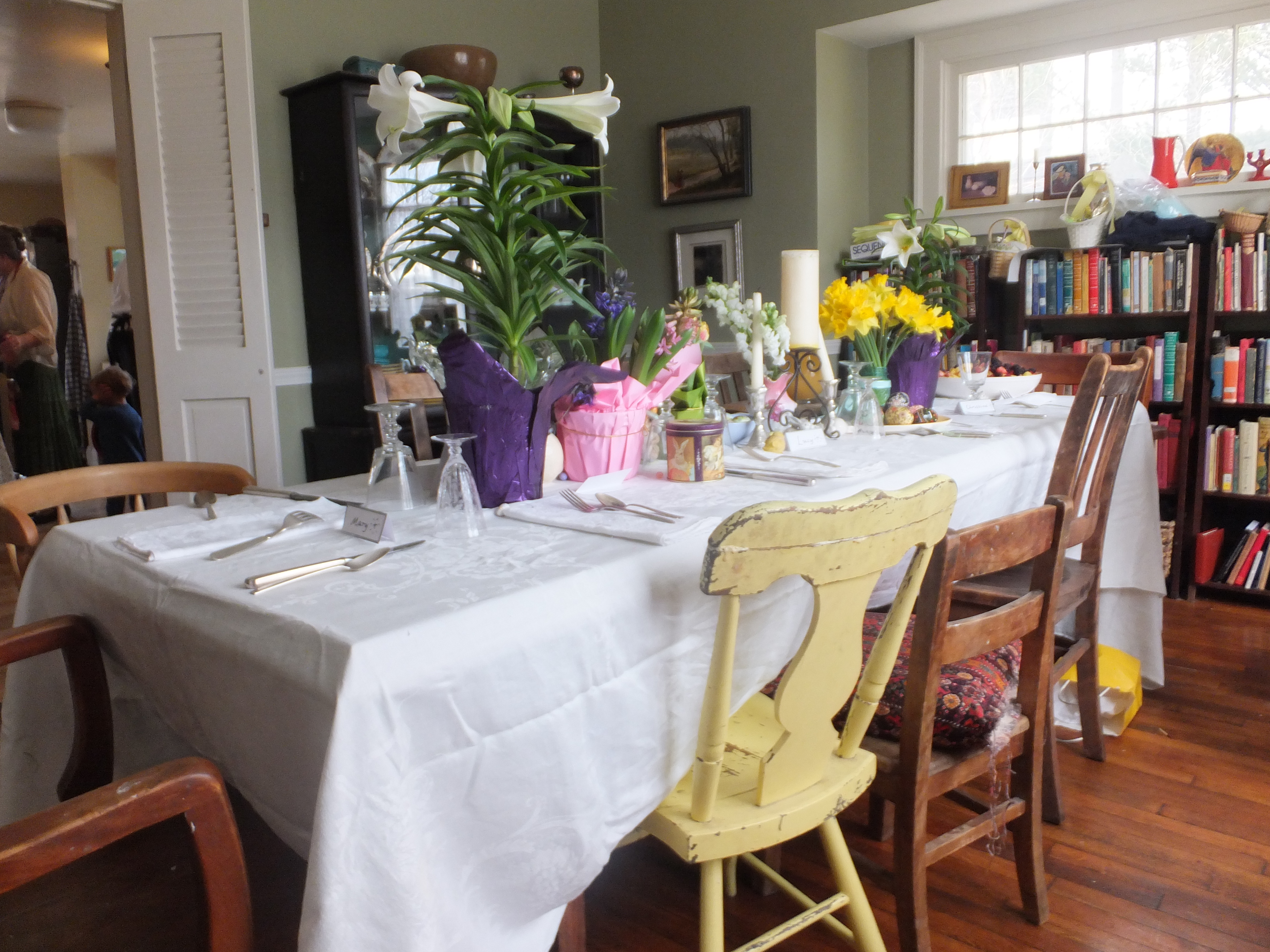
I will let the photos tell the story.

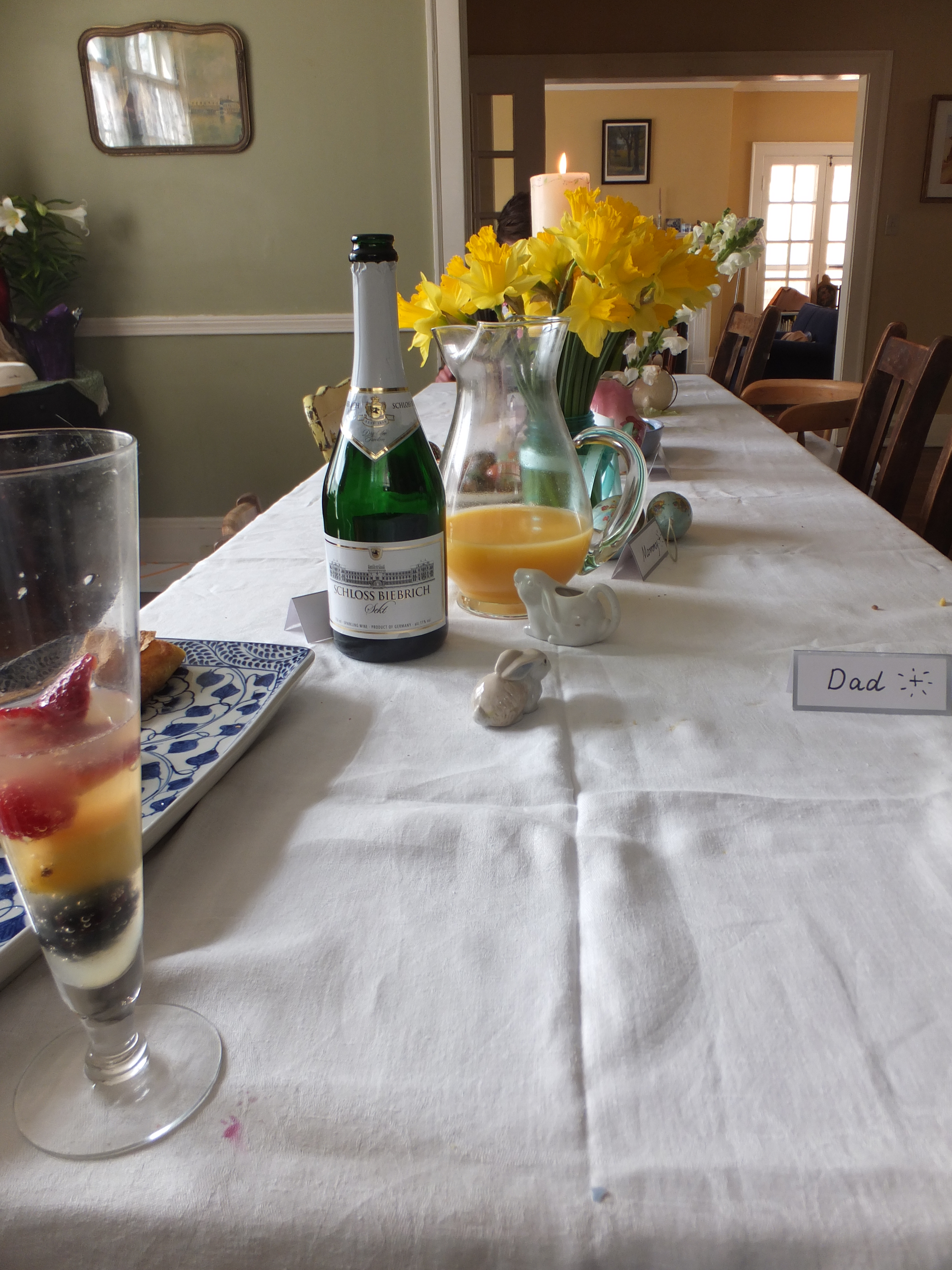
The stage is set for the ideal Easter Brunch

The stage is set for the ideal Easter Brunch

Who doesn't love Easter Lillies?

Who doesn’t love Easter Lillies?

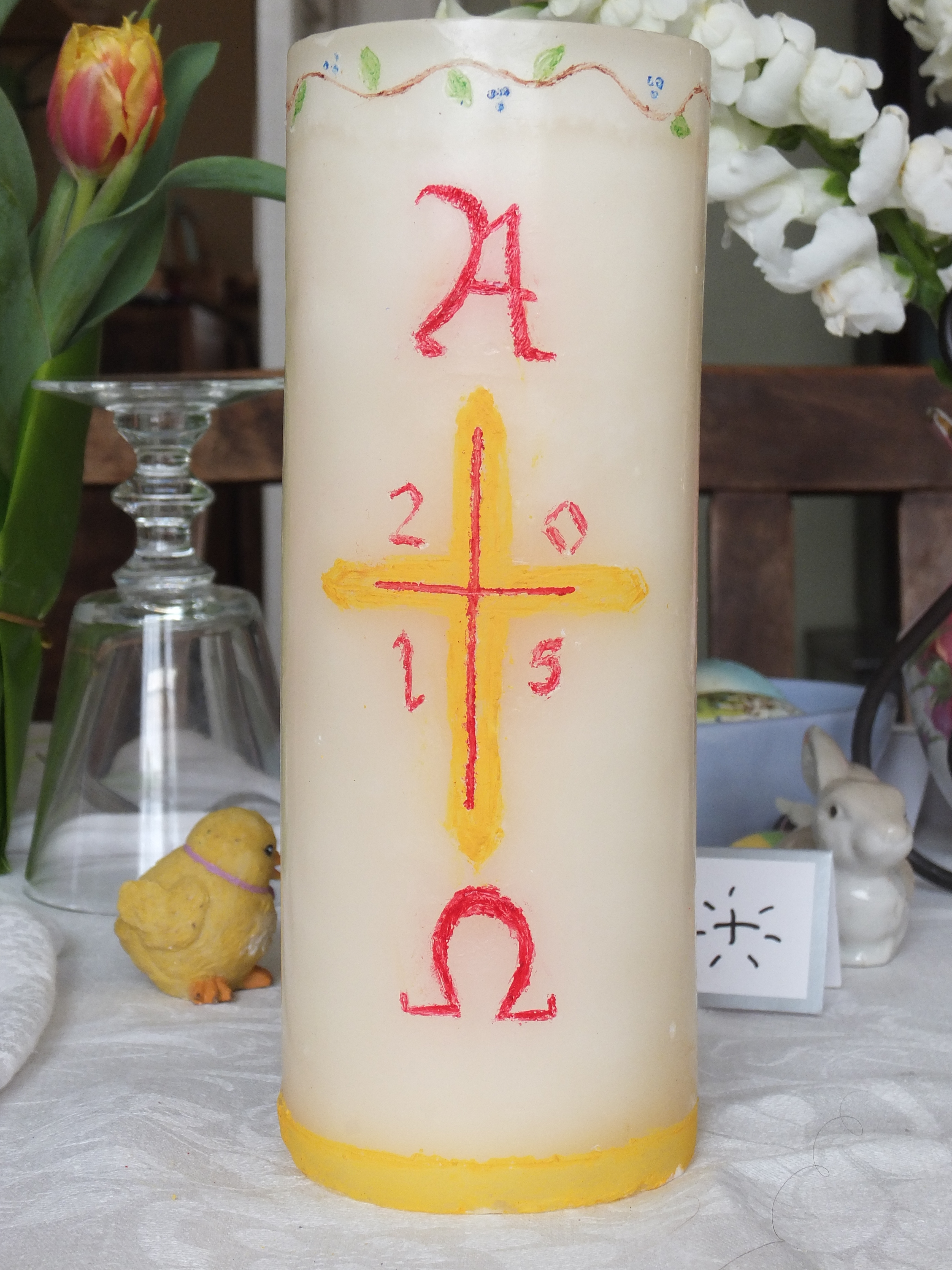
The Alleluia Candle

The Alleluia Candle

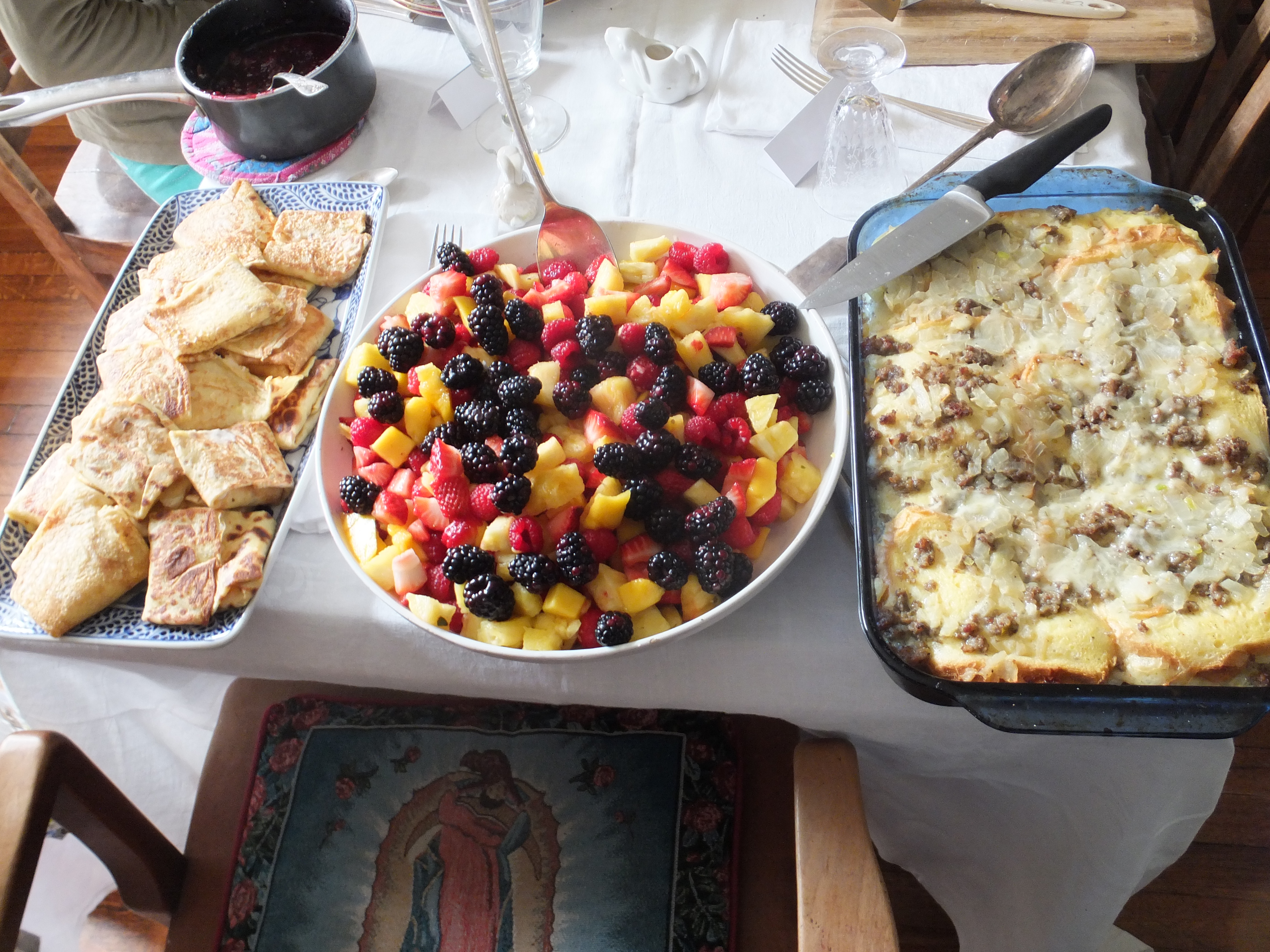
Home made Cheese Blintzes, Fruit Salad, and Egg Strada!

Home made Cheese Blintzes with blackberry sauce, Fruit Salad, and Egg Strata!

No Easter is complete without fruit salad

No Easter is complete without fruit salad

DSCF4460

The aftermath

The aftermath

Posted in beauty, breakfast, Easter, Feasts, Fine Arts | Tagged , | 1 Comment

The privilege of teaching The Ten Commandments

Every couple of years I have the opportunity to teach a course on the commandments. I love this course. Happy is the teacher to whom such a task is assigned! As a matter of fact I feel just a little like the subject of the first psalm when David cries out,
Blessed is the man who hath not walked in the counsel of the ungodly, nor stood in the way of sinners, nor sat in the chair of pestilence. But his will is in the law of the Lord, and on his law he shall meditate day and night.

Now perhaps I have not reached the psalmist “day and night” standard – but I figure that meditating on the commandments with my class for 45 minutes three times a week for a whole semester is a good start.

In my view, the secret to excellent teaching largely depends on three things, to wit:

  1. the worthwhile-ness or dignity of the subject matter
  2. How useful it is to the student
  3. the order of presentation.

If a teacher has an excellent thing to teach, which happens to be very useful, and he also has an excellent order in which to teach it, why then, voila!, this teacher will achieve great success.

In other words- these three things alone can transform any ho-hum teacher with mediocre communication abilities into a veritable paragon of teaching success! He will be admired by his students. He will be admired by his teaching colleagues.

First, the Decalogue provides us with an eminently worthwhile subject matter.  As a matter of fact, it is a treasure-trove of Wisdom. It teaches us about God, the universe, and man, who is himself according to Democritus, a veritable “micro-cosmos.”

Man is a little universe.

Knowledge about man and his proper behavior and how to achieve happiness is certainly a knowledge to be prized. No wonder Moses called the commandments wisdom in Deuteronomy when he said,

For this is your wisdom, and understanding in the sight of nations, that hearing all these precepts, they may say: Behold a wise and understanding people, a great nation.

It is not too often that a teacher gets to teach a subject with such a recommendation.

Sure, perhaps a teacher might occupy himself and his students with other things like differential calculus and balancing chemical equations, perhaps he might teach students how to categorize the various kinds of rocks and minerals and animals and plants and whatnot, but at best these things are meant to lead a student to wisdom. One would not assert that these things constitute wisdom all by themselves.

But to know the law of the Lord- that is quite a different matter. That appears to be wisdom itself… at least according to Moses.

As for order, the commandments, believe it or not, happen to be a set of laws that have been handed down to us in an order that is absolutely magnificent, nay, even Divine! After all God, who is Wisdom, did not deliver his commandments to Moses in any old manner. No, according to Solomon, who speaks about Wisdom under the guise of a beautiful woman, Wisdom

…reacheth therefore from end to end mightily, and ordereth all things sweetly. Her have I loved, and have sought her out from my youth, and have desired to take her for my spouse, and I became a lover of her beauty.

Consequently, should the teacher simply choose to teach the commandments in the order in which God gave them to Moses, he will, ipso facto, have an extremely well-ordered course.

Let me give you an example.

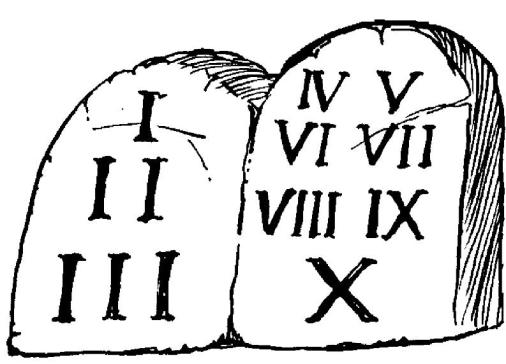
We all know that the commandments were written on two stone tablets because we read in Deuteronomy:

And he shewed you his covenant, which he commanded you to do, and the ten words that he wrote in two tables of stone.

And of course we all know the reason for this, right? Why of course, one tablet, the first, contains the commandments which address our relation to God Himself, and the other contains the precepts concerning our relations with our neighbor.

Now this consideration alone provides us with a rich soil for meditation. But what about the order of the commandments on each tablet? What about the order of the first three commandments for instance?

St. Thomas, teaches that there is an order.

In his little work (his “Opuscula”) on the Commandments St Thomas writes (commenting on the third commandment),

For we are first commanded to adore God in our hearts, and the Commandment is to worship one God: “You shall not have strange gods before Me.” In the Second Commandment we are told to reverence God by word: “You shall not take the name of the Lord your God in vain.” The Third commands us to reverence God by act. It is: “Remember that you keep holy the Sabbath day”. God wished that a certain day be set aside on which men direct their minds to the service of the Lord.

I just love that order!

And this is just the beginning. This is just the tip of the iceberg. One already wonders, “Is there a similar order among the commandments on the second tablet?” Aren’t you dying to know?

As far as the usefulness of the ten commandments, I should think that this point is pretty clear. Does anyone want the secret to happiness?

Well then, if a happy life and a happy eternity are something to be valued, then so is an intimate knowledge of the commandments! Wisdom about God and his works is very useful. Wisdom about what God wants from us is also very useful. Studying the commandments gives us this wisdom. For Wisdom

……teacheth the knowledge of God, and is the chooser of his works. And if riches be desired in life, what is richer than wisdom, which maketh all things?

Posted in Decalogue, Heraclitus, Wisdom | Tagged , , , , | 2 Comments