“Active Participation” or “Actual Participation?”

There is a great article over there at newliturgicalmovement that deals with this text, significant to the worship of every Catholic:

“Mother Church earnestly desires that all the faithful should be led to that full, conscious and active participation in the ceremonies which is demanded by the very nature of the liturgy.” (Constitution on the Sacred Liturgy Art 14 Sacrosanctum Consilium)

What does the Church mean?

Now when I was growing up I thought that this was the big “break-through” that the church made in Vatican II. Vatican II finally shook off the cobwebs of sleepy passive Catholicism and ushered in a new and vibrant era of active singing, dancing, hand-clapping, music ministering, out-loud talking, hand shaking, praise and worshiping… spirituality that was 800 years long overdue.

Some of my earliest memories of going to mass included singing The King of Glory with guitars and tambourines. Back in the seventies and eighties this song seemed right!

And who can forget Stephen Colbert’s interpretive rendition!

Although I liked the song, I don’t think I was ever able to become accustomed to the idea that it was finally quite appropriate for liturgical purposes.

But it turns out that Vatican II was not saying something new when it called for “full, conscious and active participation,” but was rather restating and reiterating what the Church has always taught and even with the same words that St Pius X had employed 100 years earlier.

Filled as We are with a most ardent desire to see the true Christian spirit flourish in every respect and be preserved by all the faithful, We deem it necessary to provide before anything else for the sanctity and dignity of the temple, in which the faithful assemble for no other object than that of acquiring this spirit from its foremost and indispensable font, which is the active participation in the most holy mysteries and in the public and solemn prayer of the Church. (Tra Le Sollecitudine)

But what does “active participation” mean?

Well for me the big “break-through” came when I had the pleasure of hearing this very phrase discussed by the man who seemed to be its most ardent champion!

The one and only Msgr. Richard Schuler of St. Agnes in St. Paul (MN)

(By the way take a look at this cool letter from BXVI about Msgr. Schuler on Fr Z’s blog)

It was at the very first or second annual Sacred Music Conference (hosted by Christendom College that year), which I attended along with my first musical mentor and friend J.G. Phillips and Dr. Samuel Schmitt, where we heard Msgr. Schuler explain what “active participation means.”

That was the conference where we sang a solemn high mass as the culminating event in the crypt Church of the Basilica of the National Shrine of the Immaculate Conception in Washington DC.

I remember this event very well because I had inadvertently pocketed the keys to the rental car, in which we had traveled together from Massachusetts, and, having obtained a ride from another friend, had thoughtlessly left my two friends stranded back at the college in Front Royal!

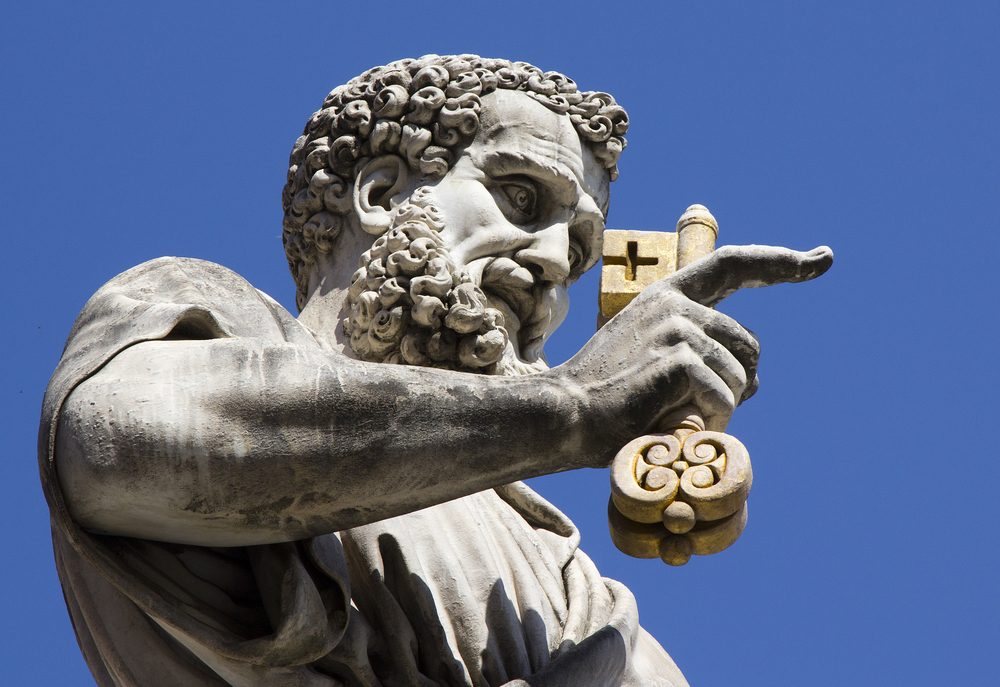
Well, not wanting to miss the major event for which we had practiced all week, the two of them took a taxi for the roughly 75 miles to the shrine. I noticed that Jerry and Sam came a little late and as I smirked in a rebuking manner at both of them while singing Tu Es Petrus (I can’t remember which one) Jerry whispers to me just as I was singing the words

“Et tibi dabo claves regni” 

claves… claves… DABO claves! He wasn’t really whispering…it was a sort of very low and menacing under-the-breath sort of utterance. It was just then that I felt the keys in my pocket and remembered!
You will be happy to know that I did “man up” with some kind of partial taxi reimbursement to cover the $150 fare. Jerry was very forgiving!

It was still a  very beautiful solemn Mass and besides Msgr. Schuler we had the pleasure of being directed by the great Paul Salamunovich

Paul was great! I really liked him although it was a little intimidating singing under his direction.

But back to the point! Msgr. Schuler said, in effect, the following concerning the teaching in Sacrosanctum Consilium quoted above:

The word “full” (plena) refers to the integrally human fashion in which the baptized faithful take part in the liturgy, i.e., internally and externally. The word “conscious” (conscia) demands a knowledge of what one is doing on the part of the faithful, excluding any superstition or false piety. But the word “active” (actuosa) requires some greater examination.

…The difference between participation in the liturgy that can be called activa and participation that can be labeled actuosa rests in the presence in the soul of the baptismal character, the seal that grants one the right to participate. Without the baptismal mark, all the actions of singing, walking, kneeling or anything else can be termed “active,” but they do not constitute participatio actuosa. Only the baptismal character can make any actions truly participatory. Let us use an example. Let us say that a pious Hindu attends Mass, takes part in the singing and even walks in a procession with great piety. In the same church is also a Catholic who is blind and deaf and who is unable to leave his chair; he can neither sing nor hear the readings nor walk in the procession. Which one has truly participated, the one who is very active, or the one who has confined himself solely to his thoughts of adoration? Obviously, it is the baptized Catholic who has exercised participatio actuosa despite his lack of external, physical movement. The Hindu even with his many actions has not been capable of it, since he lacks the baptismal character.

Powerful! I did not take these notes at the conference but rather copied them from the excellent article that you may find here

Sure “Particpatio activa.” But “Participatio Actuosa” is the goal!

Posted in Sacred Music, The Mass | Tagged , , , , | 5 Comments

Six Characteristics By Which To Identify The Wisest Man

As Heraclitus said (and we never tire of repeating)

“If you do not expect the unexpected you will never find it, for it is hard to find and inaccessible.”

This is certainly a wise statement. A clear example of its truth presents itself every time we discover the answer to some question, or discover something new. Consider the paradoxical nature of learning.

If I don’t know something, if I am ignorant, if I don’t know the answer to a question…then how will I be able to find it? If one doesn’t know where he is going how would he know when he arrived? If one is in complete ignorance, it would seem impossible to learn anything.

For example, if you were trying to find a particular person but you did not know anything else about him except his name, how would you be able to recognize him even if you met him? I guess you could say “are you Harold?” and then trust his reply. But this seems quite perilous especially in a deceptive world.

It must be the case that whenever we learn something we have some fuzzy idea about what it is that we learned before we learned it. In other words we were not in complete ignorance, but rather had some vague, indistinct, unclear notion of what the answer was already! (Whatever Descartes might say to the contrary!)

So it is with our search for the wisest man in the world. How are we to recognize him or her among the over 7 billion human beings that inhabit the planet?

Well ok… I am going to boldly propose a small list of signs or characteristics by which you may recognize the wisest person in the world. Who knows? Maybe you will meet this person today!

A list Purporting to give Signs By Which the Wisest Man in the World Might be Recognized.

1) The Wisest Man Really Ought to be a Catholic. Now this is of course a little sensitive because I could have said Christian … or at least a “worshiper of the one true God.” But I hope my reader will indulge me on this point because part of being a Catholic is believing that the Catholic church is the one true church. And so one would not expect me to entertain the possibility that the wisest man in the world would not know this would one?

But look at that, what a powerful sign! We have now eliminated 5.8 billion candidates. Wow! Now we only need to go out and meet approximately 1.2 billion Catholics. But let’s see maybe we can whittle this down a little more.

2) The Wisest Man Has to be a Philosopher. Obviously! The wisest man will of course, like Solomon, love wisdom more than anything else. This is part of being wise. But he who loves wisdom before everything else is nothing other than a philosopher. Clearly. That is what the word means for heaven’s sake!

Homo sedens fit sapiens

So lets’ do some math. What percentage of Catholics are philosophers? Shall we say 1% or is that too generous? Let’s be generous and say 1%.

Ok so when we multiply 1,200,000,000 by 1% I get 12,000,000. That’s only twelve million! I still think that sounds kind of high. Do we really think that there are twelve million philosophers in the world? Maybe.

3) The wisest man in the world has to be a disciple of Aristotle. Now this is also pretty obvious isn’t it?  Aristotle was, after all, the philosopher (by antonomasia) and so therefore the wisest man in the world would surely be a disciple of Aristotle. QED.

But this fact alone will eliminate 96% of all philosophers. Just think of all the strange philosophy out there. For example some are disciples of Descartes (the “Father of Modern philosophy”), some of Spinoza or some other of the so-called “rationalists.” But others are “empiricists” and are disciples of Bacon, Locke, Berkeley, Hume or Mill. Then you get others who are sort of in between and are disciples of Kant or Hegel?  I don’t really know. But there sure are lots of philosophical schools out there and it is not as if Aristotle’s philosophy holds the majority any longer…especially after the “Newtonian revolution.” I am no expert by any means of the history of philosophy. But I do know that Aristotelians are “few and far between.”

So let’s say that there are as many as 4% of philosophers that actually admit to being “disciples of Aristotle.” This is really generous because many intellectuals really shy away from admitting that they are disciples of anybody …but perhaps themselves. But the wisest man in the world will boldly declare the fact!

So 4% of 12,000,000 gives us 480,000.

4) The Wisest Man has to be a Disciple of St. Thomas Aquinas. You might have thought I would have put this earlier, but I think it follows that one really can’t be a disciple of Aristotle without simultaneously being a disciple of St Thomas. St Thomas was the best student of Aristotle ever. He understood Aristotle better than anybody, and one might even wonder how likely it is that anyone could really appreciate Aristotle’s writings without the aid of the Angelic Doctor. (no offense Theophrastus!)

So I am going to go ahead and say that of the 480,000 Aristotelian philosophers out there, only 5% at most are at the same time disciples of St. Thomas Aquinas. Discipleship does not mean a passing acquaintance or familiarity with the writings of someone. Discipleship does not mean that one likes to consult another from time to time. Discipleship means that one wants not just to learn from but also to form one’s own mind after the mold of the teacher.

That leaves us with 24,000  Catholic Aristotelian Thomistic Philosophers among whom we need to find our man.

5) The Wisest Man in the World Must have a love for and expertise in Shakespeare. Now this might seem a little strange at first, but we must remember that being wise is not just having the intellectual “where withal” that one needs to burn brightly in the intellectual firmament. One must also possess the experience of soul that comes from a proper formation in the fine arts and especially the written works or imagination…because the “poet is the teacher of all” as they say. And “Homerus omnes docuit”… and…”no one is a philo-sophos who was not first a philo-mythos.

How and why it is that the great works of poetry form the soul and dispose the mind for wisdom is not the subject of this post. That it is is all I need to make the point.

And so the wisest man in the world will enjoy and be refreshed by and be an expert in the very best literature or poetry.

And what would that be? Well, obviously Shakespeare! He is simply speaking the greatest poet ever. (even exceeding Homer if you can believe that!) But all of these things deserve a longer discussion. I am presently simply trying to deliver this myself of this list.

Now for the math.  I will only allow that out of the 24,000 Catholic Aristotelian Thomistic Philosophers in the world there could possibly be as many as 5% who are lovers of Shakespeare in the way we have set forth.

Therefore  we now have a pool of 1200 candidates from whom to find our man.

6) Now for the “coup de grace.” Just as the wise man will be a lover of the finest poetry, so too he will be a lover of the very finest music.

Music is of course most formative of the soul and especially the passions. One can hardly be wise with disorderly passions. Wisdom only comes to the rightly ordered soul, the soul at peace in its own desires, the soul perfectly disposed towards beauty.

Therefore the wisest man in the world must be a lover of Mozart. He must love the music of Mozart better than the music of Bach. There must be no argument in his mind about whether other lesser composers are better musicians. He will certainly love Vivaldi and Corelli and even Rameau, but he will shy away from music of the classical era and form his soul primarily from the Baroque.

These things take a great deal of discussion and experience of course to see…but again, our aim is simply to list six principles by which we may find our man.

Now of the philosophers I know, I have to say that this principle about what music he will love the most is very sticky. One cannot counterfeit his love for long …and should he have a lingering habit of listening to and even preferring the music of say Beethoven or Chopin or Shubert or someone else…these habits may prove too difficult to break.

So we must admit that of the 1200 candidates from whom we have to select the wisest no more than 2% will also love the music of Mozart more than all other music.

That leaves us with just 24 hypothetically possible candidates.

hmmmm….I definitely have a suspicion of who it might be.

Posted in education, Literature, Music, Shakespeare, Wisdom | Tagged , , , , | 5 Comments

“A Masterpiece of God”

Over there at that classy blog site  (which is devoted to the works and thought of the late American Artist Carl Schmitt) you will find an excellent article entitled “A masterpiece of God.”

Be sure to click on the green text which will take you to some excellent articles about Carl Schmitt by Donald Powell and the well-known author Padraic Colum (among the books of whom The Children’s Homer is a favorite among homeschooling families especially!)

I happen to be sitting within arm’s reach of The Children’s Homer right now… so I feel a special connection to this fellow!

Meanwhile I am still stewing over Donald Powell’s article which you may find here

His opening line:

I charge flatly and bluntly that his fellow Catholics are enemies of Schmitt, his family and what he stands for. Here is my case.

Take a look. Although written for The Catholic Worker, in December 1934 I think Powell’s indictment of Catholics with respect to their support for the “Catholic artist” still holds true. Very sad! The same incriminating argument could be made against Catholics in general for their less than enthusiastic support for Catholic classical education in America.

For example there really ought to be a Lyceum every 7 miles or so!

Meanwhile here is a lovely painting…

CSF21107


Posted in beauty, Carl Schmitt, Seven Fine Arts | Tagged , , | 1 Comment

“A masterpiece of God”

“A masterpiece of God”.

Posted in Uncategorized | Leave a comment

What Should I Do With Myself?

That title is an attention grabber isn’t it?

But as you will see it is entirely relevant to our discussion concerning why the question “Does Nature Act For and End?” is a very interesting question. (See reason #2 below!)

So as promised here are the four reasons (although there are certainly many others)

  1. The Natural scientist and indeed everyone who would like to know something about the natural world needs to be interested in this question because as we all know, in everything we do, every enterprise we undertake, every game we play, trip we make, endeavor we make, we need to first consider what the point of it is. What is the goal? What is the point?

Well it turns out that Science is about knowing why things are the way they are. And that which explains “why something is the way it is” is obviously “the cause” or causes. When we know “the causes,” then we know “the why.”

So therefore the scientist who wishes to know why things are the way they are must consider whether nature, when it produces things, produces them for an end. He must ask whether nature has a reason for producing the things that it does, because if it does then this will be a cause and therefore a key in understanding things in nature.

Now, this might appear quite obvious. But consider this as well, Aristotle asserts that the “final cause” (i.e. that for the sake of which something is… or is done) is not just one of the four causes that he describes in his book on nature, but the final cause is the “causa causarum,” the cause of causes! What he means by this is that if one understands the end for which something is done, he will then be in a position to understand why the thing is composed out of what it is composed out of, he will understand why it is arranged the way it is arranged, and he will be able to understand the nature and character of the one who makes the thing.

2. The question “Does nature act for an end?” is very significant for the Ethicist and for everyone who is living? Why? Well simply because Ethics makes absolutely no sense if Nature does not act for an end!

Another way of putting it is this. Virtue and “virtuous living” means obtaining a habit and living life in accordance with our nature. But this assumes that nature acts for an end.

Do you see what I mean here?  If nature has produced our minds and our bodies (and it has…I mean, we were not produced by some artificial process were we?) then the question is did nature produce our minds and our bodies for some reason? If there is a reason like, for example, to gain knowledge or to possess health and fitness, then clearly a whole set of virtues or good habits arises-namely the habits that enable us to perform actions which help us to obtain these ends.

But if nature had no point in producing our minds and our bodies…then we are absolutely unconstrained to behave in any determinate way…we could act according to whim or fancy with impunity. Ethics disappears along with the norms of decent human behavior.

In other words each person needs to consider the question “does nature act for an end?” because otherwise he will simply not know what to do with himself! 

I think this is an excellent reason. If nature has produced man for some end, then a whole life of activity to reach that end results. One simply has to sit down and start thinking about the best way to proceed. What habits should I form that will enable me to live a life in accordance with my nature? Voila …Ethics!

So imagine asking some freshmen in college “does nature act for an end?” If he says “No” or “I don’t know” then it follows that he will simply have no idea what to do with himself?

And if I come along and say “well I think you would serve my interests very well as a door stop.” What would he respond except that perhaps he may not want to. But then it becomes simply a question of who is the stronger.

On the other hand, the one who thinks nature acts for an end, might have a very good chance at making the case that a human being is not meant to serve as a door stop but is rather suited for some other more elevated purpose.

Important question to ask and answer!

3. Does nature act for an end is a significant question for the artist or artisan…but most especially for the one who practices an art whose aim is to help nature.

The arts are divided into two sorts. One sort, we used to call the mechanical arts, are concerned with producing things that are useful for men, such things as chairs and tables or spoons and automobiles and many other things. The other kind of art has to do with those who are trying to find ways to help nature, for example doctors and farmers and midwives.

One does not ordinarily say that the ‘chair maker’ is trying to help the tree grow a chair. As far as I know a tree is not trying to make chairs (except of course for maybe the cherry tree!)

But the midwife and the framer are definitely attempting to aid nature in what it is already trying to do. These are special arts for this reason.

But consider, what if nature is not trying to do anything? What if nature is not acting for some purpose?

Well then, the doctor is then free to practice medicine, not in a way that aids and helps nature, but rather in any way that suits his interests or the interests of his employer or the state. Scary!

4. Well, you probably saw this one coming. The question “does nature act for an end?” is important for the Theologian.

It doesn’t take long to see that if nature acts for an end then it does so because of some intelligence. This is the principle sign of intelligence, namely ordered activity. That is what mind does. It orders. Reason loves order and making order.

But one who considers nature finally figures out that nature does not act for an end because it (i.e. nature) has a mind of its own.

Therefore one might consider that if nature acts for an end but not because it has a mind of its own, therefore it acts for end because of some other intelligence or mind.

And thus one sees that this whole consideration might lead the Theologian to a very powerful argument towards the existence of God.

So in short, to be brief, let me state, without undue repetition, that the question “does nature act for an end?”  is a very significant question!

Posted in classical education, education, Philosophy of Nature, Wisdom | Tagged , , , , | Leave a comment

Four Reasons Why “Does Nature Act For An End?” Is A Very Good Question

Today I mean to simply to go straight to the point. There will be no interruptions and I won’t even be taking questions! I find that this is the only way to really get things done. Sometimes we like to defend the excellence of the Socratic method and the effectiveness of the seminar or discussion method in learning. But let’s face it. These methods are not really that effective when the object is merely to get things done. There is simply no greater obstacle to progressing through a text or a curriculum plan than allowing students to ask questions or examine one’s argument premise by premise. Well I suppose a tornado or an earthquake might cause significant interruptions, but these things are not half so threatening to a teacher’s sense of “getting things done” as eight or nine students who feel free to speak their minds when they please.

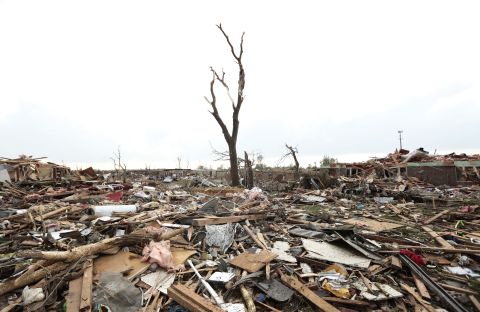
Photos: Tornadoes wreak havoc in Midwest | CNN

After rebuilding the school, I bet I could still get through more text, turn more pages and “cover more material” if we just jettisoned the discussion method! Sure maybe the discussion method is an effective way for a student to become actively engaged in his own education. Maybe allowing a student to speak and ask questions and make comments (relevant or even irrelevant) is an effective way to provoke his enthusiasm for knowledge and perhaps provoke deeper understanding and even real learning. Nonetheless, I still maintain that it is a very poor method for getting things done. And the terrible irony is this: After allowing students to speak freely and engage in discussion and intelligent “back and forth” and “two-way learning” (to use Adler’s expression) and Socratic-like debate, after provoking authentic interest in their minds for a subject by long examinations of even minor points and perhaps even trivial matters (of course “trivial matters” are arguably what an education in the Trivium and the liberal arts is all about!), after all this I say, students will be the first to point out at the end of the Fall semester,

“Hey… isn’t this a class on the Sacraments?… Well how are we supposed to get through all seven if we are still only half way through Baptism?

Isn’t this just the way of it? I almost blush to think how fast a student will “turn his back” on his poor teacher in pointing out the lack of progress-through-the-text simply because the teacher was suckered into the idea of provoking real learning! And is the student ashamed to draw attention to this “lack of progress” to his parents? No! How many students have carefully pointed out to their parents

Mom…Dad…the reason why our American History Class never made it past the North’s violent attempt to resupply Fort Sumter in 1861, was that we were really trying to understand step by step from a careful reading of the “Declaration” and the Constitution, and all relevant primary source material …of course all the time with spirited but amicable debate and discussion ….how the North could so brazenly betray the very principles of their own independence.”

No instead who gets crucified for what appears to be sheer incompetence in “making progress?” You guessed it. The poor teacher. Not that I am complaining or anything, I am simply pointing out the  fact that allowing students the intellectual liberty to speak at all is inimical to covering material! I have known some teachers who disagree. They say things like

“well one can have it both ways, in discussions, the teacher must be very vigilant in only allowing relevant points to advance. There must be a firm discipline in directing students to speak to the point succinctly etc… etc…”

Obviously this teacher knows nothing about real classroom discussions. “Relevant points”…”Succinct” … ha! or sometimes teachers will say

“I spend the first 35 minutes lecturing on important material that I want to cover and then I allow 5 minutes for a lively and spirited debate.”

Well that is just shameless. As if a discussion could happen in five minutes. In my experience it takes at least 30 minutes to simply make a question arise. To even make and issue seem discussable… worth discussing…interesting…arguable…this takes loads and loads of time.  The mind of the student, you must remember, is sort of like the mind of a bear in hibernation.

Study Shows How Bears Hibernate: What It Means for Science - TIME

And it certainly takes more than five minutes to provoke such a mind to vibrant discussion. But it is much easier to make progress when one is simply writing things down in a blog post such as this. The fact of the matter is that one gets to control the flow of the “discussion” more closely. As a result the flow of ideas, the thread of thought is easier to follow than in a real-time discussion, and, frankly, the ability to use images to advance a point can be a very powerful aid…like that bear for instance…isn’t “he” just like what you might imagine the mind of a student might look like, say, in the morning during those first period classes? About those four reasons… I would like to address this rather quickly, but now that I have considered it, I think it might be a mistake to attempt to present all four reasons simultaneously, and therefore I will attempt to only present maybe one or at most two reasons at a time.  But I will go ahead and mention that the reasons why “Does nature act for an end?” is an excellent question will be arranged as follows

  1. It is an extremely important question for the student of nature (i.e. the one who would like to know something about nature….maybe even the person that we call these days “the scientist!”
  2. It is an absolutely significant question for the Ethicist and for anyone who is living. (I suppose that would apply to all of us)
  3. It is a very good question for those who practice one of the arts that “aid nature” (e.g. doctors, midwives, logicians)
  4. It is an excellent question for the Theologian.

But this needs to be discussed at more length and certainly “wisely and slowly” as Friar Lawrence would advise.

Posted in classical education, discussion, education, Philosophy of Nature | Tagged , , , , , | 11 Comments

Does Nature Act For A Purpose?

The title of this post is “Does Nature Act For A Purpose?” And it is a post that I have been wanting to post for some weeks now, mainly because there are some ideas in my head that I have admittedly received from another (i.e. a very wise person) and like most of my ideas they seem to stay in my head for only about two weeks, if that, and then other ideas come in and crowd these ones out, no matter how important they seemed to me at the time.

I don’t exactly know why this happens unless ideas are really explained through some electrical/particle theory. I don’t know much about electricity, but one can understand a little why some people would listen to that crazy second-rate poet Percy Shelley

A second-rate adolescent poet!

when he uttered the nonsense “man is no more than electrified clay.”

This thought was, of course, not original to him but I could see why my ideas appear to get crowded out. There is a limit to how much electricity a thing can hold at one time!

But ideas are not simply electrical impulses, and the fact of the matter is that the ideas do not get “crowded out.” I just forget them for a while. That’s all. But let’s not discuss this minor point right now.

We are discussing whether Nature Acts for an end (or purpose)? But before we discuss this foundational  Aristotelian idea, we need to first discuss why it is an important idea for everybody!

One can’t just simply launch into ideas without a prior discussion about why the launch should be attempted…can one?

No, I think not.

And I will not be accused of spontaneous intellectual launches! We want to make the case that if we launch into an idea, SO SHOULD EVERYBODY! Our launchings should be everyone’s launchings.

And this question “Does Nature act for an end or purpose?” certainly qualifies as being in the realm of ideas that simply have to be asked by every last human being (or asked by his parents or legal guardian… or I suppose even his paid advisors).

Allow me to propose four reasons why this is an important question.

But “wait” you say, “what on earth does the question mean in the first place? The question makes no sense! Nature is not an animal or plant or human being … so nature does not, properly speaking, act at all! Are we doing poetry now or what?!?”

Well, that’s a fair question and I guess we need to talk about what the question means in the first place.

Maybe there is no question to ask and answer because “nature does not act” except in some kind of metaphorical way that we use in communication like when we say

“the winds ablowing up a real gale today.”

Or

“Like as the waves make toward the pebbled shore, so do our minutes hasten to their end”

as if the winds did blow and the waves did make toward the pebbled shore of their own will and accord.

To say that nature is acting when it is hot or cold outside seems like a mere custom of speech. The rain and snow, the heat and cold might all seem like random phenomena governed by the movement of inanimate particles and unintentional forces.

Or is nature acting for a purpose in all these cases?

What about  clouds for example? Do they act for an end or do they just sort of pass through the sky at random? I suspect that most of us look at them as if they are mere conglomerations of water particles being blown against their natural inclination by the wind…which itself is just another force produced by the convective force of heat and cold which is nothing other than molecules moving at various velocities (not speeds mind you!)

Of course as luck would have it, that second-rate-adolescent-poet Percy Shelley wrote a lovely little poem about clouds that starts like this:

         I bring fresh showers for the thirsting flowers,From the seas and the streams;
I bear light shade for the leaves when laid
         In their noonday dreams.
From my wings are shaken the dews that waken
         The sweet buds every one,
When rocked to rest on their mother’s breast,
         As she dances about the sun.
I wield the flail of the lashing hail,
         And whiten the green plains under,
And then again I dissolve it in rain,
         And laugh as I pass in thunder.


Now maybe I need to give Mr. Shelley a second look because even despite his saying that “man is no more than electrified clay” this poem about clouds does in fact seem to imply that clouds are a bit more spiritual than a mere random event of particles.

So I don’t know what to say about him. He might be a little at odds with himself which is an understandable trait …especially in adolescents.

Now we all know from experience what it means to act for an end or purpose. We spend long years in school working for good grades so that we can all go to good colleges so that we can get good jobs so that we can all live comfortably and hopefully be very, very wealthy! Right?

Of course!

And just think of the myriad intermediate steps between where we are now and where we intend to be at the end…perhaps lounging in the library of our mansion in Rhode Island complete with coffered ceilings and perhaps a painting of a dolphin!

Or maybe indulging in some cold fresh-squeezed orange juice in the platinum paneled “Morning Room” decorated with images of the muses!

Ahhh…the dream! But it takes many, many intentional steps to arrive there… and then (oh cruel irony…or rather Infandum!) unfortunately only the liberally educated person would actually know how to use and enjoy the paneled library…the very last person likely to have the privilege of standing in it because he never  took those myriad steps to get there!

After all the inscription on the fireplace in this library reads,

“I laugh at great wealth, and never miss it;

nothing but

wisdom matters in the end.”

which is a sentiment that only a liberal education would allow one to understand – but a sentiment not very friendly towards the production of wealth!

And it is the liberally educated person that would know how to properly enjoy, day after day, the quiet gardens and scenic verandas.

And of course it is precisely not the liberally educated person that lives in that house. No it is probably only some nineteenth century industrialist that could afford a place like that!

Cornelius Vanderbilt Daguerrotype2.jpg

And why? Because he doggedly took very careful planned out intentional steps over many years to achieve the magnificent wealth that makes such a mansion possible. I mean imagine the kind of energy and careful planning it would take to build a steam boat and railroad empire. No… steam boat and railroad empires do not just come about by chance!…at least not ordinarily.

But does nature act like this? Does nature employ myriad steps in order to obtain some intended end…some rational planned out …even long-term goal?

Or do things in nature just sort of happen because of irrational forces and the properties of inanimate matter?

Mountains? What are they trying to do?

How about air? How about light? Do these act for an end?

What about man? Does he also have an end to which nature directs him? Evidently man is a product of nature, and the question here is “Does nature act for an end?

Hopefully the question makes some sense…. may I give four reasons why I think it is a good one?

“No” you say, “some other time…besides I am already convinced, why do we need four reasons why this is a good question?”

Well, because this question concerns all of us very deeply and the intellectual custom of the day is not very friendly to the concept.

“Why is that?” you ask.

Well we need to talk about the roots of our intellectual custom to settle that question… maybe some other time? I just want to get to my four reasons why “Does nature act for an end is a pivotal question.”

“Ok” you say “but later.”

Posted in ad libitum, Custom, Uncategorized, Wisdom | Tagged , , , , | Leave a comment

Who Is The Wisest Person In The World?

I think I know who the wisest living person is in the world and as luck would have it, I happen to know him personally. (hint: besides Our Lord)

But I hesitate to tell you this and am even hesitant to share his name with you because:

  1. I don’t think you would really believe me.
  2. I don’t want to embarrass him.
  3. I don’t want to give away my sources!

But isn’t it strange that as large as the world is, and with as many people in it that there are, that even despite the gigantic odds of ever meeting this person, I would happen to have a very good relationship with him.

And what’s more, I have had the pleasure of listening to him for hours and hours and hours!

Now you might think that I am trying to make a case that I, who have had this privilege, am therefore wise.

But this is not at all what I am trying to do. No sir! Nor do I think I am particularly wiser than you (although I have a suspicion that I like Euclid more than you do.)

No…the point that I am attempting to bring out here may be summed up in the following statements:

  1. There are (as of today) 6.94 Billion people on the earth
  2. One of these is the wisest person.
  3. I happen to know this person!

Isn’t that extraordinary?

But of course you still disbelieve me and I think it is probably because you refuse to accept statement #2! And even if you did accept statement #2 you probably would still refuse to believe statement #3 because you would say something like

Sure there might be a wisest person, BUT how could one ever know who this was?!

So it turns out that YOU are sort of an agnostic with respect to the whole question.

Nonetheless your position really amounts to no more than because you do not know how to recognize who the wisest person is, you therefore deny the existence of the wisest person.

And that does not follow!

This reminds me of the great Heraclitus when he said,

“If you do not expect the unexpected you will never find it, for it is hard to find and inaccessible.”

In other words as with many things, if we do not have a fair idea or expectation of what the wisest person would “look like,” we would never recognize him even if we happened to live with him. (or her?)

And perhaps this is what we need to discuss. By what traits would we recognize who the wisest person is? How would we measure whether one person is wiser than another?

But I suppose you might be thinking “why bother?”

Well…it could be that your own wisdom depends on it.

Posted in ad libitum, Wisdom | Tagged , , | 3 Comments

Patriotism the Classical Way

In the spirit of the day Jeffrey Mirus wrote an excellent article over there at “Catholic Culture” Patriotism, Tempered and Pure. His essay ends with these sage words (my comments in bold):

This Catholic awareness of a higher duty and a higher love makes Catholicism suspect in the eyes of those who place country at the apex of their hierarchy of being, (“hierarchy of being” is always a phrase that betrays the one who employs it as a classical thinker!) and above all in the eyes of those who deify the State. Such a response is merely a counterfeit of patriotism. Our love of country is a good and wholly natural response to the gift of a God who sustains and teaches us in time and place and culture, manifesting all the goods of nature and human industry in ways meant to lead us to that “something more” for which we all instinctively yearn. (through the visible we see the invisible!)

Country is part of the law of the gift, and we are right to cherish all of our gifts. But as with everything else, we love country for the sake of the Giver. We do not receive the gift and then push the Giver aside. It is this that tempers love of country and keeps it pure. It is this alone that properly orders patriotism. (excellent!)

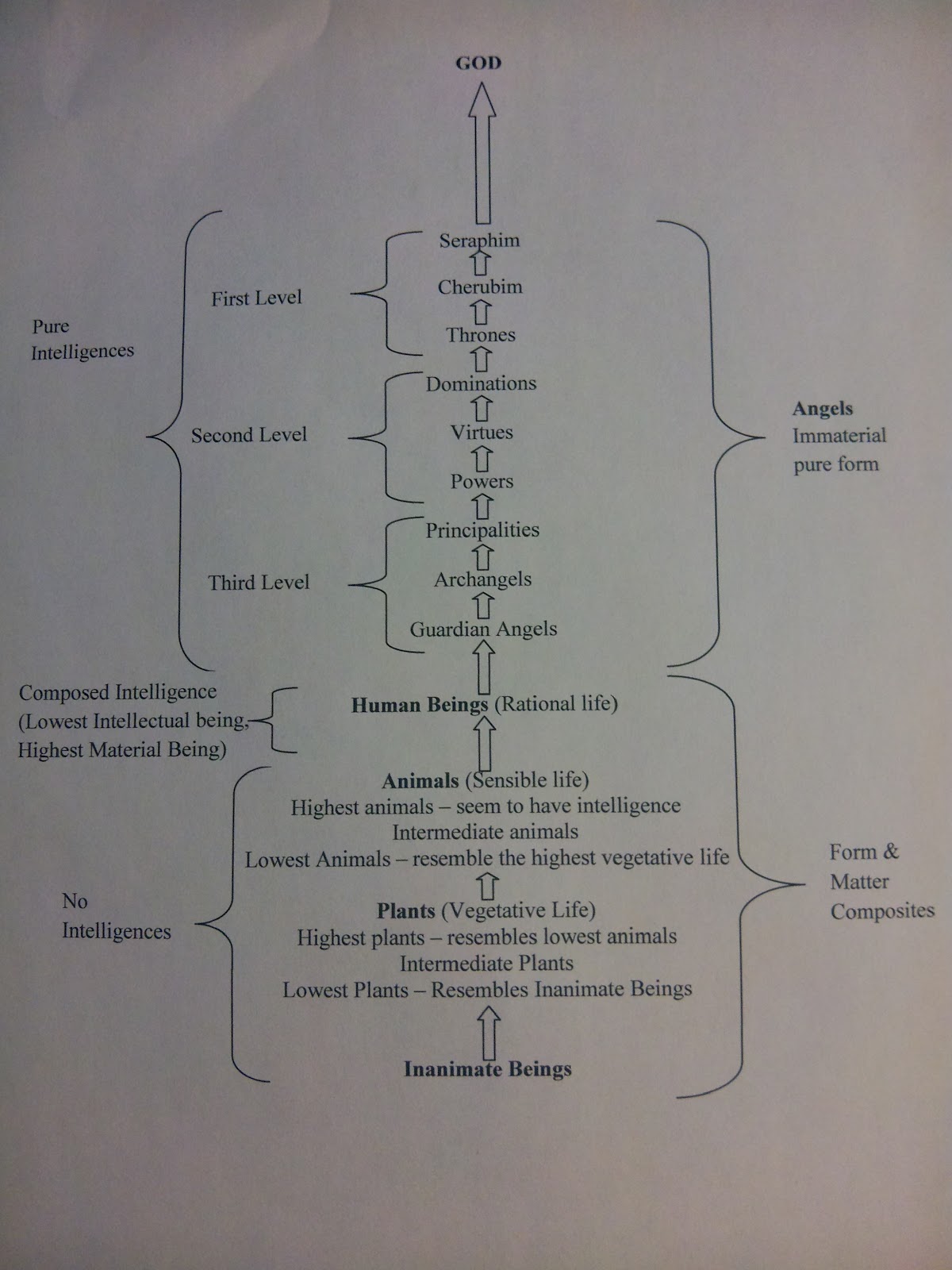
Great Hierarchy Chart!

Liberal Education (AKA “Classical Education”) is all about knowing things and therefore knowing the order of things. After all order is in the definition of reason itself. There is no knowing apart from knowing the order of a thing. Where does the thing stand in the order – or hierarchy – of being? For example when we begin to know something we might ask questions like… is it caused or uncaused? Is it timeless or temporal? Is it mobile or changeless? is it spirit or matter? Is it a natural substance or something that belongs to substance? Is it animate or inanimate? Is it a quantity? Is it a relation? is it a time or place ?…and so on… although I think we might need to think more seriously about the order of these questions!

Naturally, as our knowledge becomes ordered so do our loves. Love follows upon our knowledge. When we know the right order of things this very knowledge enables us to love things properly; enables us to love things in the proper order!

As Dr. Mirus points out those who “deify the state” do so, because to them it appears to be at the “apex” of being. And this makes sense, to some extent, because the state certainly appears to be more known and closer to our senses than God.

But it is childish for a man to assert that the state is the highest authority. It is also the symptom of a mind that has never developed a habit of looking for causes, a mind that has never developed a habit of searching beyond what merely meets the senses. In fact it is the symptom of a mind that has never grown out of its infancy. Forgivable and charming when an infant thinks that no one is stronger than his own daddy- but shameful when an adult bows first to the state before God.

The liberally educated man, so habituated to order, is able to be authentically patriotic because his love is properly ordered. His love ascends like that of Pius Aeneas from parents to country to God. And those whose loves are not ordered are mere counterfeits.

Certainly it was Divine Providence that coupled the death of Thomas More on July 6, 1535 so closely with our own national day of Independence. He was the very embodiment of authentic Catholic patriotism and it was his liberal education that enabled him to say before his beheading

“I die the King’s good servant and God’s first.”


Posted in classical education | Tagged , , , | 1 Comment

Liberal Education Works

As a teacher at a prestigious Catholic classical high school,  I have been thinking a great deal about floor joists, plywood widths, cast iron pipe and tile.

 Why? Well…it’s summer, and this is just what classical teachers do in the summer!

 The classically trained mind thinks lofty spiritual matters, and about matter itself and the material world during those long winter school months…but in the summer it immerses itself with great zeal and energy into the very heart of the physical world. Mind confronts matter in its myriad and individual circumstances, its messy imperfections and raw primal state with an unflappable confidence saying “this is only matter after all. How hard can it be?”

Very hard indeed!

But do not confuse the classically trained mind with the “ivory tower intellectual!” The ivory tower intellectual gives a bad name to learning and philosophical pursuits. He lives aloof from the brazen realities of cast iron plumbing and horsehair plaster. He has never scorched his fingers with a propane flame torch when soldering copper pipes together. He has never melted lead off the end of a brass collar!

The ivory tower intellectual gets his practical work done by making phone calls.

But the classically educated mind does not hesitate to leap headlong into full-scale demolition work. He doesn’t have the snobbish contempt for matter (which is probably really a mask for his fear) that the “intellectual” has. The CLASSICALLY trained mind knows with religious conviction that mere matter – mere concrete, wood, bricks, cast iron or copper pipe is simply no match for the dynamic power that the mind has from chanting Latin forms. But this does not make him despise matter. No! It does however help him to appreciate the mind.

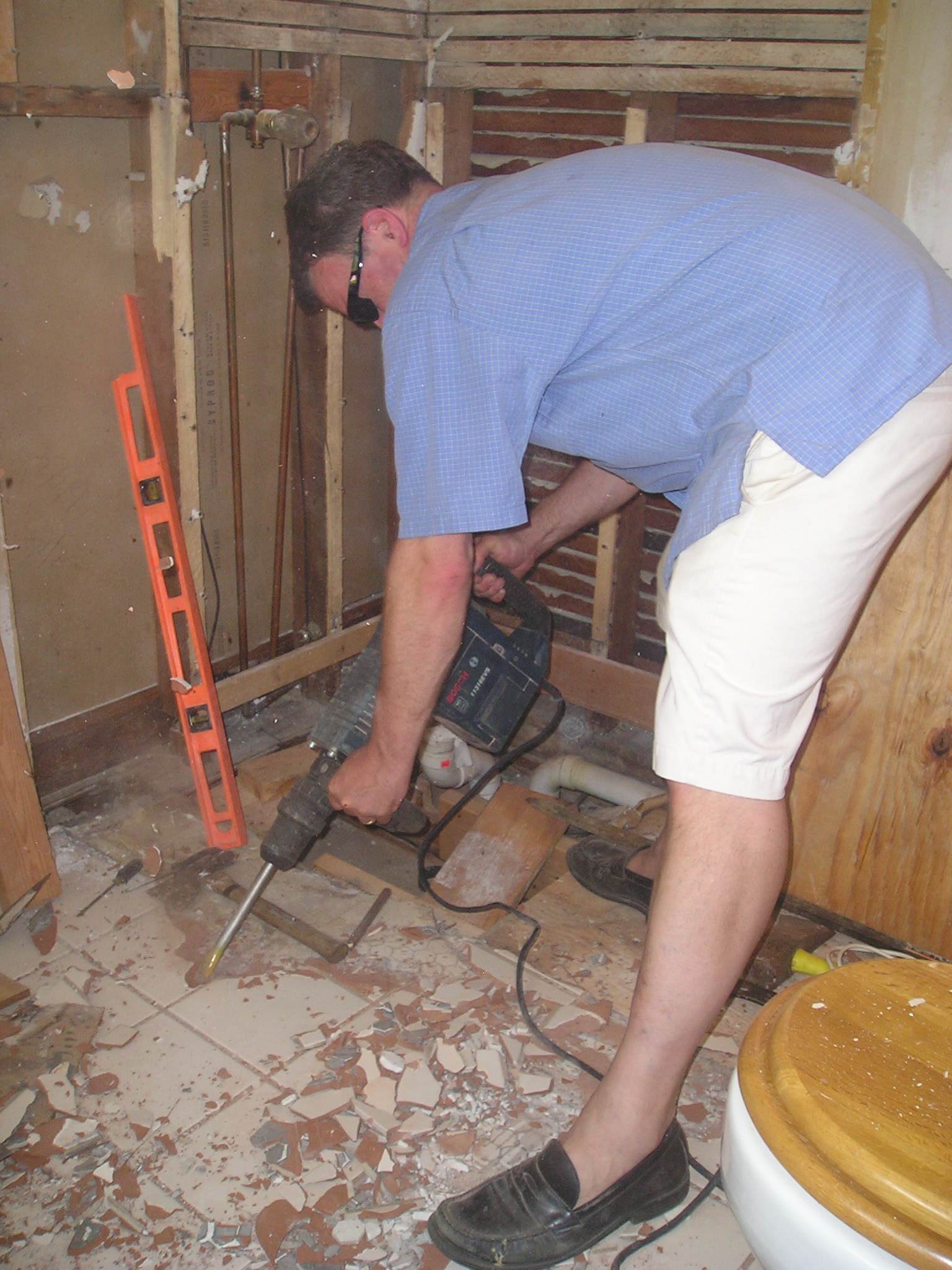
Take for example this photo of the classically trained mind wielding the thirty-five pound Hitachi Jack Hammer!


Two layers of tile over 3 inches of concrete. My sunglasses served just fine for eye protection.

Taking out that floor was tough…but not nearly as challenging as learning the rules for the sequence of tenses in Latin! Even if they used to make tile floors in second story bathrooms on 3+ inches of concrete!

Or take this example!

IMG_7879

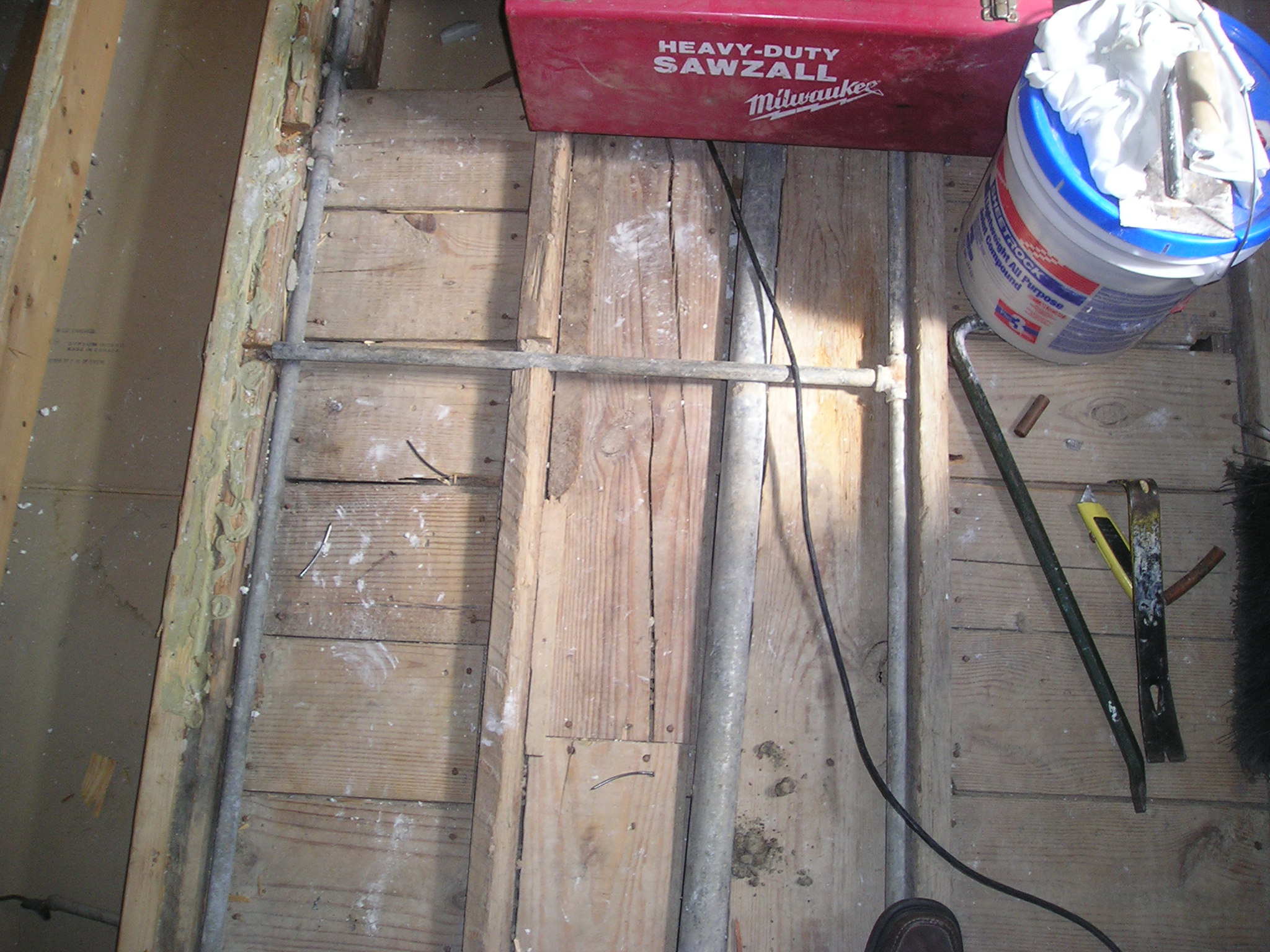
I had to laugh when I saw this semi hexagonal shape under the shower. I said to myself “Euclid would hardly consider this a regular polygon!” So I ripped it all out and am now ready to work with the “almost prime matter” underneath it all!

After hauling out 30 buckets of concrete and broken tile we have something we can work with!

There is no problem in the material world, as far as I can see, that the classically trained mind can’t overcome with the aid of a heavy-duty Milwaukee Sawzall. I love this tool. I even cut through those old obsolete steel pipes – except for the wider one in the middle which I think services some of my radiators.

In general I think my house is breathing a sigh of relief now.  Wouldn’t you feel better if someone removed 1500 pounds of material from your life?

But I did wonder how the house could remain substantially the same house with all of those parts removed.

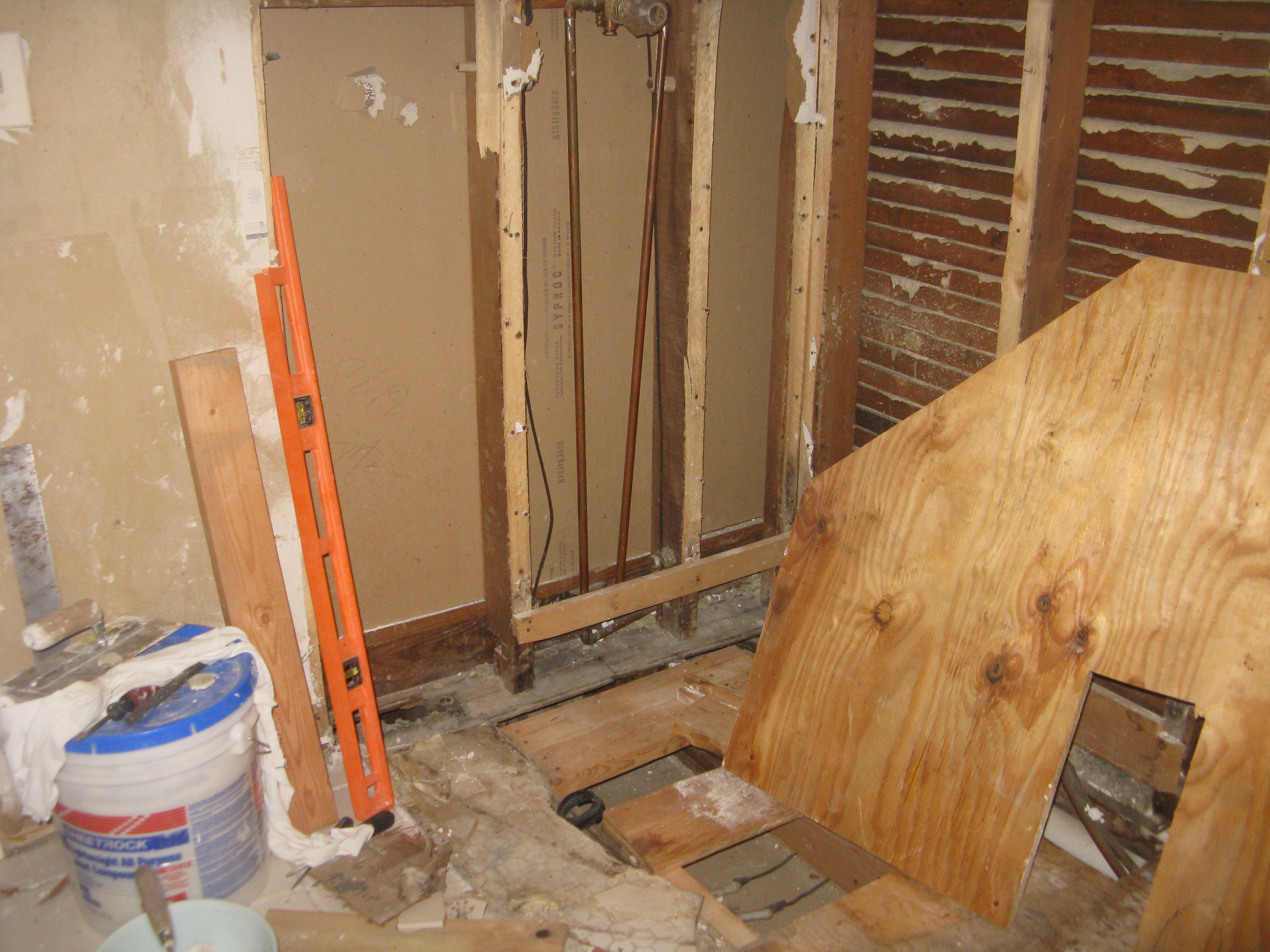
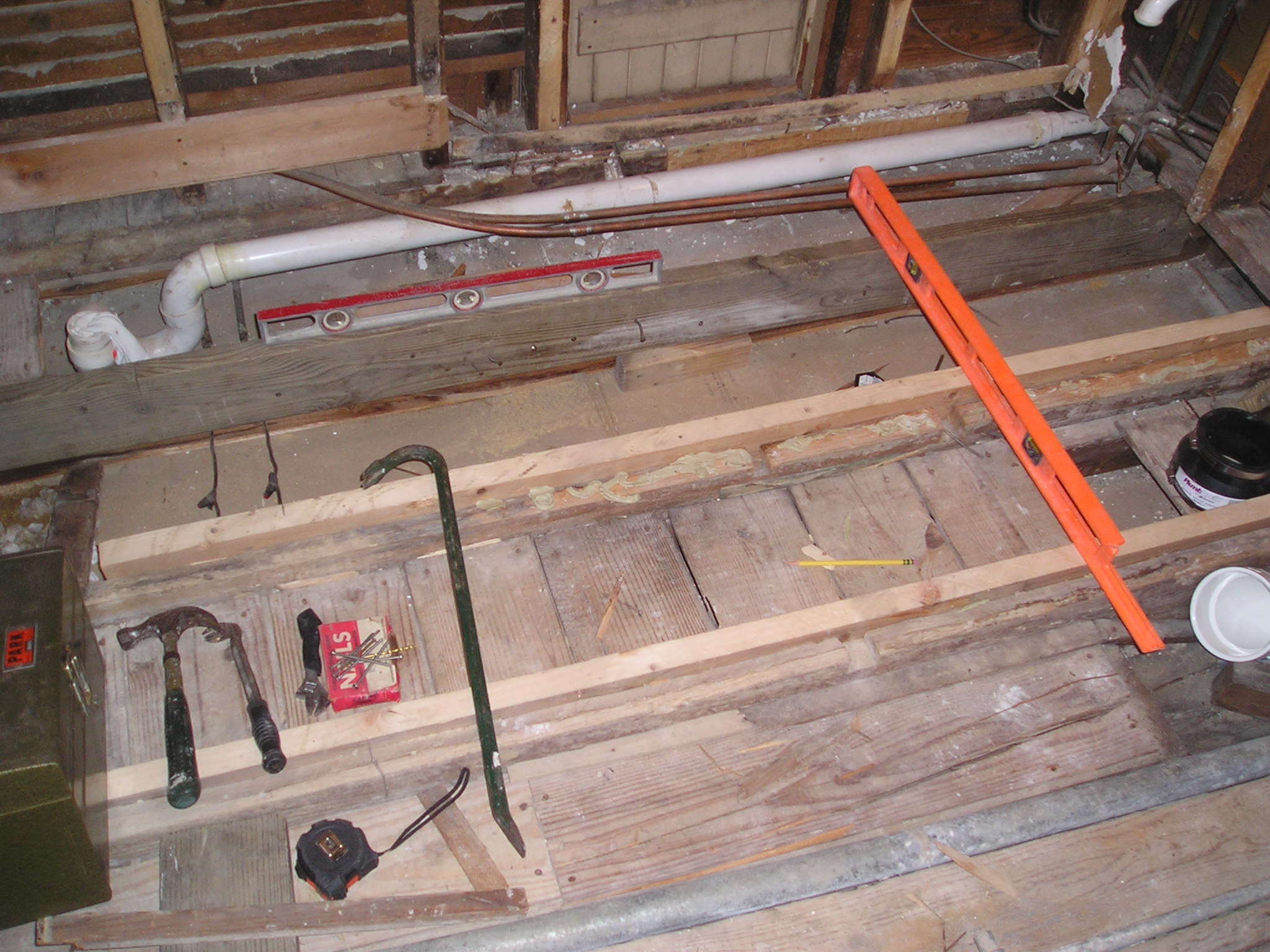
I had to "sister" some of the floor joists to provide a level substratum upon which to lay the 3/4" ply
I had to “sister” some of the floor joists to provide a level substratum upon which to lay the 3/4″ ply

Don’t worry about the broken orange level on the right, it still has the essential parts that I need to make this job level! I do wonder whether I should replace those ugly copper pipes at the top. They bend up from under the joists and then go behind the wall studs. Not quite up to classical standards.


Posted in liberal education works | Tagged , , , , | 11 Comments