A post wherein the author is caught singing opera

I have been debating for a week now whether this post is really a good idea.

But now I realize that the edification and wholesome entertainment of my friends trumps any personal desires that I have to maintain an aura of dignity, and what little human respect that I may still have.

Not exactly the fine art of drama at its highest…admittedly farcical!

My excuse is that this was all done in response to a call for help from my high school Alma Mater … Trivium School. How could I refuse? And the chance to see Boston and its environs and my dear old friends, even for just a weekend, was too much to pass up.

It was at least twenty years ago when I made my debut on stage. Admittedly my career singing opera was a short-lived one after that performance.

And so you can imagine the pleasure that I had in receiving “the call” to assume my former role as “Mr. Box” and stand in the spotlight once again.

And so I am going to post the link to  this little “one-act operetta composed by Arthur Sullivan (before he teamed up with W.S. Gilbert) … performed on April 20, 2013.”


(The author does not appear until about minute nine)


Posted in Music, Seven Fine Arts | Tagged , | Leave a comment

This is the day the Lord has made!

IMG_6075


Ok… Ok, due to popular demand I have decided to post one of my favorite Easter Hymns- even if it is in English.

Just listen to this!

This Is The Day

(UPDATE: unfortunately these links no longer work! You will have to buy the CD. Fantastic! right here. In the mean time click on the sample “This is the Day”)

But remember also to listen to this as well… Alleluia! In resurrectione tua

(again buy this CD. Click on #3 for a sample)

Fantastic!

Happy Fifth Week of Easter!!!

Posted in Easter, Feasts, Music | Tagged , | Leave a comment

History and Poetry

What has more the character of a scientist, the poet or the historian?

That question might appear rather odd I suppose, because in our day we are accustomed to limit the word “scientist” only to those who wear some kind of white lab jacket or goggles or at least some kind of eye protection.

In our day “science” must include some kind of mathematics, and must arrive at various mathmatical-formulas-that-explain-our-observations to be science.

But really, and it bears repeating, science is a much broader term that includes far more than the very limited world of knowledge that is included in mathematics or the mathematical sciences.

Science has always been divided into three parts, to wit:

  1. The science which concerns itself with material things (matter) and includes matter in the definition of those things. This is what the ancients used to call physics but which we might call the “Philosophy of Nature” or “Natural Science” or something like that.
  2. The science which concerns itself with material things but excludes matter in the definition of those things which it considers. This is another name for mathematics. For example material things have a quantitative aspect, and it is the job of the mathematician to consider quantity, but when he does this he excludes the matter. The Geometer does not define a triangle including the matter out of which a triangle is made. He does not say for example, a triangle is a three sided rectilineal figure made out of wood or metal or plastic.
  3. The science which concerns itself with non material things and which, of course, does not include matter at all in the definition of those things. Here we have something which is beyond the philosophy of nature or “physics,” and so Aristotle called it “Meta ta Phusike,” (i.e. the things which are beyond physics). Metaphysics.

Thus philosophy (i.e. Science) has this threefold division. Broadly, philosophy is any “reasoned out knowledge” about what exists. We probably should point out that by reasoned out knowledge we mean something very distinct from reasoned out guesses or opinions. We mean real knowledge. Necessary knowledge. The kind of knowledge that literally coerces the mind into agreement (“coacta a veritate”).

But where is Biology, Chemistry, and Physics in this explanation?

Well, these three “sciences” are what we might call mixed sciences– or better, “middle sciences.” For example, Chemistry appears to be about physical things and so it seems like Natural Science. But Chemistry also includes a high level of mathematical calculation and borrows heavily from the principles of mathematics, and so therefore it seems like a part of mathematics.

What is chemistry? Is it a branch of Natural Science, or is it a branch of Mathematics?

It is the offspring of both- hence we call it a “scientia media.”

But strictly speaking no responsible chemist would claim that chemistry produces absolutely certain knowledge. Although its assertions are certainly very reasonable and quite probable, although one might be a fool to deny its current theories, we nonetheless do not say that it produces conclusions the way that say Geometry does. Geometry produces conclusions which one might say are eternally true and necessary and cannot be doubted by any thinking mind. But the conclusions of chemistry do not claim such rigour. As a matter of fact one suspects that the assertions of chemistry in a future time might very well be at odds with what is now considered ‘dogma’ by leading chemists.

And so given the fact that the “middle sciences” (Biology, Chemistry, Physics and other mathematical sciences) which the fashion of our day forces us to call science, excluding the sacred term (i.e. science) from every other branch of learning, our original question might appear absurd to many!

And what, you ask, was the original question?

It was, and I quote, “What has more the character of a scientist, the poet or the historian?

Which field of “knowledge” appears to produce knowledge? Does History appear to be more about truth than literature or the other way around? Or are History and Literature equal with respect to being truth bearing disciplines?

After having taken such great pains to set this question up, I am guessing that most people would be inclined to say that History is more scientific than Poetry (or Literature).

And this is what I want them to say because it turns out that Aristotle appears to say the opposite!

Hence we have a tension. Hence we have an argument. Hence we have a war! And “war is the father of all” as the great Heraclitus says.

Therefore we need further discussion. But not just now.
Posted in classical education, education, History, Literature | Tagged , , | Leave a comment

Loving Eastertide!

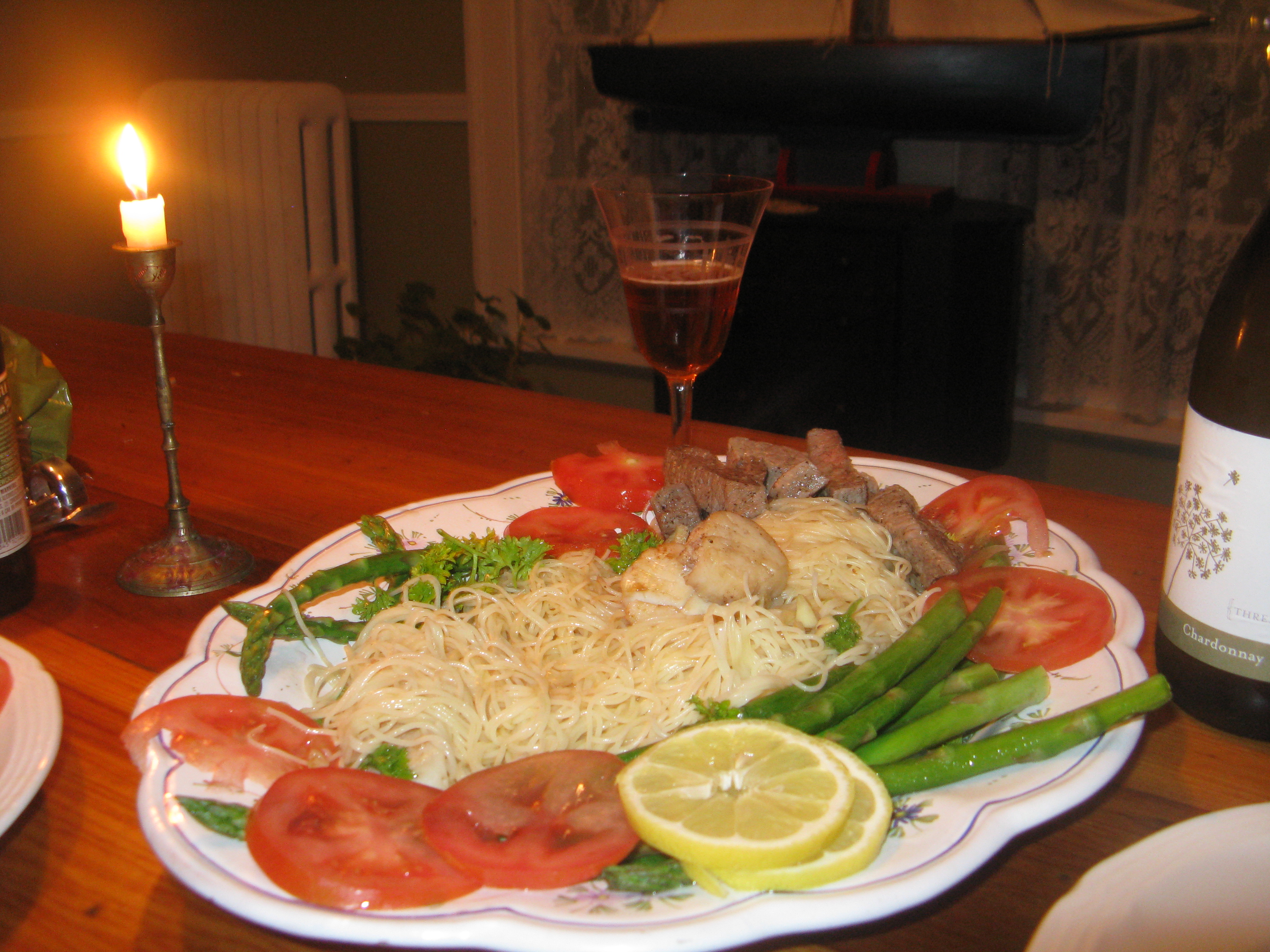
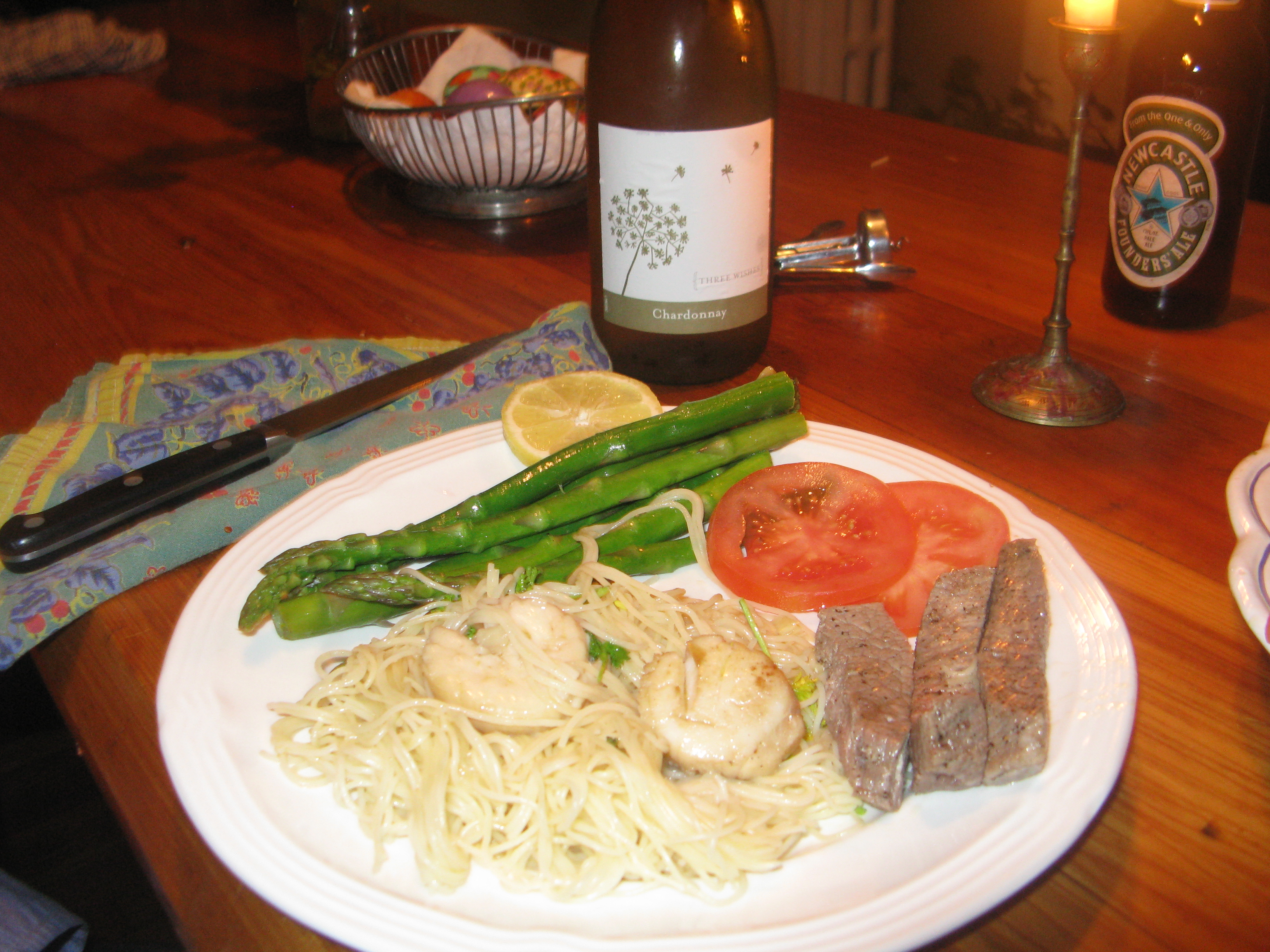
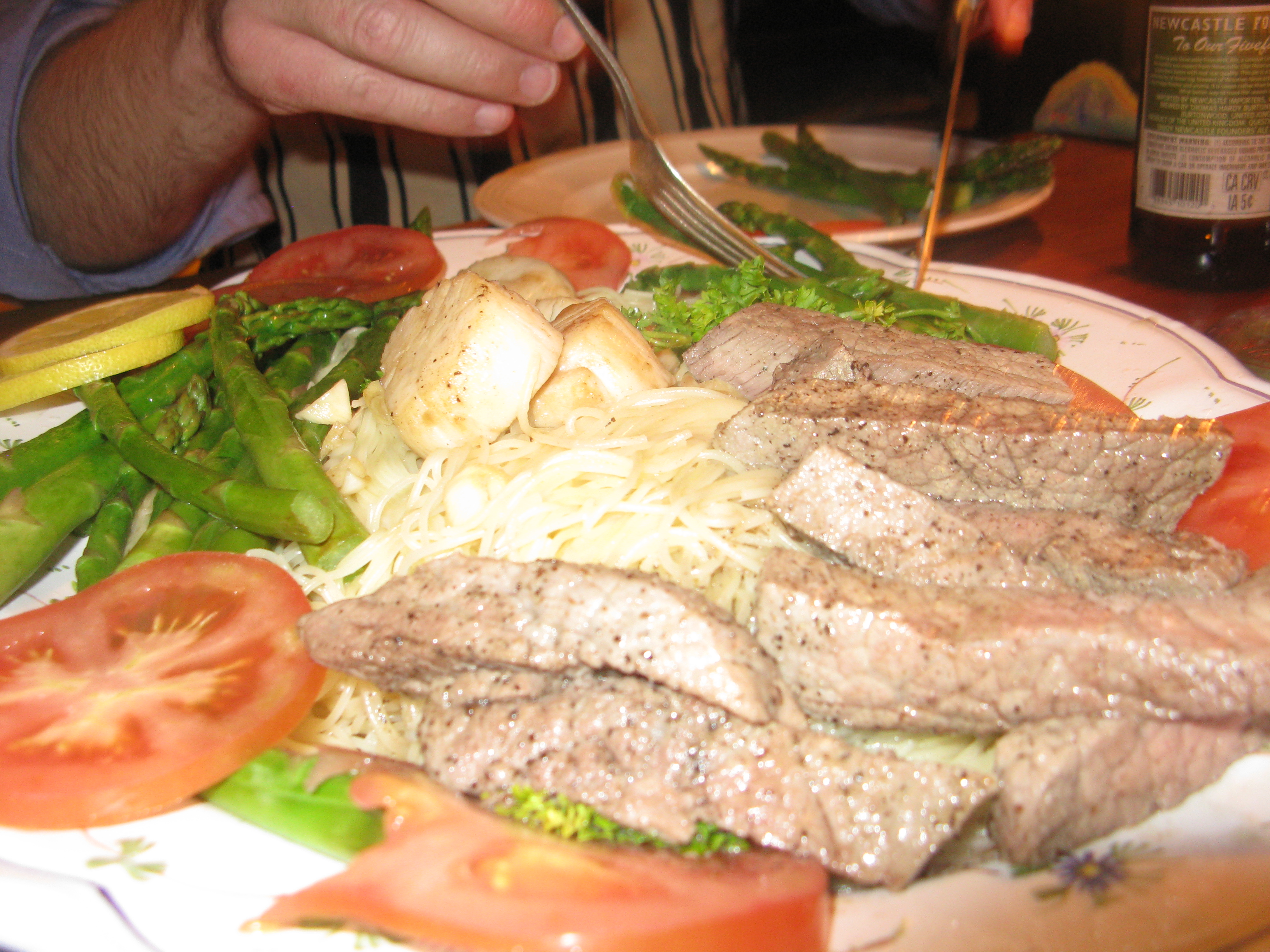
"Capellinini" with asparagus, scallops, lemon, fresh tomatoes, and a side of modest steak slices!

“Capellinini” with asparagus, scallops, lemon, fresh tomatoes, and a side of modest steak slices!

delicious


Well, here we are in the fourth week of the Easter season and I hope it never ends!

I was speaking with a good friend the other day in the church parking lot in Clinton, Massachusetts and we were talking about how a certain well known blogger, that both of us often read, is in the habit of blogging his own dinner creations.

I was laughing about it and jesting about what sort of person would do this. Imagine blogging one’s own dinner!

Well hopefully my friend will not see this-because here I am blogging my dinner.

The reason is simple. I made this dinner, and I think I really impressed my wife!

Fortunately, living close to the grocer, I first went hunting for a few scallops. After seeing the $19 per pound price tag, I told the  lady at the deli “I think I can afford four of those scallops.”

She understood the modest order very well, but did add that there were indeed some people who in fact “did buy scallops.” And by that I think she meant that there were people who actually bought whole pounds of scallops. Wow!

Then I found two small slices of “eye of round”  steak which I thought just looked scrumptious.

This is the season for asparagus so I have been eating as much of it as possible and was able to find a nicely packaged handful for $1.81. Great price!

As we all know, asparagus, like pasta (especially capellini!) has got to be watched with the closest attention if it is to be enjoyed as it should be. I love my asparagus just on the other side of crunchy. I guess “al dente” is the phrase- but I think that even that might be slightly overcooked and it loses its fresh flavor.

Fresh tomato slices are always a perfect compliment to a white pasta meal, but so are slices of fresh lemon.

My wife and I discovered the joys of a slice of fresh lemon squeezed on pasta while honeymooning in Bar Harbor. I remember admiring the brilliance of this idea – so simple, yet so powerful. I suppose any new culinary idea gains additional magic when it is discovered on one’s honeymoon.

But forgive me – this is getting a tad personal I suppose.

I did attempt to seal in the flavors of the eye of round steak by first giving them a good quick sizzle on the frying pan before placing them in the oven. But I think neither the frying pan nor the oven were quite hot enough to achieve what I was imagining. Nonetheless, although I was aiming for a rarer steak, I did manage to catch them at medium rare before all the flavor vanished completely.

The scallops were simply cooked with as much garlic as I could slice up in a minute, and butter and olive oil. Then I added some sherry which is the perfect compliment to scallops cooked in butter.

Whoever invented the idea of cooking with sherry was brilliant!

Served with chardonnay. Wonderful!


Posted in Dinner | Tagged , , , , | 6 Comments

What Would Socrates Do?

Well, someone at the Wall Street Journal is a reader of this blog. An excellent friend who is kind enough to share his subscription to the WSJ – even if slightly wrinkled, brought my attention to this.

Having read this inspiring piece about Socrates which I posted on April 6 about the man whom I think we might as well refer to as “Saint Socrates,”

The WSJ published this inspiring little book review  by Naomi Schaefer Riley on April 17.

Now let no one accuse me of making the mistake in logic known as “post hoc ergo propter hoc.” This is certainly a clear case of necessary cause and effect!

Ms. Riley reviews a book called the Art of Freedom by Earl Shorris the basic point of which appears to me to be that

Liberal Education Works. Liberal education is the solution to poverty. Liberal education is the solution to crime. Liberal education prevents murder.

In short next to Christianity itself Liberal Education is the answer to man’s woes!

This may be going a little farther than what Earl Shorris thought or Riley- but even if one divides the thesis by 2, one still comes out with a ringing endorsement of liberal education in combating the effects of original sin and advancing mans happiness! I need to get a copy of this book because this is exactly the way that I have always felt about liberal education.

Ms. Schaeffer writes about the project that Earl Shorris started which is known as the “Clemente Course in the Humanities“,

 In the classes he taught, he addressed his students with “Mr.” or “Ms.” He believed that a proper form of address conveys dignity and avoids the kind of casual relationship that most universities want their students and professors to have.

Absolutely true!

According to Riley, Earl Shorris began

with a class of 25 or so students found through a social-service agency in New York, Shorris—along with a few professors he had recruited—taught literature, art history and philosophy. The first classes included readings in Plato, Aristotle, Thucydides and Sophocles.

Excellent!

Liberal education is the right kind of education for everyone. In a Democratic Republic such as the one in which we are privileged to live here in the United States, liberal education ought to be imposed on the young before they are allowed to specialize in some career path (by young I mean up until the age of 21 or thereabouts)

Listen to this (and as a minor correction – we ought to substitute the phrase liberal education wherever we see the word humanities),

One way that the humanities can help the poor in particular, according to Shorris, is by making them more “political.” But, he writes, “I don’t mean ‘political’ in the sense of voting in an election, but in the way Pericles used the word: to mean activity with other people at every level, from the family to the neighborhood to the broader community to the city-state.” The humanities, he tells his first class, “are a foundation for getting along in the world, for thinking, for learning to reflect on the world instead of just reacting to whatever force is turned against you.”

Wonderful!

Posted in classical education, education, History, Liberal Arts, liberal education works, Socrates | Tagged , , , | 1 Comment

Pious Aeneas..Hey! Hey! Hey!

A certain young lady that I know is intending to write a paper on, “Whether Aeneas is Pious?” I think this is a splendid topic and have been struggling with just why I think it is a splendid topic.

Here is the struggle:

On the one hand it seems perfectly obvious that Aeneas is Pious because one might say that his piety is a premiss upon which the Aeneid based. Every couple hundred lines Virgil makes certain to remind us that Aeneas is pious by simply using the word as an epithet

Praecipue pius Aeneas nunc acris Oronti,
 nunc Amyci casum gemit et crudelia secum
 fata Lyci, fortemque Gyan, fortemque Cloanthum.

“Pius Aeneas especially groans now for keen Orontes, now for the fallen Amycus ….”

To draw a parallel with the Iliad, one would not ask “whether Achilles was wrathful?” If Achilles was not wrathful then the whole Iliad just kind of melts away into a little green pool of ooze, sort of like the way that the wicked witch of the west melted in The Wizard of Oz.

On the other hand, piety is an important virtue when it comes to civilization and Aeneas is an important figure in civilization, because he is the iconic founder of the Roman civilization- which is among the greatest civilizations known to man (another premiss that we will not question!)

That piety is a fundamental virtue in the very founding and sustaining of any civilization needs a little discussion. We might even suggest that Virgil is indicating it as the chief virtue from which civilization is born.

Is piety in fact the chief virtue that gives rise to civilization? Arguably it is. Civilization appears to spring from a continuance of practices of our fathers and ancestors. We build upon those who came before us and thus traditions spring up and give rise to rituals and a sense of something beyond ourselves.

Perhaps other virtues are involved as well – but piety seems to be all wrapped up in  civilization and not just its founding but also its healthy continuance.  We might ask “whether a civilization can long endure should its citizens lose their piety?” Frightening question.

So given the importance of this virtue and the importance of the Roman civilization (as a beacon of civilization for all) it is therefore significant to establish a clear idea of what piety is.

And Aeneas is also an important figurehead of this virtue insofar as he was a good old-fashioned pagan!

Christians might begin to think that important virtues like piety only come through baptism and no real virtue is possible without supernatural grace. Christians should not confuse what belongs to nature with what belongs to grace. And so Aeneas might be thought of as someone who represents what is possible by nature. He is a very important example for Christians.

But is he? In other words does Aeneas live up to a Christian idea of piety? Or does he show us how flawed human nature is without Christ? Is he Pious? Is piety even possible without Christ?

I have a hunch that many of my friends will say “No! Piety is not possible without Christ! There is no true piety without Christianity!”

and therefore it would seem to follow that “Civilization is not possible without Christianity,” although I don’t think  these same friends would feel comfortable saying this especially from a historical standpoint.

And to make matters worse, we as Christians tend to identify the pious man with the holy man. But Aeneas does seem to involve himself in various situations which do not seem holy. One …Dido! Two…his apparently unmerciful stance towards poor Turnus!

But Saint Gregory says that

“piety fills the inmost recesses of the heart with works of mercy” 

Hence the struggle. Was Aeneas Pious?

Important question?


Posted in classical education, Literature | Tagged , , , , | 10 Comments

A Third Reason Why Philosophy is The Best and Most Noble Music

Let’s see if we can make this argument quickly and effectively!

We have given two reason why Socrates said that “Philosophy Is The Best And Most Noble Music.”

We now present a third. Maybe there are more than three? But Three is enough!

Philosophy is the best and most noble music in so far as the purpose of music is to aid man in bringing his soul into harmony with reason. But this is what philosophy aims at in a higher and even more sublime way!

Therefore in comparison with music Philosophy might be said to be “the best and most noble music.”

Music like the other fine arts aims at a catharsis of the passions, as Aristotle points out specifically about Drama in his Poetics. The fine arts are various arts by which we are able to make our senses and imagination and the passions more reasonable.

Music has an obvious relationship to our passions. And so it is very easy to see that when we listen to beautiful music we are bringing at least part of our interior life into a more orderly and reasonable state.

But isn’t it obvious that this is what the philosopher aims to achieve?

We could probably do a better job making this reason clearer- but let’s avoid pedantry, for a change, and be done with it!

Thus our three reasons are:

  1. Philosophy really knows nature whereas music only imitates it (imitation being loosely a sort of “knowing”)
  2. Philosophy brings our souls into harmony with the truth. It brings the whole of our interior life into agreement with itself and with God whereas music brings about a harmony of sound.
  3. Philosophy aims to perfect man by bringing his whole soul into the service of reason whereas music aims more specific at bringing mans passions into the service of reason.

 Philosophy is The Best and Most Noble Music.


Posted in classical education, Music, Seven Fine Arts, Socrates | Tagged , , , | Leave a comment

ὡς φιλοσοφίας μὲν οὔσης μεγίστης μουσικῆς

Well, its time to give one more reason to support Socrates when he said that

Philosophy Is The Best And Most Noble Music

Otherwise I might forget it and then where will we be?

As we mentioned, one reason that “Philosophy Is The Best And Most Noble Music” stems from what a fine art is.

The fine arts imitate nature.  Whereas Philosophy does something that is even more than this- it does not just imitate nature, it knows nature! Therefore, comparatively speaking, philosophy is  “the best music.”

Here is a second reason:

Philosophy Is The Best And Most Noble Music (which seems to be a kind of free translation of “ὡς φιλοσοφίας μὲν οὔσης μεγίστης μουσικῆς”) because of what music is.

Another word for music is harmony. And harmony refers to, if nothing else, the bringing together in pleasant agreement various and different sounds.

Now don’t quote me here if it matters, because I did not look the word up. I am merely defining the word from my own experience. To harmonize means to make agreeable sounds. To blend notes such that when heard together one hears “agreement.”

Thus to make harmony (or music) means to make agreement.

The agreement might be between one note and the next in a melody (horizontally), and the agreement could be between all the notes among the chords (vertically).  Or both hopefully.

The point is that to make music mean to make agreement!

Now do you see how Music is like philosophy? Socrates devoted a life time to talking with people in an attempt to bring them to an interior agreement.

The dialogues are all example of this.

Someone claims to know something. Socrates of course, always interested in learning, engages him in a discussion in which Socrates “tests” whether the claim to knowledge is really authentic.

In most cases Socrates discovers that those who claim to know something do not in fact know what they claimed. And Socrates attempts, with patience and charity, to show each of these pretenders to knowledge that they really don’t know what they claimed.

How do you show someone who falsely claims to know something that he doesn’t know?

The best way to do this, as Socrates teaches us, is to show a person that if he asserts one thing which contradicts other things about which he is more certain, then the assertion cannot be true.

In other words, if someone has the truth then  all of his ideas must be in agreement with one another.

With the truth all things harmonize. With the truth all things are in harmony. With truth there is Music!

And so what could be clearer?

Music is the art which brings various sounds into harmony or agreement, Philosophy is the science in which all of ones ideas and thoughts are brought into harmony; the method by which the entire intellectual life of man is brought into a beautiful agreement.

Therefore Philosophy, as Socrates maintains, is the best and most noble music!


Posted in classical education, education, Socrates | Tagged , , | Leave a comment

The First Reason Why Philosophy Is The Best And Noblest Music

The first reason why philosophy is the best and noblest music is taken from what music shares with all the fine arts but has in a preeminent degree. All the fine arts are works of reason. (I prefer to say that they are discoveries by reason instead of products of reason.)

In other words the fine arts imitate nature. They are not mental constructs as say “Lobachevskian Geometry.”

Image result for lobachevsky

Doesn’t Lobachevsky look kind of haunted?

Датотека:Sferni-trougao.gif

 An equilateral triangle with three right angles…NOT!

The fine arts imitate the order in nature, they do not attempt to impose some new kind of order. Perhaps the works of science fiction might be thought of as impositions of man’s imagination upon nature- or against nature, but the fine artist finds beauty in bringing out the order that is already in nature and making it even more manifest to our senses.Image result for carl schmitt eggs painterMy wife’s grandfather (the “American Painter” Carl Schmitt) knew about the order in things – especially eggs!
The point here is that the fine arts are works or discoveries of reason that bring forth the order that is in nature. It is not the job of the fine arts to be “creative” as if the order that man creates is something that merits to be called divinely inspired. The fine arts are gifts of the muses to man- not gifts of one man to another. This is why the fine arts are able to uplift men. They stem from principles which are above man and therefore have the capacity to lift man above himself.

But music is preeminent among all the fine arts as a work of reason that is orderly and imitative of the order that is in nature.

This is easy to see if one considers that among the fine arts (e.g. sculpting, dancing, painting, architecture, etc) music is the art which is most directly related to mathematics.

This is not to say that the other arts, like architecture which is obviously related very directly to Geometry, are not related to mathematics. I am merely asserting that music is the art which is most directly related to mathematics. The very sounds that produce music are all products of various mathematical ratios like the octave and the fifth as the immortal Pythagoras discovered. And of course the tempo and rhythm are obviously governed by mathematical principles as well.

The fact that music is the most imitative of the mathematical order that reason knows, is certainly a reason why music is the only fine art that made its way into the sacred seven liberal arts of the quadrivium and the Trivium.

Now Mathematics itself is a beginning part of philosophy and the study of mathematics is necessary for anyone who would want to pursue philosophy.

But the point here is that Music is a work or discovery of man’s reason about the order in the world. (albeit the particular order that is found in man’s soul especially with regard to his passions)

This is also, loosely speaking  a definition of philosophy. Philosophy if nothing else is a work of man’s reason in its attempt to know the various orders that are found in the world.

So – and again not trying to be too strict here – the last two sentences amount to two premisses in a syllogism the result of which is that

Philosophy is Music or  Music is Philosophy.

But the art of music does not really know the order that it imitates. Imitation is, broadly speaking, a sort of knowing – but it is not knowing in the strict sense of knowing. So given the fact that philosophy aims at really knowing we might say that Philosophy is better than music in this regard – and perhaps even say that “Philosophy is the best music.”

And whereas Music attempts to imitate the passions individually as they exist in the souls of men, philosophy attempts to know the passions. Philosophy knows what the passions are with precision and it knows their excesses and defects. And finally philosophy knows how many passions there are and how they relate to one another as well as how the passions relate to man himself and his final end.

Therefore we might agree with Socrates that Philosophy is Music and it might very well be figured under the name of music especially if we call philosophy the best and most noble music.

That is the first reason but I like the next two reasons even more!

Posted in education, Liberal Arts, Seven Fine Arts | Tagged , , , | 3 Comments

“The noblest and best music”

In light of the prior post we really can’t avoid asking the question “for what reasons did Socrates say that philosophy is the noblest and best of music?”

As readers of the Phaedo are aware Socrates was alluding to the recurring dream that he had in which he was exhorted to

“Make and cultivate music”

(What a man!)

and as he himself explains he took this message as a clear command by the muse, or God, that he should devote his life to philosophy.

Now in endeavoring to answer this question I am taking it for granted that:

  1. Everyone wants to be like Socrates. Socrates is an example of holiness and virtue. He is an especially admirable example of virtue with regard to the extent that a man who does not have the advantages of Christianity is able to achieve any virtue at all!
  2. Socrates is to some extent comparable to Christ insofar as he was put to death for teaching the truth. He was a “martyr” for the truth.
  3. Everything that Socrates said was profoundly wise and therefore, we, who all want to be just like him, should spend a great deal of time in our short lives trying to figure out what he said.
  4. It is also an excellent question to ask for all who are concerned with the liberal education of the young. Because really when you get down to the nub of things, we would all be very, very happy if the sum total of all of our efforts resulted in a student saying some thing like

“I just love Socrates!”

or

“when I grow up I want to be just like Socrates!”

(Homo sedens fit sapiens!)

As a matter of fact I personally take great delight if perchance once in a great while a student might say “Mr Langley, you are just like Socrates!”

When I hear something like this, or even something vaguely approximating this sentiment within a million miles of the mark – I feel so good all over. A tear pops out of my eye and I feel warm fuzzies swimming all over my whole body!

What teacher would not love, no matter how remotely, to be compared to Socrates?

Therefore this question has profound relevance to the mission of this blog which is about “classical education and the formation of Catholic liberally educated ladies and gentlemen.”

I don’t think it is necessary to justify any further why we need to investigate what Socrates meant when he compared philosophy to music.

So what did he mean? Are there many reasons for what he said or maybe just one good reason?  What if instead of music, the dream alluded to painting – Socrates make and cultivate beautiful paintings!” or “Socrates, make and cultivate beautiful sculptures”

Or is music specifically and specially suited as an excellent symbol or likeness or metaphor for philosophy?

Why is music so suitable as a sign of philosophy?

I can think of at least three reasons…

Posted in classical education, education | Tagged , | Leave a comment