What man is there who doesn’t want to “weigh anchor” and find his natural freedom over the water… like the Spirit that “Hovered over the waters?” Now I am not saying that the Holy Spirit was hovering in an Inagua Sharpie – but He was hovering over the water- and I intend to do my best to do just the same.
If you don’t have this desire you need to read more Belloc (time to put down the Chesterton!) and read his essay “Weighing Anchor!”
And getting in touch with water is fundamental. After all water is a very excellent and reasonable guess about the origin of all things. The great Thales was the one who first proposed this. No wonder then that every man has a desire to sail.
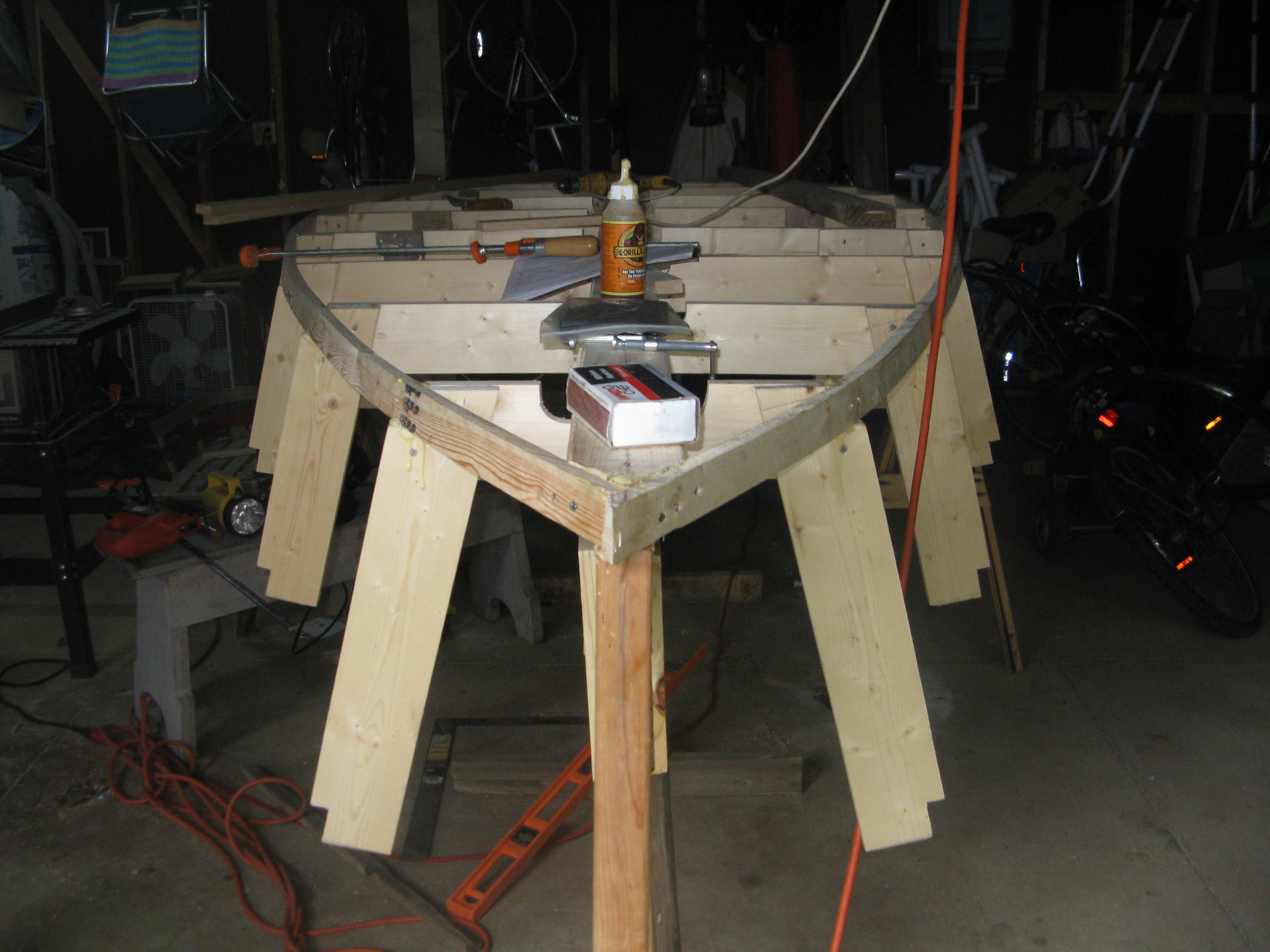
To that end we Langleys have been busy constructing a fourteen foot “Inagua Sharpie”
Front view. Sheer clamps attached!
That bottle of Gorrila Glue is a little unsettling
Well…I always argue that a neat and tidy workspace is essential for boat construction
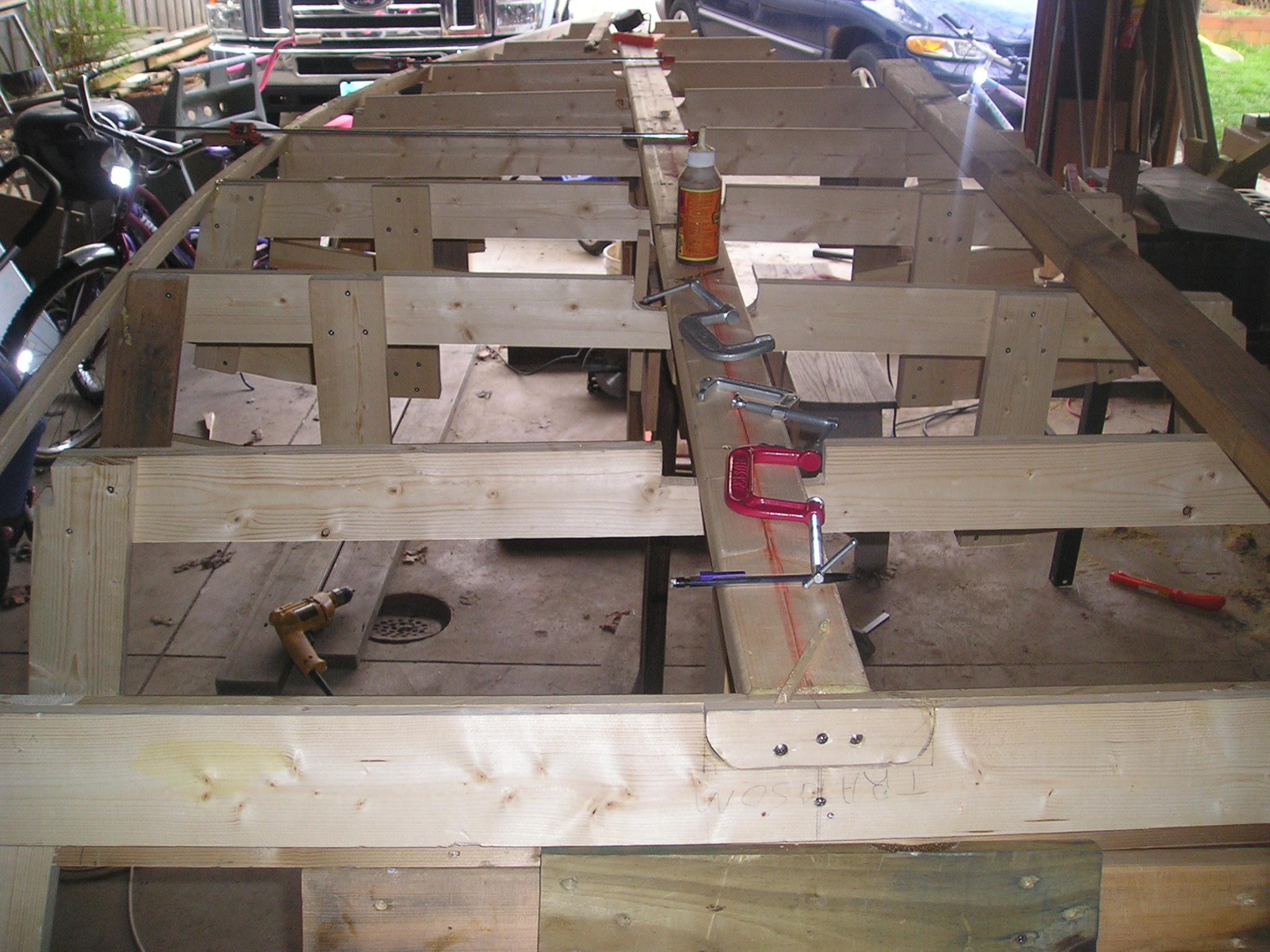
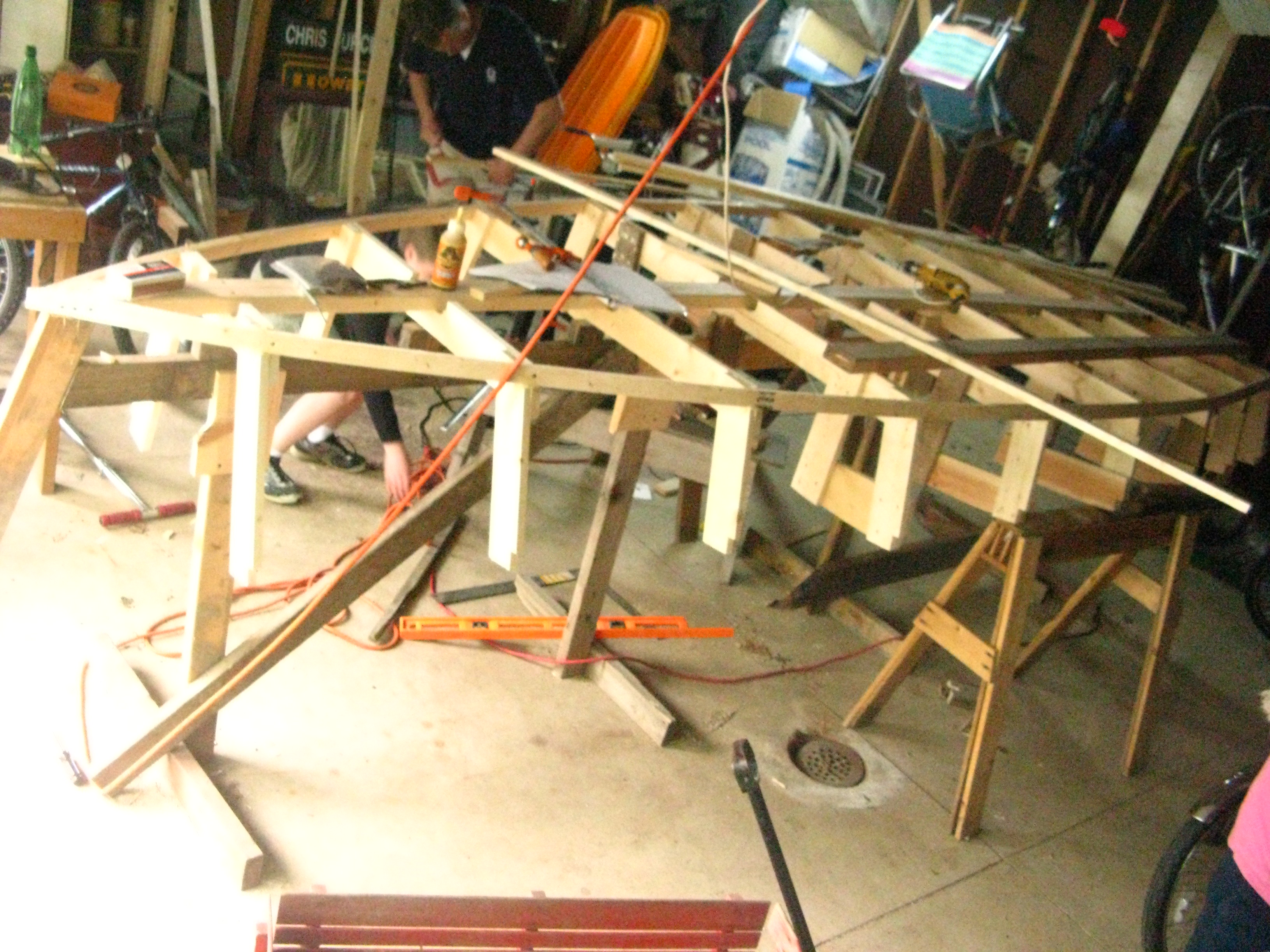
I need to attach the “chine logs” now, which are the longitudinal “elements” that run parallel to the sheer clamps. As you can see the “boat” is upside down on top of a very shaky “strong back jig.” The strong back jig is the very first thing one makes, of course, when building a boat. But one really has to pay attention to the name – because the tendency of the sometimes-boat-builder is to say things like “there… that will do” Or “I guess that will hold” or “this is good enough.” But then the thing begins to take shape and weight is added bit by bit incrementally and voila!… the thing is 200 pounds and one thinks “if only I had made the “strong back jig” a little stronger!
I need to start thinking about a mast. If anyone has a ten or eleven foot long laminated mahogany cylindrical pole about 3 inches in diameter let me know.
In his essay entitled “An Essay Concerning Human Understanding” John Locke, the seventeenth century English “enlightenment” thinker who had vast influence on other thinkers like Voltaire and Rousseau and of course on the American Revolutionaries like Samuel Adams, James Otis and Thomas Paine, said the following,
“For when we reflect on general ideas accurately and with care we’ll find that they are artifacts, contrivances of the mind, which have a lot of difficulty in them and don’t offer themselves as easily as we tend to think. For example, it requires some effort and skill to form the general idea of a triangle(though this isn’t one of the most abstract, comprehensive, and difficult), for it must be neither oblique nor rectangle, neither equilateral, equicrural, nor scalenon; but all and none of these at once. In effect, it is something imperfect, that cannot exist; an idea in which some parts of several different and inconsistent ideas are put together. The mind certainly needs such ideas, and hurries to get them as fast as it can, to make communication easier and to enlarge knowledge. But there is reason to suspect that abstract ideas are signs of our imperfection; and at least I have said enough to show that the most abstract and general ideas are not those that the mind is first and most easily acquainted with, nor what its earliest knowledge is about.” (Book IV, ch. 7, section 9)
In other words…he is saying that there is no such thing as abstractions. There are no universals. There is no such thing as a general idea.
Or rather…these things exist, but only as “contrivances” of the mind!
And why?
Well, as his own example concerning “the general idea of a triangle” illustrates, there is a slight problem. What exactly?
Let’s do a little Socratic dialogue to help make this clearer. We will pretend that Locke is teaching this idea to Langley.
Locke: Ok Langley, so you think that there is such thing as ‘the universal?’
Langley: Yes, I do.
Locke: Would you be so kind as to give me an example?
Langley: Yes, nothing would give me more pleasure Mr. Locke. I have always loved Euclid and so I can think of no universal idea more clearly than that of the triangle. The word triangle is of course a word that signifies the universal concept of a three sided plane figure.
Locke: Ahhhhh, I see. And so you evidently have an idea in your head about a triangle. It is not a specific triangle- but rather a triangle that has properties that every triangle shares? Is this why you call it a universal idea?
Langley: Well yes… quite so.
Locke: Yes, but perhaps you have not really considered this very carefully, my good friend.
Langley: Actually I have been thinking about triangles for as long as I can remember. I don’t see any problem whatsoever in claiming the existence of this universal idea.
Locke: Well let me ask you some questions about your supposedly universal triangle.
Langley: sure
Locke: Does every triangle have three sides?
Langley: Yes
Locke: And must every triangle be equilateral, isosceles, or scalene…or can a triangle be more than one of these at the same time?
Langley: uhhhh….err… would you be so kind as to repeat the question? I don’t quite see what you mean.
Locke: Well, must a triangle either have all its sides unequal, or two sides equal or all three sides equal? Or is it able to be all of these at the same time?
Langley: Well…no…any specific triangle must be one of the three.
Locke: In other words a triangle can’t be, for example, both scalene and equilateral at the same time?
Langley: Quite so…No it cannot.
Locke: Nor can any triangle have only two sides equal and at the same time have all three sides equal
Langley: quite true, quite true
Locke: So when you say that you have a universal idea of triangle… May I ask you which is it? Is your universal idea of a triangle equilateral, isosceles, or scalene?
Langley: Well….I don’t want to say…I mean, I guess it isn’t any one of those.
Locke: But you admitted before that every triangle must be one of the three, did you not?
Langley: Yes I did.
Locke: So which is it?
Langley: Well….I really cannot answer the question. Maybe we could change the subject. Did you hear about the IRS scandal?
Locke: Listen Langley… we need to stick to the question. We need to focus. We need to have intellectual perseverance. We need to follow the logic of the question to its inevitable conclusions!
Langley: Ok but what about the whole Benghazi affair?
Locke: Focus…think…one will never obtain wisdom if one lets his mind dwell on transient political affairs.
Langley: Ok, Ok…so what were you asking?
Locke: You were asserting that you have a universal idea of a triangle. You also admitted that every triangle must be either equilateral, isosceles or scalene- but it cannot be all three of these at once. You admitted that every triangle must have its sides disposed in only one of these ways at once. And so I ask you again… Which of the three is your universal idea? Is the universal idea of triangle equilateral , isosceles, or scalene?
Langley: Uhhhhhh… you know I don’t really get what you are saying and besides I just remembered that there is something that I have to do.
Locke: Maybe you were not cut out for philosophy?
Langley: Well maybe so…I actually was wondering if you know anything about plumbing. You see I have this stack pipe that appears to be a little on the leaky side….
As anyone can see from the above dialogue, Langley was simply no match for John Locke. Langley failed to defend the idea of the universal and so down it went in a flaming mess!
And along with the death of the universal, so died philosophy! So died Theology! So died the perfection of the intellect….and what is left?
When I first made the decision to become a teacher I don’t think I quite realized to just what extent that decision would focus and concentrate my daily thoughts upon one subject; I didn’t realize that the vast majority of my thoughts for the next twenty five years would be focused on schools, learning and education. I didn’t realize that this career choice would define most of my conscious experience…even after class was ended!
I suppose any career choice would have this effect. That is a little scary isn’t it?
In other words if one becomes a plumber, or a fishermen, or a farmer, or an electrician, or an accountant, then one chooses a life in which the majority of one’s day will be spent thinking about pipes, fish, pigs, wires and balances.
(I would love to be a plumber but I am not certain for just how long!)
(This would never appeal to me)
(I do like the idea of working the fields…imagine the satisfaction of growing this stack of potatoes! Not a single one of them knows what an ablative absolute is…but the again I have known some Latin III students who don’t either)
Do most young people realize this when they think about a career path? Do they realize that their career choice is not just a choice about how to spend 1/3 of each day, but will also define the majority of their thoughts for the rest of their professional life? I emphatically did not!
I can’t stop thinking about education; schools, curricula, the nature of students, the procedures, methods and goals of education. And what is amazing is that the subject never really gets exhausted. And every time a question is settled with one person, two or three others ask it again. It reminds me of that famous little scene in the Sorcerer’s Apprentice where Mickey Mouse smashes the misbehaving broom to smithereens, only to find out that the problem increases exponentially!
(broom smashing – go to about the 7th minute)
I will admit that one tends to have the same discussion again and again with people over the years.
And I don’t complain about this! It provides never-ending excitement. For example, one has to discuss every single class with every new parent. One has to engage in a never-ending defense of Latin and Greek. One has to talk all the time about the comparative merits of discussions as opposed to lectures, one has to talk about whether co-education is natural or whether the Church prefers to only educate boys and girls in isolation.
What is mathematics? What is science? What is the place of History and Literature? What are the so-called “humanities?” Are the so-called “humanities” the same thing as the liberal arts?
(Humanities…hmmmm….this seems a little sketchy….I don’t see Algebra and Calculus or Chemistry and Newtonian Physics anywhere in this list….aren’t these also included in “the things that man has done.”)
What about athletics? What about technology? What about the computer lab? What about textbooks as opposed to original texts?
Should every student study what he wants? Or should everyone be compelled to study the same things? Does education mean one thing or many things?
What role do living languages play in education and what about standardized testing? How about AP, IB, and honors courses?
What makes a good teacher? What is a good class? Should a teacher cover things deeply and slowly or should he cover wide swaths of material superficially? Should he focus on the ancient or the new? Or both? Should a teacher attempt to be funny and entertaining…or should he try to teach mental discipline and attention with due gravitas?
What should the goal of a high school be? Is it the same as the goal of a college?
Are boarding schools against nature? When might a parent send a student away from the home? How much of a financial sacrifice should a parent be ready to make for the education of his child?
What about a Catholic high school? Should students be compelled to go to Mass everyday. Should there be a daily rosary? Should classes begin and end with a prayer? Should everyone be required to take a Religion or Theology course?
what should a school dress code should require!
Should there be economics classes? Should there be sewing and home economics classes. How about shop?
Is education at home more ideal than at a school?
What does it mean to say a parent is the primary educator?
Are schools even natural?
These are just a few questions and I expect to be thinking about them for the rest of my life just as I have up to this point. None of these questions ever gets answered once and for all for everyone.
Unlike the question of the earth’s rotundity which appears to be pretty well settled (as much as I try to raise it every year with my seventh graders), all of the questions above appear to belong to education itself and no person can be educated on behalf of everyone else. Each one must ask the question and find an answer.
In other words, I do not say that these questions do not have clear answers. I will not even pretend to be humble here by claiming that I don’t know some, many or all of them.
For example, it is perfectly obvious to me that every last human being on earthshould study Latin insofar as he is able.
Nonetheless, I continue to meet people all the time for whom this answer does not appear so obvious. As a matter of fact, disagreement continues to exist about this question as if, like the earth’s rotundity, the answer to it had not been established long, long ago.
But I suppose I have strayed considerably from the original point which is this:
One will tend to spend the vast majority of his thinking life considering questions that relate directly to his chosen profession.
Last Saturday I attended my daughter’s graduation from Thomas Aquinas College. The campus is beautiful, the weather perfect, the people are smart, wholesome, good and everyone is beautiful for some reason. Maybe the soul really is the substantial form of the body!
I am kicking myself for not taking pictures. The science building was beautiful and contains a beautiful Foucault Pendulum in its atrium.
The college choir sang the well-known Hassler Mass which by now is sort of a TAC trademark. I haven’t seen a Novus Ordo Mass in Latin for quite a while, so that was thrilling as well.
The final hymn was set to the tune “I vow to thee my country” which you may hear for yourself:
That is an excellent hymn and just perfect for stirring hearts in the right way for a commencement.
The classrooms in the science building (St Albert’s Hall) were beautiful and contained excellent seminar tables (octagonal I think). I have always wanted to have a discussion around a real seminar table. We have improvised tables of our own at The Lyceum- but someday it would be nice to have real solid mahogany or oak oval tables that can seat anywhere between 12 to 19 people. That would be heaven!
The professors at the college are fantastic and one can’t help but to come away knowing that the mission of the college as envisioned by its founders is well-preserved and carried forward by many capable hands.
The weekend flew by too fast, but I was still able to see beautiful Malibu (my friend made certain to take the coastal route from the airport to Ojai where he also “put me up”). Friday night we attended a little soiree at a “beach house” in Ventura after walking on the famous pier. Saturday night we returned to Ventura for some Thai food. Sunday afternoon and evening we enjoyed a six-eight course meal at the little “pad” of a tutor who is well known for his extravagant hospitality. (I don’t mean to imply excess here- just magnificence!) This dinner also included a single malt scotch tasting which was very instructive, and a “once in a life time experience” – since several of the scotches simply are not produced anymore. That is the way with single malt scotch production, as I have come to understand. There are roughly 100 distilleries in Scotland of which this or that one may cease production – of which my friend possessed several bottles – among his very large collection of those which are still producing)
Needless to say – if one intends to become a single malt scotch connoisseur one will need to become an expert with this map.
The whole weekend reminded me a bit of what St Thomas Aquinas says might be understood of a “long life” when he talks about the rewards for those who obey the fourth commandment. Sometimes a pious person does not live that long in years- but, as St Thomas says, if we understand “a long life” in the sense of a ‘full life’ we might say that saints such as Dominic Savio and Maria Goretti lived long lives.
So even though the weekend was short temporally speaking- it was about the fullest three days I have spent in the last ten years!
Classical Education is all about providing students with a good beginning; most especially a good beginning in the intellectual life; a good beginning with regard to the mind of the student in its encounter with the various orders that God created; a good beginning in viewing the things that exist.
In other words classical education attempts to enable students to view the world in which they live with truth. Truth is supposed to indicate some kind of “conformity of the mind with things,” and so classical education attempts to help students to obtain this conformity.
Now, believe it or not, one of the first things that we want to know about anything is:
is it one or many?
This is such an obvious question that we have about things that we sometimes forget that it is one of the first things that we have to know.
Take for example a giraffe. All of us instinctively recognize a substantial unity when we see a giraffe. We think about the giraffe or the elephant or the horse as being something like ourselves…they are all individual substances. They are all beings that appear to amount to something more than just a collection of their individual parts.
We instinctively recognize a oneness in these animals that we associate with the oneness in our own selves. When we look at the individual parts of a giraffe we do not think that they all exist as distinct parts which are heaped together in one place. No, we think about all the parts of the giraffe as being parts of only one thing that exists substantially, namely the giraffe. So the giraffe’s ears, for example, are not independently existing substantial realities. But the giraffe is an independent existing substantial reality.
Maybe the phrase “independent existing substantial reality” is overkill. I am only trying to signify what I mean by “substance.”
So one could say that whereas the giraffe is a substance, the giraffe’s ears are not substances.
But increasingly through the magical thing we call education, we teachers accomplish a thing in the minds of our students. We manage to convince them that one by one the things that they considered as substantial unities are really nothing more than a collection of parts.
So for example, little children think about something as simple as water, as being just that …simple as water. Simple means not complex. Complex means composed of parts. Simple means not composed. Ergo water, for children is something un-composed!
But voila! After a few years in school water is no longer a single simple substance. No it is a mere heap of individually existing atoms, two hydrogen and one oxygen.
And a molecule of water is supposedly not like a giraffe because the three atoms are supposedly existing in the molecule much like three stones in a pile. The stones all have as independent and actual existence as does the pile.
After a few years of school we enable students to see everything through a new kind of vision which shatters their former “illusions” about the substantial unity of things.
Everything that exists in the physical world and even the mathematical world has lost their individual unities. Lines are now made up of independently existing actual points. White Light is made up of an individually existing actual panalopy of other colors. Each individual thing is made up of the individually existing smaller parts into which it can be broken.
In other words after a few years of school we are able to graduate students who can say
everything that exists has no more unity than an army or a brick wall has.
But armies and brick walls only have unity in an accidental sense. An army is not a substance. A brick wall is not a substance. These are both excellent examples of things which we say are accidental unities.
And so when God created light he said
“Let there be an accidental unity composed of all of the individually and actually existing colors in the spectra”
and when He created water he said
“Let there be another accidental unity which has no independent existence that is anything beyond the individual parts out of which it is composed”
And both of these things were not very difficult to make because He, of course, had the various parts out of which they were composed already! and really therefore, these things were nothing new.
As a matter of fact His creating light and water was strictly speaking not a creation because, whereas creation means to produce out of nothing, He only had to compose them out of things which already existed presumably, namely the individual pre-existing atoms of hydrogen and oxygen. Unless of course one thinks that in creating water he created hydrogen and oxygen. I haven’t checked recently- but I think water already existed and isn’t there some hydrogen in water?
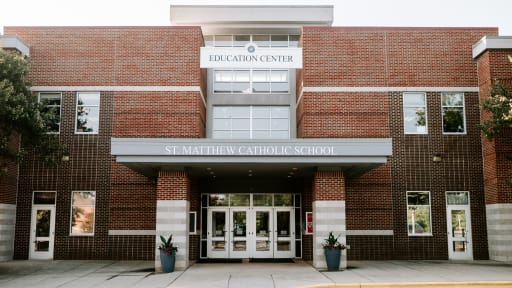
At some point one begins to wonder what the real difference is between the education offered at the prestigious $25,000+ per year private school and the conventional garden variety public school?
Garden Variety Public School
Prestigious Private School
Or for that matter, what is the difference between the education offered at the conventional $10,000- $15,000 Catholic school and the conventional free public school? (even though “free” still means that each student is being educated at around $10,000-$16,000 depending on the location)
Catholic School
And we might as well ask the third question, what is the difference between the education offered at the typical $10,000-$15,000 Catholic school and the school that offers a Catholic Classical Education for less than all of the above?
Let’s cut to the chase. With the exception of the latter type school (i.e. the school that offers a Catholic Classical education – which is really just “code” for a liberal education), the mathematics curriculum at all these schools is really just the same curriculum. Whether Pre-Algebra, Algebra or Calculus it doesn’t – it’s all the same…right?
Whether one attends Philips Exeter or the public school in Little Rock Arkansas, the Science curriculum is essentially the same. Biology Chemistry and Physics…the same material, the same approach, the same presentation sprung from the current intellectual fashion.
The Literature and composition curricula are the same as well. Sure there might be slight differences between the books read. This school might read Brave New World,Animal Farm, and Nineteen Eighty-Four, whereas that school reads Grapes of Wrath, The Great Gatsby and Lord of The Flies. It’s all the same isn’t it?
Sure, maybe the facilities are nicer at the fancy private school. Maybe, at the private school, the teachers all have Ph.Ds. Maybe the textbooks are the latest edition. But the fundamental ideas and philosophy that governs the curricula at nearly every school is exactly the same!
Doesn’t the conventional Catholic school teach the same Mathematics, Physics, Biology, and Chemistry as the public school? Sure, a Catholic school might attempt to teach Chemistry Biology and Physics with the additional
But I think that you will agree that there is no difference between any school except perhaps in the degree to which the same (monolithic) curriculum is executed.
Sure…maybe a Catholic school offers an occasional prayer at the beginning of the day. Does the school become Catholic because of a prayer or a Mass which the students are forced to attend?
You might be saying
“well what is wrong with that? Surely it is worth while sending my children to an expensive private school if the teachers are Catholic … even if the curriculum is the same.”
Or perhaps you admit that the curricula at every school is fundamentally the same but,
“what makes the biggest difference is the social setting in which one places one children.”
After all, given the fact that every school’s curriculum is governed by a philosophy of utilitarianism, one’s children will be more successful if they are placed in an environment which allows greater exposure to other children from families that are successful.
Or perhaps someone will say,
“Although Catholic schools offer the same curriculum as other schools, although the vision of reality as it is presented through the Mathematics and Science curricula is exactly the same (after all- facts and the “laws of nature” do not change), it makes a big difference that the students also take a religion course.”
And so a Catholic school is the same thing as a public school except that it has a Catholic “veneer” spread over the top of what is fundamentally the same curriculum.
But you say,
“The phrase “Catholic veneer” is going too far! What is up with you Langley!?!”
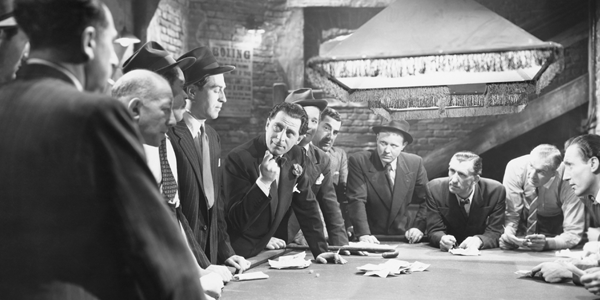
But really, what is the difference in educational philosophy? I would suggest there is none. The current educational philosophy that governs everything that is taught and how it is taught is the same everywhere and is dictated on high by the educational elite – probably in some secret back room.
Secret Back Room
Classical education presents an alternative… but not a very popular one!
In his Poetics, Aristotle asserts that the poet does something that is actually more scientific than the historian. This is rather a shock to us who live in a time whose intellectual fashion compels us to think just the reverse. Although not a “hard science,” history is thought to be something of a science. After all, history is thought to deal with facts and “data” just like science. It is thought to have rigorous scientific methods for establishing its conclusions just like science. History also takes much of its evidence from other fields of study which appear to be “sciences,” like Archeology and Geology.
Nonetheless, hear this:
The poet and the historian differ not by writing in verse or in prose. The work of Herodotus might be put into verse, and it would still be a species of history, with meter no less than without it. The true difference is that one relates what has happened, the other what may happen. Poetry, therefore, is a more philosophical and a higher thing than history: for poetry tends to express the universal, history the particular. By the universal I mean how a person of a certain type on occasion speak or act, according to the law of probability or necessity; and it is this universality at which poetry aims in the names she attaches to the personages. The particular is- for example- what Alcibiades did or suffered.(Bk. I Chapter IX Poetics)
In other words the characters about which we read in the works of poetry think, speak and behave in a way which is far more predictable according to the laws of human behavior than do the characters in history. This also applies to the events in history. One appears to be hardly able to trace any sort of necessary cause and effect relation between the way a battle ought to go and the way it actually goes. History affords us with countless examples of events that appear to have occurred randomly and even against our expectations- whereas the thoughts and deeds of Lucie Manette in Dickens’ A Tale of Two Cities are entirely predictable from beginning to end.
The lovely Lucie Manette…and her crazed father.
This is a good way to start thinking about what Aristotle means… Let us pursue this a little farther…later.
And I shall tell thee another thing. There is no substance of any of all the things that perish, nor any cessation for them of baneful death. They are only a mingling and interchange of what has been mingled. Substance is but a name given to these things by men. R. P. 165.
So wrote the fifth century B.C. Empedocles in the beautiful Sicilian city of Agrigentum.
Beautiful Agrigentum!
Of all that “comes to be” or “perishes” there is really only a mingling of things and an unmingling of things.
Hydrogen and oxygen come together in different proportions and we cry out “Ahhh… water has been born!”
We throw a little party and make celebratory toasts.
And then you, through a process of electrolysis, separate the various components until not a drop of water is left but instead we have various containers of hydrogen and oxygen.
I cry out “Alas…woe…water is dead!”
But you say “No, no, no…you have no far reaching mind Langley, you fool!…there is no death here, but what you have observed is a mere separation of what was always actually there in the first place”
“There is only a mixture and a separation. But no substance perishes! There is no death of substance because there is no such thing as substance among the things that perish or come to be! All of the original substances are still intact but merely separated!”
And as I dry my tears you continue,
“It is as ridiculous to throw a party, and celebrate, when everlasting substances (such as oxygen, carbon, hydrogen, nitrogen, calcium, and phosphorus) come together to make a new human person- as it is to weep and cry and mourn and have a funeral when these substances separate.”
“After all….birth and death are nothing other than a mixing and un-mixing of things that never die!”
“Don’t get so emotional about things which are nothing other than mere geographical arrangements!”
Ahhh… Empedocles…thank you!
But they, when these have been mixed in a way suited to men or to the race of wild beasts or to bushes or birds of prey, say then that this has been born; and when these have been separated, they call it wretched death. They do not name these things rightly, but I also follow the custom. (Empedocles, DK 9)
Fools. For they have no far reaching minds who think that what before was not comes to be or that anything dies and is destroyed utterly in every way. (Empedocles, DK 11)




 Secret Back Room




 Classical Catholic Education