Want a Job at Google? Get a Liberal Education!

All of us over here at Lion & Ox just love liberal education.

We think that liberal education is for everybody.

everybody

We think that the object of every primary and secondary school and college should be to offer a liberal education.

We think that the time for specialization is after a liberal education has been acquired. Therefore specialization should happen in graduate school or medical school or law school or any other technical school, but not before one has tried his best to acquire a liberal education.

But you say,

“yes that is a very nice idea, but unfortunately we live in a world where one needs to think practically. Liberal education is very nice indeed, but we all know that the best way to live, pragmatically speaking, the real path to success is through choosing a career early and focusing on that career doggedly from at least junior year in high-school. And for musicians one has to focus on music from the time that one is three!”

Well both the Lion and the OX are here to tell you that this is a narrow minded self defeating idea. We are ashamed of you for even saying such a thing. It makes me blush.

Didn’t you read this, and this, and this?!?

And besides Mr. Laszlo Bock, who is in charge of all hiring at Google does not agree with you!

Here is what Laszlo said about getting a job at Google, (April 19 2014 interview in the New York Times )

My belief is … that among 18- to 22-year-olds — or people returning to school years later — most don’t put enough thought into why they’re going, and what they want to get out of it…It’s a huge investment of time, effort and money and people should think “incredibly hard about what they’re getting in return.”

…the first thing Google looks for “is general cognitive ability — the ability to learn things and solve problems...a knowledge set that will be invaluable is the ability to understand and apply information — so, basic computer science skills. I’m not saying you have to be some terrific coder, but to just understand how [these] things work you have to be able to think in a formal and logical and structured way. But that kind of thinking doesn’t have to come from a computer science degree. I took statistics at business school, and it was transformative for my career. Analytical training gives you a skill set that differentiates you from most people in the labor market.”

…Humans are by nature creative beings, but not by nature logical, structured-thinking beings. Those are skills you have to learn. One of the things that makes people more effective is if you can do both. … If you’re great on both attributes, you’ll have a lot more options. If you have just one, that’s fine, too.” But a lot fewer people have this kind of structured thought process and creativity.

creative

cognitive

When Bock was asked “Are the liberal arts still important?” he replied,

They are phenomenally important…especially when you combine them with other disciplines.

Posted in liberal education works | Tagged , , | 3 Comments

Alleluia! In Resurrectione Tua

Happy Easter!

And here are two gifts for you in keeping with our annual Easter Sunday tradition!

First an exultation.

Second a great piece of Easter music for you to commence (or continue) the celebrations!

This is the day the Lord has made: all time and truth is God’s alone. Let heaven rejoice, let earth be glad, and praise surround high heaven’s throne. This is the day Christ rose from death; evil’s strong hold forever fell. This day the saints Christ’s triumph spread, and of the wonders all do tell. Hosanna in the highest strains Christians throughout the earth now raise. The highest heavens where Christ now reigns shall sing their glorious thanks and praise. (based on a hymn by Isaac Watts 1674-1748)

I love that.

Now  listen to this! (click on “short preview”)

Alleluia! In Resurrectione Tua

By Jacob Handl (1550-1591) Sung by the Cathedral singers conducted by Richard Proulx.

Alleluia! In resurrection tua Christe, Alleuia! Coelum et terra laetentur. Alleluia! Surrexit Dominus de sepulchro, Alleluia! Qui pro nobis pependit in ligno. Alleluia! Gari sunt discipuli viso Domino. Alleluia!

(2016 UPDATE: unfortunately these links no longer work! You will have to buy the CD. Fantastic! right here. In the mean time click on the sample “This is the Day” – buy this CD )

Posted in beauty | Tagged , , | Leave a comment

Life Has No Meaning?

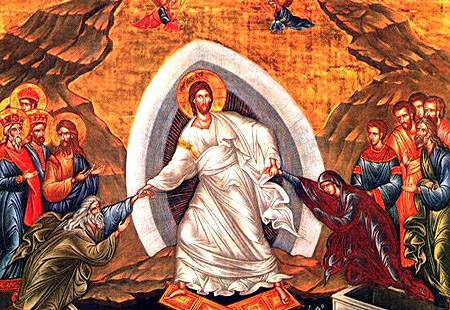
On Holy Saturday, between His death and Resurrection Our Lord is engaged in what the medievals called the “Harrowing of Hell.” He descended into the Netherworld and freed all those just souls from their captivity to whom the gates of heaven had heretofore been shut because of Adam’s sin. This is the time when I imagine that Euclid, Socrates, and Aristotle issued forth in triumph following in the train led by Adam and Eve, Isaiah and Ezekiel, Moses and David, Job, Ruth and Naomi, Sarah and Hannah, all the prophets and patriarchs,  Esther, Judith, and all the saints of the Old Testament. They all came forth out of the outer rings of Hell in triumph.

That is what we commemorate today.

Let us engage in our own descent, and at the risk of the taunts of those who will accuse us of descending from the sublime to the ridiculous, let us march straight down into the hell of the printed word; let us descend into the depths of the New York Times; yea, even into its very heart the opinion pages!

And what do we find there?

In an Op-Ed piece written on March 14th, 2014 written by on Ferris Jabr entitled “Why Nothing is Truly Alive” we find that life has no meaning!

Well that does it. Cancel my subscription. Up to this point I was still clinging to the question that has stumped just about everybody in the modern world, everyone, that is, who has heretofore turned their hopeful gaze towards The Old Grey Lady for a meaningful answer to the question “does life have meaning?!?”

One would think that if its readers took this paper seriously, this article alone would have been the death knell.

Fortunately for the Times, however, the paper can commit an occasional act of intellectual suicide from time to time, sustained by the fact that for its editors, in all probability, there is no truth. And so it doesn’t really matter what one prints for the entire world to see.

Nonetheless, for the classical educator, Mr Jabr’s thoughts afford an excellent exemplification of a point that I continually try to impress upon my students.

Classical Education makes a difference.

What is the difference?

A life and death difference, or at least a Life has meaning and life has no meaning difference.

Interestingly Mr. Jabr bases his argument upon the pure Kantian priniciple that we cannot know things. Or rather the ideas that we have in our head about things amount to mental categories which we impose upon things. Jabr writes,

 Sometimes the brain creates a representation of a thing: light bounces off a pine tree and into our eyes; molecules waft from its needles and ping neurons in our nose; the brain instantly weaves together these sensations with our memories to create a mental model of that tree. Other times the brain develops a pure concept based on observations — a useful way of thinking about the world. Our idealized notion of “a tree” is a pure concept. There is no such thing as “a tree” in the world outside the mind. Rather, there are billions of individual plants we have collectively named trees. You might think botanists have a precise unfailing definition of a tree — they don’t. Sometimes it’s really difficult to say whether a plant is a tree or shrub because “tree” and “shrub” are not properties intrinsic to plants — they are ideas we impinged on them.

This amounts to a sort of nominalism. The names we have for things are useful categories but do not stand for any thing real outside the mind.

There is no such thing as “a tree” in the world outside the mind.

Proceeding from this fundamental but significant confusion about our knowledge, Mr. Jabr then proceeds to say that there is no such thing as life either.

Likewise, “life” is an idea. We find it useful to think of some things as alive and others as inanimate, but this division exists only in our heads.

And then note how quickly Mr. Jabr descends into a purely utilitarian view.

“We must accept that the concept of life sometimes has its pragmatic value for our particular human purposes, but it does not reflect the reality of the universe outside the mind.”

Moderns like Mr. Jabr are always unfailingly discourteous to serious thinkers before them. They are condescendingly dismissive of Aquinas, dismissive of Aristotle, dismissive of the entire Greek tradition. Based upon his superficial attempt at understanding the thought that has preceded his own Jabr simply says,

What is life? Science cannot tell us. Since the time of Aristotle, philosophers and scientists have struggled and failed to produce a precise, universally accepted definition of life.

But the great Jabr has it all figured out. And the answer is that the question ‘what is life’ doesn’t matter. Speaking about the mechanical monsters (“strandbeest”) that Dutch artist Theo Jansen has made his life’s work, Jabr says,

 It does not matter whether this magnificent entity is alive or not. Just look at it go.

Education makes a difference.


Posted in Easter | Tagged , , , | 1 Comment

Don’t Mess With Newman!

It’s already been three years since his inauguration as the president of Catholic University of America, but I still haven’t forgiven John Garvey, for his mildly disparaging remarks about Blessed John Henry Cardinal Newman.

Now don’t get me wrong here. I think John Garvey is an excellent man and probably the best man for the job at CUA. He deserves a big “thank you” for returning CUA to single sex dorms! This was an obvious reform to make – but it probably took a fair amount of courage to carry out in the face of strident opposition.

But I did take offense when he said, speaking of Newman’s The Idea of a University,

Thinking I might learn something to the purpose, I turned to them with interest.  The first thing I noticed was how much we disagreed.  Newman thought it was not the business of a university to extend the boundaries of knowledge.  “To discover and to teach,” he says, “are distinct functions; they are also distinct gifts, and are not commonly found united in the same person.”

I am always amazed when someone feels bold enough to say something like that. Disagree with Newman about what a University is?  How is that possible? How does John Garvey feel that he can say that? Does John Garvey feel that he can enter the same intellectual ring as the Blessed John Henry Cardinal Newman? Does John Garvey feel that he is on the same intellectual plane as Newman? That must feel really good! But what are John Garvey’s qualifications for thinking that? Is he a master of Aristotle’s Metaphysics? Did Garvey specialize in the writings of Aquinas?

And then Garvey said,

Newman defended the idea of a liberal education – a notion I heartily endorse.  But he thought that imparting scientific, technical, and professional knowledge was not the business of a university.  He had one foot in the Oxford of the eighteenth century, and on this point too we part company.

How is this possible? How can president Garvey say this? On the one hand he says that liberal education is a notion that he heartily endorses, and on the other hand he says that he parts company with Newman on what the business of a university is.

Who says that CUA is a university that is true to the idea of a university? A university cannot impart a liberal education and a professional education at the same time (despite what I may have appeared to have said in the last three posts – here, here, and here).

And then Garvey says this

Then there is his nineteenth century prose.  It’s a style I loved in my youth (when I also loved Chopin and Turner and Melville).  But it doesn’t work for lawyers.  Legal ideas are hard enough.  You can’t let your writing compete with them for the reader’s attention.

The last thing that I think I will ever criticize is the prose of John Henry Cardinal Newman. He is a master of the English language. College and University presidents should simply avoid ever saying anything disparaging or condescending about the prose of Newman. Just don’t do it. Bad idea! Really bad idea! I just can’t belive that Garvey said that.

Is he proposing that the sterile, mind numbing, and stultifying legal prose of the day is some kind of standard against which the glorious rich, vibrant and life-giving prose of Newman should be measured?

Posted in education, Liberal Arts, Newman | Tagged , , , | Leave a comment

“Liberal Arts Is Best Preparation for Business Careers…”

Speaking of secondary reasons to pursue a liberal education, did I mention that pursuing the liberal arts is the best preparation for a successful career?

For those of you who are still wavering on this point, don’t take my word for it, listen to Clyde Tuggle, Coca-Cola senior vice president and chief public affairs officer,

“I never had finance or accounting, yet I help run a huge business,” the visiting Woodrow Wilson Fellow said. “I learned communications, research and critical thinking” in liberal arts and religious studies at Hamilton College and Yale, respectively. At Coke, “I blew right by the [business majors].”

Clyde C. Tuggle - Georgia Historical Society

And further he says,

“Succeeding in business is all about bringing good judgment to bear. When I need data, I bring in a team to crunch the numbers, but then I go negotiate the deal…a liberal arts university … offers all the learning needed to succeed in any business today.”

And when I read the next passage I couldn’t help but to think of the famous saying that Plutarch attributes to Socrates when he said,

“I am not an Athenian or a Greek, but a citizen of the world”

Socrates

Echoing this, Mr. Tuggle says that to serve an organization like Coca-Cola,

“you need to speak a minimum of two foreign languages…You need to see yourself as a citizen of the world …You need the cultural skill to walk into any space and be comfortable, to blend into the environment….If you are going to lead something, you must imagine not only what it is, but what it can be in the future. Doing so requires process, rigor and discipline … it requires creativity, courage and breaking rules, but especially creativity— thinking skills, …that are taught by the liberal arts.”

For the full article click here.

Posted in classical education, liberal education works, Socrates | Tagged , , , , | Leave a comment

Liberal Artists Make More Money

What is the first piece of advice that billionaire Harry Stine gives to aspiring entrepreneurs?

Get a liberal arts degree of course!

You can read it for yourself at Forbes.

Stine graduated from McPherson College — a small liberal arts school in Kansas. Many courses he took didn’t immediately apply to the work he did on his father’s farm after graduating. But over the course of his career, he’s often benefited from knowledge he gleaned from different classes.

“I strongly think that a wide, diverse background is advantageous for an entrepreneur,” Stine says.

We have spoken about the evils of premature specialization elsewhere. Remember there is a time and place for everything and wisdom dictates that there is a right order that we should strive to follow in our life choices.

Now this is obvious when it comes to ‘training one’s mind up’ in order to become wise–when one is pursuing wisdom for its own sake.

But billionaire Harry Stine is here to testify that even if one does not care a hoot for wisdom, if one only wants to… say, make a billion dollars, the best way to do that is to get a liberal arts degree!

One might have thought that pursuing truth, the good of the soul, is at odds with pursuing wealth which is on the side of the body.  But Stine has empirically demonstrated beyond the shadow of a doubt–that is to say 3 billion dollars beyond that shadow, that both goods lie on the same road!

A similar point is made later in the article when Mr Stine encourages entrepreneurs to “treat employees well,”

A number of years back, Stine Seed gave every employee a $1,000 bonus for each year they had been with the company — a hefty sum for Stine lifers. This past Christmas, he gave each employee a dollar per hour raise, a significant marginal increase for those on the lower end of the pay scale.  Though Stine seems by all accounts a perfectly generous and benevolent person, it’s actually his pragmatism that drives his treatment of employees.

“We don’t do things like that to be nice, we do it because it’s good business,” Stine says. “I just know as a company it’s better for us to have our people feeling good.”

Although I suspect that Mr. Stine is probably a very nice person, it is interesting to see that treating employees well is also good business.

The pursuit of wisdom though the liberal arts is ordinarily something that one would do in order to obtain the truth. Similarly the study of Aristotle’s Ethics is ordinarily something that one would do in order to pursue goodness.

Turns out that these things are good for business too!

Posted in liberal education works | Tagged , | Leave a comment

Socrates And Making Money

Scott Samuelson wrote a very good piece in the Opinion pages of the WSJ making two excellent points.

  1. Liberally educated people do in fact make more money on average than non liberally educated people.
  2. Liberal education is not about making money!

He writes,

The myth that studying the humanities doesn’t pay was recently exploded by the Association of American Colleges and Universities and the National Center for Higher Education Management Systems.

Their study, released in January, analyzed Census Bureau data on the education and occupation of about three million U.S. residents. It found that “at peak earnings ages (56-60 years) workers who majored as undergraduates in the humanities or social sciences earn annually on average about $2,000 more than those who majored as undergraduates in professional or pre-professional fields.”

So there it is. This is the empirical data that we have all been waiting for, right?

But then Samuelson writes,

Thinking of the value of the humanities predominately in terms of earnings and employment is to miss the point. America should strive to be a society of free people deeply engaged in “the pursuit of happiness,” not simply one of decently compensated and well-behaved employees.

A true liberal-arts education furnishes the mind with great art and ideas, empowers us to think for ourselves and appreciate the world in all its complexity and grandeur. Is there anyone who doesn’t feel a pang of desire for a meaning that goes beyond work and politics, for a meaning that confronts the mysteries of life, love, suffering and death?

Despite his confusing the term “humanities” with a “liberal-arts education,” I like this man!

Posted in classical education, education, Homer Sightings, liberal education works | Tagged , , | 1 Comment

Why Do We Read Aeschylus?

Taking a page from the playbook of an old friend this post is entitled “Why Do We Read Aeschylus?”

This title kills two birds with one stone. First it effectively puts the world on notice that one day I intend to get through an analysis of every book in the entire curriculum at the prestigious little classical school at which I have the privilege to teach. Second it suggests the salutary pedagogical principle that if we can’t offer a ready and compelling defense of the books that we demand our students read, then perhaps the position of this or that book in the curriculum needs to be re-thought!

Granted that a zealous bookworm might devour a great many books in the course of a normal lifespan, nonetheless the number of books that anyone can read still amounts to only a drop in the bucket of the almost infinite number of books that exist.

For example, let’s say that an especially ferocious reader was able to read an average of 5 books every month for his entire life, and let’s set the parameters of his “reading life” to, say, 70 years.

This person will read 60 books each year and therefore 4200 books in 70 years.  That really would be an impressive feat. Maybe someone will read more than 4,200 books, perhaps even double -8400 books. Imagine that!

But, you might ask, “just how many books are there that could possibly be read?”

The answer: 129,864,880!

So it is quite clear that even if someone read 120 books a year for 70 years, even he would not make a measurable dent in the nearly 130 million books that exist.

But a school curriculum makes the parameters even narrower. Curriculum designers cannot realistically expect a student to read five books every month. When will the poor student find time to accomplish the countless mathematical calculations that he is expected to calculate? When will he learn the principle parts of all those Latin and Greek verbs?

Remember, he also has to pay attention to history and science and writing and maybe even learning how to play the piano!

Maybe a student even has some kind of home life. Chores? A job? Some kind of athletic hobby?

It is not realistic to think that an ordinary student, nay even an extraordinary student, could read even two books a month on average for school.

That a student would, in fact, read as much as possible on his own, outside of school is to be expected. This is a characteristic of many excellent students.

But the responsible literature curriculum designer would do well to remember that it is not his responsibility to assign every book that a student should ever read.

And, parenthetically, who says that it is a virtue to plow through books at a breakneck speed anyway? That’s not what Friar Lawrence would advise! Perhaps good reading is slow reading. Perhaps effective and fruitful reading is the same thing as slow reading. But this is another question.

On average it seems reasonable to me to propose that the wise literature curriculum will do no more than to assign one good book at most per month. Let us assume that each book is an excellent book. Let us propose that each book be read with a view towards fruitful understanding though discussion, and perhaps even some out loud reading.

Therefore in any given year of high school a student might read as many as nine books. But let us not forget that some books like the Odyssey or the Divine Comedy will most certainly take more than one month to read – especially if students are to discuss them in a leisurely way.

Where does this leave us? Well, although theoretically students might read as many as nine books each year, in actual fact it is probably the case that nine books is an unrealistic goal; a more realistic number of books to be read in an annual literature curriculum is probably closer to six  or seven.

Which brings me to my point.

If an ordinary student in high school is able to fruitfully read, discuss, and appreciate  7 books each year, then over the ordinary course of a  four-year high-school career a student would read a total of 28 books in his literature curriculum.

So which 28 books out of the 130 million should he be expected to read?

Which 28 of the 130 million books will survive the almost Darwinian struggle to survive the epic purge. (epic purge…that is clever!)

Which 28 books will emerge on top of this veritable battle of books, a battle between the comparatively few works of greatness and the myriad and mercenary battalions of mediocrity!

The Oresteia of Aeschylus for starters!

But why?

(to be continued)

Posted in classical education, education | Tagged , , | 2 Comments

Classical Catholic Education: Defending and Promoting Life

Sometimes a thought is expressed so eloquently that the only thing left for us to do is to repeat it.

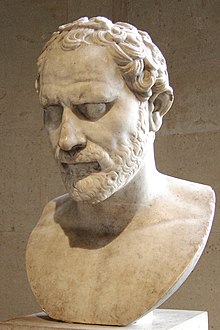
Demosthenes orator Louvre.jpg

Demosthenes!

Therefore since the Lyceum community is presently attending the Cleveland Right to Life Conference, I thought nothing could be more appropriate for the occasion than to quote these wise words from a little known, and I might say humble teacher, at a small school devoted to Classical Catholic education in Northeast Ohio.

He said

“Catholic classical education…is primarily ordered to life. The whole point of classical education is life. To spread life. To increase life. To enrich life. To propagate and widen its extension. To deepen it and strengthen it. To perpetuate it and make it eternal. That in a nutshell is what … Catholic liberal education, is all about.”

Now I must say, that really got me thinking. Was the author simply indulging in a flight of enthusiasm? Did the author really mean what he said or was this just another brave, and even desperate rhetorical speech designed to make liberal education seem relevant? To make one’s enterprise appear relevant is the sort of thing we might expect from the clever and overworked marketing team at one of these small classical schools.

But then the author gave an argument which deserves a second look, he says

The simple reason for this is that to know the truth and to live is the same thing. That is why Our Lord and Savior said in John 14:6

I am the way, and the truth, and the life. No man cometh to the Father, but by me.”

Isn’t that a stunning reason?

Isn’t that compelling?

Christ is “the life” and he is “the truth!”

Therefore an education (i.e. Liberal education) which is ordered to truth for its own sake is also an education that is ordered to Christ for His own sake!

And further an education that is ordered to Christ for his own sake is also an education that is ordered to life for its own sake!

Q.E.D. as Euclid would say.

As our Lord says in John 10:10,

The thief cometh not, but for to steal, and to kill, and to destroy. I am come that they may have life, and may have it more abundantly.

Those who are for life must necessarily be for truth. Those who wish to promote the dignity and goodness of life, must also, perforce, promote the dignity and goodness of truth.

But if we do not promote the truth, for its own sake, but rather for the sake of “usefulness” and “what it can do for us,” how then will we reconcile that with our defense of life?

Classical Catholic education, Catholic liberal education is the education that recognizes the dignity of truth. Catholic classical education is the education that recognizes, promotes, and defends life.

And we might add that Catholic liberal education is not simply the only education that provides the philosophical and Theological defense for the dignity of every human life, especially in its beginnings, but it is also the only education that is able to provide a defense and vision for the end of human life.

As our humble teacher said,

This is the point of Catholic classical education. It is the only point really- that men can live life abundantly, happily, joyfully, in the fullness of truth in union with God.

Posted in classical education, education, truth for its own sake | Tagged , , | Leave a comment

Hesiod And Classical Catholic Education

Image result for hesiod

The classical Catholic educator is always interested in forming his students in the things of nature so that they might be better disposed for the things of grace. Grace builds on nature and nature is dispositive to grace. It is therefore the task of the wise Catholic school to design a curriculum that achieves a full sustained and extended confrontation between the minds of its students and nature. And when this confrontation has been achieved then might the words of Saint Paul be understood when he says in Romans,

Because that which is known of God is manifest in them. For God hath manifested it unto them. [20] For the invisible things of him, from the creation of the world, are clearly seen, being understood by the things that are made; his eternal power also, and divinity: so that they are inexcusable.

To bring students to grace from nature is, in a nutshell, the whole goal of the classical Catholic educator.

Now, as it turns out, what this means in actual fact is that the school which boasts itself as a place of “classical Catholic learning” will therefore be recognized by the extent to which it attempts to facilitate the inheritance by its students of the patrimony of the Greek mind.

That is to say, every student, by virtue of his membership in Western Civilization,  has an intellectual inheritance bequeathed to him by the ancient Greeks. Or to put it another way,  every student has a rich inheritance of Greek thought about nature in all of its aspects. Or, if you will, a treasure trove of thought and truth about nature, as preeminently grasped and understood by the ancient Greeks, belongs to every student. And it is the obligation of a school to see that each student receives that inheritance. I suppose you might say that the classical Catholic educator is largely just an executor of the ancient Greek estate.

By way of example allow me to illustrate what I mean about the ancient Greeks disposing the mind to grace through their grasp of nature. And in this case let us examine a couple of remarks taken from Hesiod’s poem Works and Days almost at random.

Hesiod begins his work piously invoking the muses of Pieria  “who give glory through song,” and he invites them “to tell of Zeus” and “give him praise.” Now granted that Zeus is actually a pagan god, and putting aside anything that Saint Augustine might say about invoking these pagan gods, I still hold firmly that Hesiod teaches all men, and sets an excellent example, that at the beginning of every significant endeavor (or indeed any endeavor) we ought to begin by invoking God. Piety requires that we first look upwards for help or for inspiration and direction.

For Hesiod knows that it is through God that

“mortal men are famed or un-famed, sung or unsung alike, as great Zeus wills.”

In the next line he attests

For easily he makes strong, and easily he brings the strong man low; easily he humbles the proud and raises the obscure, and easily he straightens the crooked and blasts the proud, — Zeus who thunders aloft and has his dwelling most high.

and who is not reminded of Our Lady when she uttered the truth that Hesiod only saw through a cloud,

He hath shewed might in his arm: he hath scattered the proud in the conceit of their heart. He hath put down the mighty from their seat, and hath exalted the humble. He hath filled the hungry with good things.

Proceeding, Hesiod then says an interesting thing. Two kinds of strife, (who are in fact two goddesses) demand homage and honor among mortals.

The first, “harsh Strife” is hateful, because she,

“fosters evil war and battle, being cruel: her no man loves; but perforce, through the will of the deathless gods, men pay harsh Strife her honour due.”

Hesiod understands the inevitability of suffering war and death in the lives of men. What could explain this unnatural state of affairs? Every generation encounters the same evils, surely there must be a goddess who is honored by this, otherwise we would learn from our mistakes.

Next to the doctrine of original sin and the teaching about its universal contagion, its effects, the punishment due to it, next to a theology that explains original sin as a sufficient cause for explaining all the evil and suffering in this world – next to all this, I say, Hesiod’s explanation isn’t far off from the mark.

But according to Hesiod there is also another goddess, whom we will call “good Strife,” who is good because,

She stirs up even the shiftless to toil; for a man grows eager to work when he considers his neighbor, a rich man who hastens to plough and plant and put his house in good order; and neighbor vies with his neighbor as he hurries after wealth. This Strife is wholesome for men.

Good Strife impels us to work. She impels us to virtue and order. She impels us towards a wholesome competition with our neighbor, and consequently towards an orderly society.

Hesiod saw great meaning in strife. He saw great value in day-to-day toil. He glimpsed value in suffering and saw strife as a  begetter. Strife gives birth to wealth, goodness, and even justice.

Hesiod reveals, in part,  the wisdom of God when he told Adam,

In the sweat of thy face shalt thou eat bread till thou return to the earth, out of which thou wast taken

because (as Hesiod says),

badness can be got easily and in shoals; the road to her is smooth, and she lives very near us. But between us and Goodness the gods have placed the sweat of our brows; long and steep is the path that leads to her, and it is rough at the first; but when a man has reached the top, then is she easy to reach, though before that she was hard.

Hesiod says that the road to badness is an easy and smooth one, but the road to goodness is long and steep and rough at first, how faintly we hear the echo of Our Lord when He perfects the comparison of our moral life with a road that leads to a gate,

Enter ye in at the narrow gate: for wide is the gate, and broad is the way that leadeth to destruction, and many there are who go in thereat. How narrow is the gate, and strait is the way that leadeth to life: and few there are that find it!

Without knowing about the punishment of Adam, Hesiod sees the wisdom of God in designing a world in which we earn our bread by “the sweat of our brows.” Although he attributes this sweat as the work of the goddess of good strife, Hesiod understands something very significant about the nature and dignity of man. The difficulty that we encounter in our daily lives, the work and even suffering that appears to be our lot is ordered to a greater good. And so it is because there is a God who loves us that the means of our livelihood sometimes appear hidden to us; it is because goodness rules the earth that we have to work,

For the gods keep hidden from men the means of life. Else you would easily do work enough in a day to supply you for a full year even without working; [45] soon would you put away your rudder over the smoke, and the fields worked by ox and sturdy mule would run to waste.

Posted in classical education, education | Tagged , , , | 2 Comments