A choir loft is a good place to get a whole view of what is going on at Mass. In fact, it is the only place in a Church where a bird’s-eye view is possible. Of course it is mostly a bird’s-eye view of the back of people’s heads. But from my lofty position as Music Director, I do get a sense for the makeup of the various congregations that come to Mass five times each weekend.
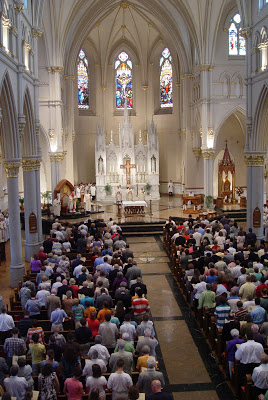
At my parish, unsurprisingly, there are people from various socio-economic classes and various ethnicities. There appears to be a fairly even distribution of men and women. Although predominantly white and of Italian, Irish and Eastern European descent, our parish also has members who are Asian, African American, Jamaican and, undoubtedly, members of other ethicities as well. With regard to age I see both young and old in the pews, but there are, on average, an assortment of folks who are on the more mature side of life.
Demography is not my strong suit, but to my parochial vision I can see that our parish is not homogenous.
Now when I read Sacrosanctum Concilium , which is of course the primary governing document set forth by the Second Vatican Council concerning sacred liturgy, I am particularly mindful of the passage that reads,
In the restoration and promotion of the sacred liturgy, this full and active participation by all the people is the aim to be considered before all else.
Thus, as Music Director, it is my task to choose music that encourages the full and active participation by all the people.
What is the Director of Music to do? What music should I choose that encourages all the people to engage in full and active participation?
Now, as I have said elsewhere, my procedure in choosing music is to simply choose my favorite hymns Sunday after Sunday. Naturally, I try to make my selections as appropriate for the Mass as possible depending on the time and season and what the readings and Gospel are about. Interestingly, I find that my favorite hymns appear to be appropriate for almost every Sunday of the year.
But it does strike me that the vast majority of hymns in the majority of missalettes or hymnals that are prevalent in our churches contain music that are mostly appealing to people from a specific ethnicity.

Granted that most hymnals appear to make an attempt to contain a smattering of hymns designed to appeal individually to a variety of ethnic groups, there is a tacit admission that no one hymn is meant for everybody. For example, every hymnal has at least a couple of “Spirituals” (e.g. There is a Balm in Gilead and Amazing Grace), and perhaps one or two Polish, Italian, or Irish hymns. Nonetheless, it is pretty obvious to me that the bulk of the music is aimed at a white Western-European crowd. I myself gravitate to English and German protestant hymns like Holy, Holy, Holy and Now Thank We all our God. But I really can’t say how my own preferences appeal to the Hispanic or Vietnamese parishioner in the pew.

For the most part, the hymns, the Mass settings, and the whole musical experience that ordinary Catholics encounter from Sunday to Sunday is not an experience that we could call universally appealing.
Go Make a Difference might appeal to a young person whereas Holy God We Praise Thy Name might appeal to an older person.
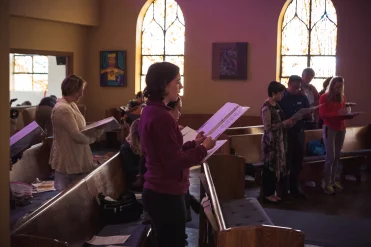
Lift High the Cross and A Mighty Fortress might appeal more to one, whereas You Are Mine and Shepherd Me, O God might appeal to another. I may have these all backwards, but I am certain that the person who loves Holy God is a different person than the one who loves Christ Be Our Light.
Here is the obvious question: For a Church which calls itself Catholic-which is a Greek word that means universal or whole or all embracing-ought there not be a corresponding music?
Ought there not be Catholic music?
Given the significance of music in the Mass (i.e. music is an “integral part” or pars integrans), one would think that the Catholic church would have a music peculiar to itself. One would think the Catholic church would have a unique music that excelled in catholicity, that is, one would think that the Catholic church would be known by a music that distinguished itself by the qualities of universality and all-embracingness.

Does it seem a little strange that the musical experience of the majority of Catholics is anything but this? The musical experience is quite definitely ‘parochial’ or ‘provinical’, which are words that signify something quite the opposite of ‘catholic.’
Now, I am not saying that there is no place for a good ol’ fashioned hymn with a decidedly Anglo-Saxon or Germanic tilt. Nor am I saying that there is not a place for a “Spiritual” or perhaps even an Irish hymn on Saint Patrick’s Day.

But shouldn’t the music at Mass be marked by a universality that characterizes the church itself?
Well, as it turns out, the church does have a music that is universal. And it is universal because it belongs precisely to no one.
It is a music that is written in a language that nobody speaks.
It is a music written by composers that are of unknown ethnicity.
It is a music that does not even appear to belong to a particular time.
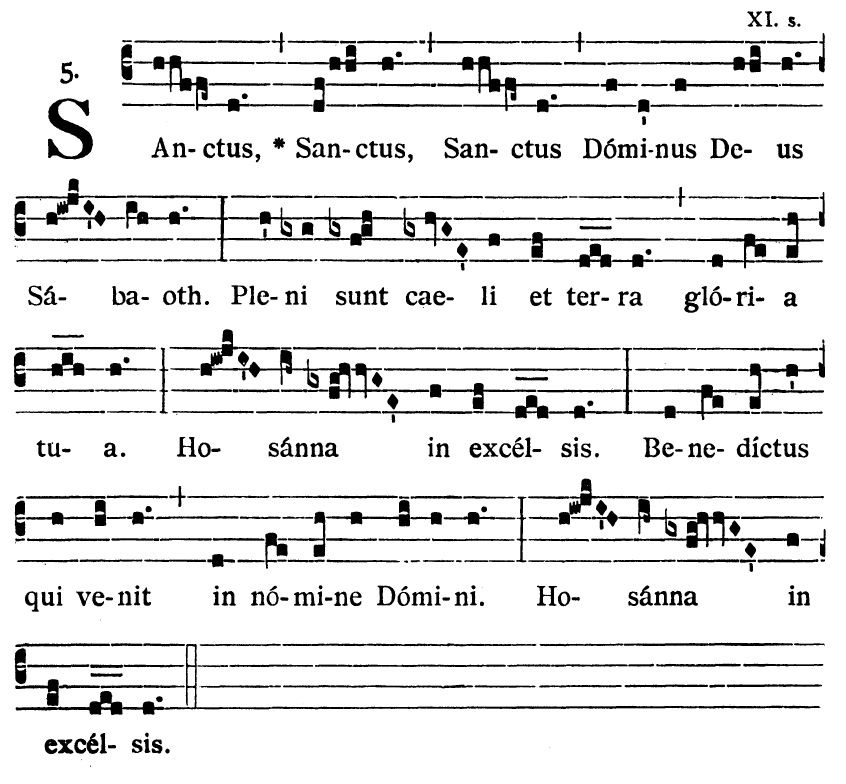
It is a music that belongs equally to all because it belongs to no one except to the Church and this music is called … Gregorian Chant.
Gregorian Chant is the music of the church. Gregorian chant is catholic music in the literal meaning of the word.
No wonder that Sacrosanctum Concilium asserts,
116. The Church acknowledges Gregorian chant as specially suited to the Roman liturgy: therefore, other things being equal, it should be given pride of place in liturgical services.
Gregorian Chant is the music that is suitable par excellence to the Mass. It is completely unique and is a music that belongs unmistakably to the Catholic Church.

I think it is safe to say that Gregorian Chant is the only music that might qualify as a possible candidate for being universal.
As a matter of fact, I would even assert that it is the only music that does not impose a specific national ethnicity on the one who sings it; Gregorian chant is not Celtic, it is not Italian, it is not Anglo, it is not German, it is not Eastern European. In my view, Gregorian Chant makes everyone equally comfortable (or uncomfortable) and that is because it does not belong to this or that tribe or family. It is the distinct music of the Catholic Church.

Gregorian Chant is the only music that can properly (and strictly) be called Catholic music.






























 Classical Catholic Education