Cave Dwellers

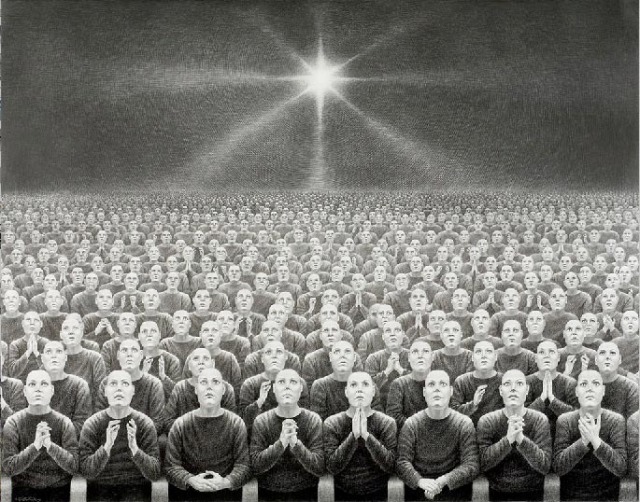
Image result for cave socrates

All of these people are cave dwellers. They live in the gloomy cave that Socrates describes in Book VII of The Republic (see http://www.historyguide.org/intellect/allegory.html). They are all looking at the wall in front of them upon which there are shadows cast by images behind them. They are all chained to their seats and as you might see they are quite taken with looking at the shadows. They take delight in guessing what the shadows are. The shadows are cast because certain men are holding little stone statues or wooden images in front of a fire, and therefore a shadow is cast upon the wall in front of the men.

These men are not free and they do not know it.

Liberal education has to do with Freedom. That much can be guessed from the “liber” part of the word liberal.

But why would anyone want to pursue a liberal education if he thought he was already free? The fact of the matter is that most people do not want a liberal education precisely because most people think that they are already free.

That is the big problem with liberal education- one doesn’t quite realize that this education bestows freedom until one has gained it to some extent. Then after gaining a certain amount of freedom, one looks back and says “how could I ever have thought that?” or “boy was I a dummy!” or “I don’t know what I was thinking- maybe I was sleeping”

In other words, one cannot understand how bad it is not to have a liberal education unless one already has a liberal education.

This is the whole point of the famous cave allegory in Plato’s Republic. Those poor blighters chained up in the cave appear to have no idea about just how bad it is down there in that cave!

As you might remember Socrates describes life in the cave as a very comfortable sort of life. Aside from the ankle and neck chains,the inhabitants of the cave were very content with their gloomy environment and would be very reluctant to leave. As a matter of fact Socrates, if I remember correctly, says that one would literally have to use coercion to get a cave dweller to leave his customary habitation. The cave dwellers are quite content with their knowledge of shadows and comfortable in their coerced state. The truth of the matter is that they are all in a prison and don’t realize it. They enjoy it.

But (and I am speaking as one cave dweller to another) due to some miraculous intervention I happen to know that men are not supposed to live in a cave. Cave dwellers need to be set free. We all need to break our chains. We can help one another. And then we can all start to move slowly up the dark tunnel encouraging one another. If necessary we will try to drag a few people that refuse to join us. They will thank us later when they see the sun.

This is what liberal education is. To me it is perfectly obvious that we all need a liberal education.  But how do we convince our fellow cave dwellers that they need one?

I don’t think any of the following lines would be very effective as marketing pitches to cave dwellers, but maybe one or another might get someone to start thinking.

“hey …pssst… these ankle and neck chains are for the birds”

“There is life outside of this cave even though you don’t think there is…in the mean time will you please contribute what you can towards the education of others who realize this?”

“Hey cave dweller…you do know that you live in a miserable cave don’t you?”

“Do you want your children to be chained up in a cave like you?”

“Come up this long dark tunnel with us and experience life outside of the cave!”

“I’m not crazy…I have seen the sun and you can too… oh yeah… the sun is a big ‘disk-like’ circle in the sky that is kind of like the fire that is behind you… that you can’t see….but it is the reason why you are able to watch all those stupid shadows that you seem to like so much.”

“Hey…I want to take your children up this really dark tunnel to see something really cool…I can’t tell you what it is, but it is sort of like the shadows in front of you cast by the images behind you.”


Posted in classical education, education, slavery | Tagged , , , , , | 2 Comments

More on Fashion

Posted in slavery | Tagged | 1 Comment

Slavery to Fashion

Image result for clothing 12th century men painting pantaloons

I don’t have any strong objection to men dressing according to the fashions of the 12th or 13th century if they happen to live in the 12th or 13th century. I assume the gentleman in the picture thought that he was looking pretty dapper. He lived in a time when the clothing fashions were perhaps a little extravagant and this fellow looks like he can afford it. My guess is that he thought he was approximating something on the side of the beautiful.

I am just not willing to adopt his fashion for fear of losing the little credibility that I have left, nor have I seen anything like his clothing on the discount rack at Filene’s. Besides I much prefer clothing that covers my legs. Give me a pair of grey slacks, a Brooks Brothers tie, a navy blue jacket and I am all set- well maybe throw in a pair of Florsheim loafers, socks, white dress shirt and …well let’s get back to the point.

Maybe we all have a bit of a duty to try to dress and appear in a manner that is comfortably within the range of what is commonly accepted as normal in any given time and place. But does that duty extend to making oneself look like this?

Image result for men bell bottoms 70s

Glancing at old family photos does make me wonder. Granted that I was too young to make decisions for myself, nonetheless I don’t remember exercising any sort of wholesome rebellion when my mother gave me a pair of bell-bottoms.  How could I ever have consented to make myself look like that? YIKES!

The seventies really were bad years for all sorts of reasons- but for me the biggest reason was that they represent a time when not only were most of us slaves to the prevailing clothing and hair fashions (which might be true most of the time) but we were all slaves to really ugly clothing and hair fashions. (well at least most of us) Scary!

What is slavery to Fashion?  Well, as one very wise living philosopher puts it:

“Those are slaves of fashion who pursue (or read) what is fashionable because it is fashionable and cease doing what is no longer fashionable.”

I think that is a very good definition. Those who do something simply because it is fashionable are slaves to fashion. Likewise, those who cease to do something simply because it is no longer fashionable are slaves to fashion.

Freedom, of course, is a good thing but the more I think about it the more it appears to me that it is not such an easy thing to achieve. For example think of what St Paul says (Philippians 4:8)

For the rest, brethren, whatsoever things are true, whatsoever modest, whatsoever just, whatsoever holy, whatsoever lovely, whatsoever of good fame, if there be any virtue, if any praise of discipline, think on these things”

Ok. That sounds good to me. But what if my thoughts about whatsoever is true, modest, just, holy, lovely and of good fame are really dictated to me right now the way that my taste in clothing was in the seventies?

For example, it strikes me that most of us pretty much follow the fashions of the day particularly with regard to what we think is lovely and what we think is true. Who among us is free from the prevailing aesthetic and intellectual views of the fashion setters?

You might think “well I don’t wear bell-bottoms or wear shoes like this”

We might think that we have good taste and exercise freedom with regard to how we appear.

But what about how we think? What about what we listen to? What about what we read and watch? If everyone appears to be doing the same thing within a certain margin of comfortable acceptability, is that apparent harmony the effect of free choice?


Posted in ad libitum, classical education, education, Liberal Arts, slavery | Tagged , , , , , , , | 2 Comments

Why Study Latin?

This week marked the 50th anniversary of Pope Blessed John XXIII’s Apostolic Constitution Veterum Sapientiae

DE LATINITATIS STUDIO PROVEHENDO

– On the Promotion of the study of Latin-

This document is absolutely wonderful. I love it! Pope John XXIII is great. No wonder he is Blessed!

Needless to say, reading through the Apostolic Constitution made me wonder at the irony that the Pope who wrote this was the same one who inaugurated the Second Vatican Council- which in the mind of many appears to have been a council which “did away” with the Latin language altogether.

Of course, that is not at all the case to anyone who has read Sacrosantum Concilium, which commands:

36. 1. Particular law remaining in force, the use of the Latin language is to be preserved in the Latin rites.

This makes one suspect that the directives of Vatican II have not really been fully put into general effect yet.

Nonetheless, let us take a moment to reflect on some cogent reasons why Catholic schools need to make a strong commitment to the study of Latin (and if they are really bold- maybe even Greek!).

In point of fact, everyone (I say “everyone” merely for rhetorical effect!) knows that these languages are the languages of classical education. Moreover a strong emphasis on learning the Latin language, specifically, is especially important for those who wish to form their children according to the heart and mind of the Church.  Children should desire to know the language of their mother, and the language of Holy Mother Church is Latin. Among other reasons we find in the Apostolic Constitution Veterum Sapientiae that the study of Latin

“…is a general passport to the proper understanding of the Christian writers of antiquity and the documents of the Church’s teaching.”

I wonder if Pope John really means “passport?” My understanding is that one cannot generally travel very far without a passport.

From a strictly educational stand point the study of Latin (and Greek) is the most effective way to teach students the grammar of their own language as well as the great majority of the vocabulary in the English language.

Now anyone who cares enough to challenge this point needs to read Dorothy Sayers’ nice little essay entitled “IGNORANCE AND DISSATISFACTION.”

It is the quickest and easiest way to mastery over one’s own language, because it supplies the structure upon which all language is built. I never had any formal instruction in English grammar, nor have I ever felt the need of it, though I find I write more grammatically than most of my juniors. It seems to me that the study of English Grammar in isolation from the inflected origins of language must be quite bewildering. English is a highly sophisticated, highly analytical language, whose forms, syntax and construction can be grasped and handled correctly only by a good deal of hard reasoning, for the inflections are not there to enable one to distinguish automatically one case or one construction from another. To embark on any complex English construction without the Latin Grammar is like trying to find one’s way across country without map or signposts. That is why so few people nowadays can put together an English paragraph without being betrayed into a false concord, a hanging or wrongly attached participle, or a wrong consecution; and why many of them fall back upon writing in a series of short sentences, like a series of gasps, punctuated only by full stops.

Ms. Sayers has many other excellent reasons as well including the one I am about to give – except I will make the point for her in a crass utilitarian manner!

Statistics from the College board continue to demonstrate that students of Latin outperform students of every other language on average by 100 points on the English portion of the SAT. So there! And if you think students of Latin outperform other students on the SAT because they are more intelligent to begin with- then keep that to yourself. It all amounts to the same thing. Either Latin makes you intelligent or the intelligent study Latin.

The study of Latin and Greek is not only the most effective way to teach language itself to the student (no matter what his first language may be) but the study of these languages has a far reaching effect on the entire intellectual formation of the student. Pope John XXIII spoke extensively about this when he said that the study of Latin specifically

“… exercises, matures and perfects the principal faculties of mind and spirit. It sharpens the wits and gives keenness of judgment. It helps the young mind to grasp things accurately and develop a true sense of values. It is also a means for teaching highly intelligent thought and speech.”

In short the study of Latin is like brain food! It is pure intellectual spinach. It is like fish! No other language is like it for making people just plain smart.

Why would anyone deprive their children of this treasure?

Why would a school deprive students of this most valuable and effective tool for training the mind?

Why would Latin be an elective at a Catholic school?

Posted in classical education, education, Latin | Tagged , , , , , | 3 Comments

Slavery to Custom

Custom is a tyrant. I am well aware of the fact that this saying is not original to me. But the truth of it is becoming clearer and clearer to me with each passing year.

Most of us are well aware of the tyranny of the passions. Passions are very sensible, and so of the four kinds of slavery from which liberal education frees us, (slavery to passion, fashion, custom and error – as we have spoken of extensively elsewhere) it is not strange that we would know about the slavery to the passions first. After all the first natural road in our knowledge is the “road of the senses into reason” as the wise Dr. Berquist puts it. Then of course comes the slavery to fashion, which again is perhaps the second most sensible of the four.

Slavery to custom, on the other hand,  is quite insensible precisely because it is a slavery to something which is….well… customary.

Things which we do by custom seem second nature to us. They largely go unnoticed. We do not notice the things that we do by nature. How many of us are even aware of our own breathing. When we do notice it, it is probably because there is a problem. So also the things that we do by custom

It is very important to become aware of what we ourselves think and why we think what we think.

We  owe our understanding of what knowledge is to the Greek philosophers, and of course especially to the Greek philosopher who said (in the second chapter of his Posterior Analytics)

We suppose ourselves to possess unqualified scientific knowledge of a thing, as opposed to knowing it in the accidental way in which the sophist knows, when we think that we know the cause on which the fact depends…

Those who wish to know truth have to be concerned with knowing the reasons for things. in other words, if we say something is true but we do not know why we say that it is true, then we cannot really say that we know.

For example among the things that we might hold:

  1. we might hold certain things because they are self evident.
  2. We might hold other things because we have reasoned them out from self evident things.
  3. Finally we might hold some things simply by custom.

For example “the whole is greater than the part” is a clear example of a truth that we all hold because it is self evident to anyone who has eaten lunch. On the other hand that the common good is a greater good than the private good is not self evident but might be deduced from this the fact that the whole is greater than the part.

What are some things that we think by custom? Let me suggest that there are a great many things that we hold for no other reason than that the tyrant custom compels us. to show how widespread custom’s influence is- how about :

  • Our ideas about politics “Democracy is the highest form of government”
  • Our idea about Mathematics “One is a number.” or “a line is made up of points”
  • even something as trivial as the fact that many of us insist on calling the name for the common prayer before each meal “Grace.”

Whether these ideas are true or false is not the point. The point here is that the one who wishes to become wise must examine why it is that he holds these ideas. I am suggesting that such ideas as these – and a great many more- are held for no other reason than the force and compulsion of custom.

Self examination is difficult. But which ideas we hold through reason and which through custom will never be known to us unless we examine ourselves. If we refuse to particpate in the examined life, then we must perforce remain slaves of custom, for a slave to custom is one who does or thinks something for no other reason than that it his custom to do or think the thing.

Being educated, however, demands that we who hold various ideas and behave in certain ways must also know the reasons why we hold those ideas and behave in those ways. If we do not examine our intellectual lives in an attempt to sort these things out – we will remain, in large part, slaves of custom.

Posted in classical education, education, slavery | Tagged , , , | Leave a comment

The Three Catharses

Our current endeavor is to discuss how it is that liberal education frees a person from slavery, and even more specifically how it frees a person from the slavery to passion.

In chapter 6 of the Poetics, Aristotle gives us a clue. When defining a tragedy (e.g. Oedipus Rex) he says:

 “Tragedy, then, is an imitation of an action that is serious, complete, and of a certain magnitude; in language embellished with each kind of artistic ornament …through pity and fear effecting the proper purgation of these emotions.”

It is interesting to note the Greek word that Aristotle uses for “purgation.” The word is “Katharsin” from which we get the English word catharsis. There is a close analogy that exists between medicine and education. Socrates was always fond of comparing a good teacher to a good physician (or sometimes even a midwife). The analogy is wonderful because just as the principles of health are already within the body so the principles of learning are already within a student.

Doctors and teachers must assist nature by first removing those things that impede good health or the growth of knowledge. This is precisely what the word Catharsis means. It is a medical term signifying something which is administered to a patient for removing a harmful substance from his body. If a patient swallows a poison or some other harmful substance, he stands in need of a catharsis. n the same way if a student suffers from one disordered passion or another, he too stands in need of a catharsis.

The first Catharsis – Fire with Fire

The love sick Duke Orsino says of music,

“give me excess of it, that, surfeiting, The appetite may sicken, and so die.”

The Duke understands that the emotions like any appetite may be exhausted by sating it. If we are suffering from too much of an emotion we can purge ourselves of it by indulging that very emotion. It seldom works to tell someone who is in the throws of sorrow to simply “cheer up.”

On the other hand excessive sorrow left to burn untended within ourselves is not good and sometimes leads to despair.  We can take a lesson from fire fighters who sometimes will allow a controlled burn to exhaust the power of a fire. Good literature and music can do just that. They have the power to focus our emotions and let them vent themselves, focusing our sorrow or anger or hate, or some other emotion, and letting them consume themselves on objects worthy of sorrow, anger and hate.

Youth is particularly susceptible to excessive and sometimes uncontrolled emotion. If only that emotion could be spent on events or objects that really befit such intense sufferings. Who can’t feel an intense pity and sorrow for Romeo and Juliet. Who wouldn’t want to angrily hack Tolkiens’ hateful and wicked Trolls and Goblins to pieces. It is beneficial to us to feel intense emotions in an appropriate manner. That is why we have them. Those whose passions are well ordered are able to act with greater conviction and vigor.

Thus sometimes the best way to bring our intense passions under control is to indulge ourselves in music or literature that will help bring out the very passion that we are suffering an excess of. When a person is sorrowful, sometimes the best thing is to have a good cry, especially to weep over the true and very pitiable misfortunes of another, as depicted by a skillful author.

The Second Catharsis- Fire with Water

If the first catharsis was similar to fighting fire with fire, the second entails dousing fire with water. In other words we will “douse” the excessive emotion that we suffer with it’s opposite. We try to cheer our overly melancholy friends by being jovial and painfully cheerful, or perhaps we take them to a funny movie. Many people when they come home from work from a very stressful day will turn on music that is calm and relaxing. Parents will try to calm the high spirits of their children by playing recordings of the most relaxed music they can find. Pachelbel’s Canon, and various second movements from Beethoven and Mozart Sonatas and Bach’s Sheep May Safely Graze, maybe even Brahm’s Intermezzo opus 117.

I remember a particular story related by Boethius’ in his De Musica, where he relates how an angry mob gathered outside of a house, getting ready to lynch or stone various of the inhabitants, were unwittingly pacified by some soft peaceful loving music played in the background. This second kind of catharsis can be very useful.

The Third Catharsis- responsible exercise

 The first two catharses assume that we are suffering from an excessive emotion of one sort or another. The third catharsis does not. So why would we need a catharsis? Well, here it is better to change our fire analogy to that of an athlete. Our emotions are like muscles which if unused for long periods of time will atrophy and become dysfunctional. We should not be surprised. Every power or function of the human person is like this, the emotions are no different. Things need to be used and exercised and maintained if they are to retain their function and usefulness.

Remembering that we have eleven basic emotions and an indefinite number of permutations and combinations of them, it actually presents a challenge for us all to keep our emotions in fine form. Those who are blessed with means, a peaceful family, and loving friends may not encounter situations that require hate and fear and anger. Similarly, those who live in the various violent war zones around the world may rarely feel joy and love and those other peaceful emotions. All of the emotions are necessary for free and effective human behavior.

Fortunately, we are all the beneficiaries of centuries of production by great men and women who have provided a world of their own in words and music. By availing ourselves of the literature and music of the greatest authors and composers, we provide ourselves with ample opportunity to exercise all of our emotions on a regular basis. Great authors like Homer who created “a cosmos in verse” leave no part of the world, no part of human action, no part of human experience out of their works.

Thus, the third kind of catharsis, like exercise, is something about which everyone needs to be concerned. Those who desire a well functioning body exercise at regular times. They undertake studied and various exercise routines focused on different and specific muscles. They maintain their functioning muscles with repetition of the same routines. In the same way, those who wish to be free from disordered and dysfunctional passions need to maintain a constant and regular schedule of reading the greatest literature and listening to the best music.


Posted in classical education, Liberal Arts, Literature, slavery | Tagged , , , , , , , , | 6 Comments

Give me that man that is not passion’s slave…

“Give me that man  that is not passion’s slave, and I will wear him  In my heart’s core, ay, in my heart of heart, As I do thee.”

Thus Hamlet, speaking to Horatio (Act III Scene 2), extols the man who is not a slave to passion. I have been asserting for some time now that among the many benefits that a student might derive from a liberal education is that he stands a chance at escaping slavery to his passions.

Now perhaps any kind of disciplined pursuit requires that a person restrain his passions to some extent. For example St Paul mentions this in today’s reading specifically referring to the discipline of the athlete:

“Know ye not that they which run in a race run all, but one receiveth the prize? So run, that ye may obtain.  25And every man that striveth for the mastery is temperate in all things. Now they do it to obtain a corruptible crown; but we an incorruptible.  26I therefore so run, not as uncertainly; so fight I, not as one that beateth the air: 27But I keep under my body, and bring it into subjection: lest that by any means, when I have preached to others, I myself should be a castaway.”

And the same would seem to hold for obtaining any kind of excellence or virtue- that is, one would need to bring one’s prevailing passions under some sort of rule in order to excel.

But in the end Athletes, especially in our time, do not provide us with many examples of people who have appeared to have succeeded in bringing their passions under the subjection of reason in general. I would think that it would be very difficult to play golf successfully if one were perpetually drunk. Or perhaps it would be difficult to be an Olympic medalist if one were excessively fearful or given to uncontrollable anger or profound despair.

Still, I have a feeling that athletes, though possessing temperance or self mastery in this or that area of their lives, might not be the best or most consistent examples of men who have achieved freedom from their passions generally.

Liberal education on the other hand attempts to address man as a whole and attempts to bring all the passions under the subjection of reason. Liberal education, frees those who pursue it, from subjection to their passions.

The means by which it does this is wrapped up largely in what Aristotle called “Catharsis.” Catharsis is a critically important word to understand for anyone who wishes to understand freedom from the passions.

What exactly does catharsis mean? How many kinds of catharsis of the passions are there?

We shall answer the first question by making an an analogy to medicine- and as to how many kinds of catharsis there are?

Three! How could there be more?

Posted in classical education, Liberal Arts, Literature | Tagged , , , | 1 Comment

Rarely divide into more than two or three!

Unless of course one is serving cake, the classically educated mind will rarely ever divide something into more than two or three. This rule of logic as strange to some ears as it may be is loaded with profound truth and good thinkers will defy it almost never.

For example if a lecturer begins his lecture by saying “There are seven points” or “There are seventeen points I would like to make in this lecture,” he will in “a single blow,” by so saying defeat the ability of the average hearer to comprehend his lecture.

The fact of the matter is that most things are divided into either two or three, and if there are more than two or three one can, upon further investigation, discover that these “more” result from further subdivisions of a thing that was already divided into two or three. For example the ten commandments first come from a division of two (i.e. Commandments concerning the love of God, and neighbor) and then each of these parts may be divided into three (e.g. commandments concerning love in thought word and deed).

Those who are inclined against this logical rule, to wit “the rule of two or three,” will not be able to understand most things of any significance. Let’s start with something that really matters- food! The rule of three is of supreme importance here, from the way a meal should be divided (appetizer, entree, dessert) to the number of meals in the day (breakfast, lunch, dinner) to the content of the main course (meat, greens, and carbs of some sort!) No dinner is complete without three things. Ignore this rule and one’s dinner guests will go away from you table with a feeling that something was missing! Ignore this classical rule and in a relatively short time you will find yourself with few friends who will accept your dinner invitations!

Think of the greatest works that serve as food for man’s soul. The Bible is divided into two! (and then one might wonder what how the various books within each part are divided). Take for example the four Gospels (first a division of two and then a division of three) Look at any given work in the Bible. St Matthew’s Gospel provides an excellent example of a work that is divided into three. Without finding these divisions one can scarcely lay claim to anything but a superficial understanding of the text!

Imagine the student in Theology not knowing the threefold division of the Summa Theologica. Imagine the student of literature not knowing the divisions in the Divine Comedy. Imagine the student of Geometry not knowing the divisions of Euclid’s The Elements. “Oh Horror, horror, horror!” (Macbeth Act II.3)

Think of the way a government is divided. Think of Saint Boethius’ division of the sciences. Nay even more… Think of the way reality itself is divided (things that are wholly material, things that are material and spiritual, and things that are wholly spiritual) Think of man himself (body and soul). Think of the hierarchy of soul (vegetable, sentient, rational)

That great sage and philosopher. That father of progress of the human mind. That fiery friend to wisdom – Heraclitus was he who said “This is wisdom to speak the truth and act according to nature giving ear thereto

Well for anyone who desires wisdom, it is an inescapable truth that to understand things and speak about things in a way that makes them comprehensible to others one must find the natural divisions in things- and these divisions will for the most part be either into two or three.


Posted in classical education, education | Tagged , , , , , | 3 Comments

A division of the four kinds of slavery from which Liberal education frees us.

I have already made the claim that a liberal education is an education that frees a person from something and it also frees a person for something. At present we are only speaking about what it frees a person from. And the short answer is that it frees a person from specifically four kinds of slavery.

Now, you might wonder about why I say “four?” You might be wondering about the process by which I arrived at the specific number “four?” That would certainly be a legitimate cause for concern. If I has said “two” or “three” you would most assuredly have found that more convincing.

My favorite living philosopher asserts that there is a “rule of two or three.” One should not be overly enthusiastic about divisions into say nine or fourteen or even, say, seven.

It turns out that the four kinds of slavery do, as a matter of fact, arise out of a prior division into two,and subsequently one of these is divided into three. So the four kinds of slavery are in fact a result of “the rule of two or three.” This should be a great comfort for anyone who is concerned about the significance of  division! Allow me to make this clear.

One might say that there are at first two kinds of slavery:

  1. The slavery that is caused by things outside of the mind.
  2. The slavery that is caused by an erroneous mind.

But the first sort of slavery is divided into three:

  1. The slavery to the passions
  2. The slavery to fashion
  3. The slavery to custom

There you have it! A prior division of something into two. And a posterior division of one of these things into three.

Thus four kinds of slavery!

Now you might be asking “what are we to call the slavery that is caused by an erroneous mind?

We will simply call this fourth type “The slavery to error.”

As it turns out there are at least six cause of slavery to error (the first three kinds of slavery as well as pride, false imagination, and illogical thinking!) But we will talk about these things later.

Posted in classical education, Liberal Arts, slavery | Tagged , , | Leave a comment

Modern education and Specialization…a digression

Among the chief marks by which the “modern school” distinguishes itself from the “classical school” is its adherence to the educational doctrine that proposes specialization as a virtue.

The doctrine of “specialization” asserts that every student ought to become a specialist, and in so doing the student is likely to become successful precisely because of his special excellence in this or that specific area. Success is alluring and therefore consequently, so is specialization!

The advantages of becoming a specialist are easy to argue. In completing any kind of practical task, from building a house, to the production of automobiles, to the building of a pyramid, the division of labor brings about a product more efficiently.

Specialization, of course, requires a whole system of “electives.” Electives, in turn, are courses taught by specialists who themselves have excelled in the particular subject which they teach. These teachers are therefore very qualified to teach this or that course because they have specialized themselves in it for as long as they can remember.

The doctrine of specialization ultimately requires the individual student (assuming, of course, some direction from parents, friends, and other advisers) to “elect” for himself what courses he would like to take. Each student will most likely guide his own intellectual formation by what he feels to be his own talent and interest. Indeed, it would be odd to elect to study something which one might feel he has no special interest or talent!

In effect specialization requires the student to become his own teacher insofar as he becomes the primary mover in his own intellectual formation. Specialization ultimately leads to a greater multiplicity of teachers. This teacher specializes in physics, that one in Chemistry and another in Biology. This teacher specializes in English Literature that one in American History. This teacher specializes in Latin, that one in Spanish (or Mandarin Chinese!).

The ideal school would of course be one that would employ myriad specialists in order to meet the myriad special interests of its students. And of course one would expect an ever increasing diversification of specialties- and ever expanding world of special interests. For who could possibly be a specialist in such a large field as English literature or Ancient civilizations when any one civilization or genre in literature might all by itself consume a lifetime to master?

I suppose this must be obvious to anyone who has paid a visit to the doctor. My father is a physician, and when people ask me what kind of physician he is, I say “a general practitioner.” But when is the last time you saw a GP? Maybe I am wrong, but I think the era of general practitioners is now either gone or in its last days. Classical education proposes a model that is almost diametrically opposed to specialization.

Classical education proposes that the end of education and all intellectual formation is something called “wisdom.” It proposes that those who wish to pursue wisdom must pursue knowledge in every major field AND, moreover, reach a certain level of mastery in each. Those who wish to become wise must become wise in mathematics and natural philosophy and the three arts of the Trivium as well as the four arts of the Quadrivium.

Those who wish to become wise consequently will have to master language and logic. It also proposes that the student must be proficient in history and poetry. Classical education proposes that those who wish to become wise must love beauty. Therefore they must love and pursue the fine arts. They also must ultimately obtain some level of mastery of moral philosophy as well as a thorough education in Theology.

Classical education proposes that no one of these subjects is able to be mastered apart from mastery in the others. It proposes that truth is connected and that the human mind is made to know all things. Classical education proposes that although a student might have specific interests, he ought to yield his judgment and personal desires to those of a teacher who is wiser than he. Classical education proposes that a student ought to subject himself as a disciple to a teacher and, if necessary, study the very things which might precisely not interest him!

This is not to say that specialization is an evil. But rather that specialization is something that is suited for those who are not specifically pursuing wisdom. For example, suppose one is attempting to support a family? Suppose someone is attempting to learn a marketable trade? Becoming a specialist might be imperative! On the other hand specialization has its own dangers.

The most obvious danger is that the specialist by definition narrows his mind according to his specialty and finds himself unable to speak with anything but mock confidence about things beyond his specialty. A second danger of specialization is that one must take particular care not to specialize in something that might become obsolete- or perhaps become undesirable should the market for it depend on current fashions.  For example when I was in school Spanish and French teachers seemed to be quite secure in their jobs, whereas these days one might be more secure as a teacher of Chinese. A third danger of specialization is that it is not by specialization that one becomes a good leader. My guess is that most CEOs have something significantly beyond specialization in their educational background in virtue of which they now occupy the corner office. Every now and then the Wall Street Journal publishes an article making this point. But for everything there is a proper time – and if we are to propose the pursuit of wisdom to our students, then let them undertake that pursuit first and then, AFTERWARDS, let them pursue a specialty.

Posted in classical education, education, Seven Fine Arts | Tagged , , , , | 1 Comment