Can we all just admit it? The chief disadvantage of living in the “greatest nation on God’s green earth” is that we Americans find it just a little tougher to sympathize with and even celebrate Monarchy.
I mean, wouldn’t we rather celebrate “Christ the President of the Universe?” This idea of Christ the king is practically a frontal assault on all of our inclinations as patriotic Americans! Or perhaps even the idea of “President of the Universe” is objectionable to those who propose some sort of democratic socialism as an ideal.
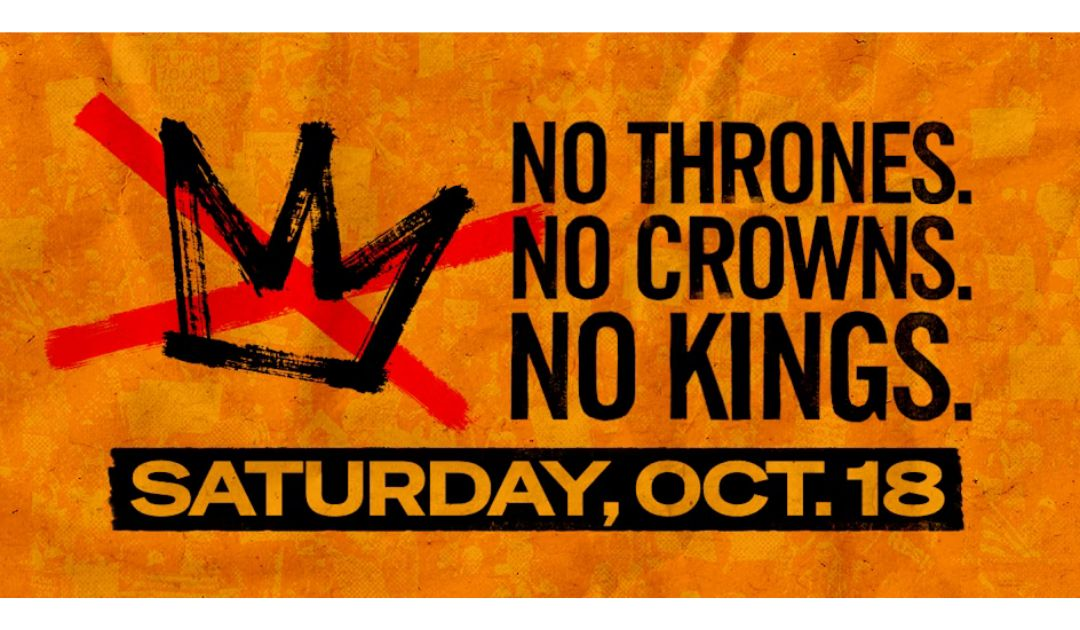
Those (millions?) who participated in the recent “No Kings” rallies know what I mean for sure! How many Catholics participated in these rallies? I don’t know, but if there is one thing I learned from them it was this…the very concept of kingship appeared to be rather unsavory.
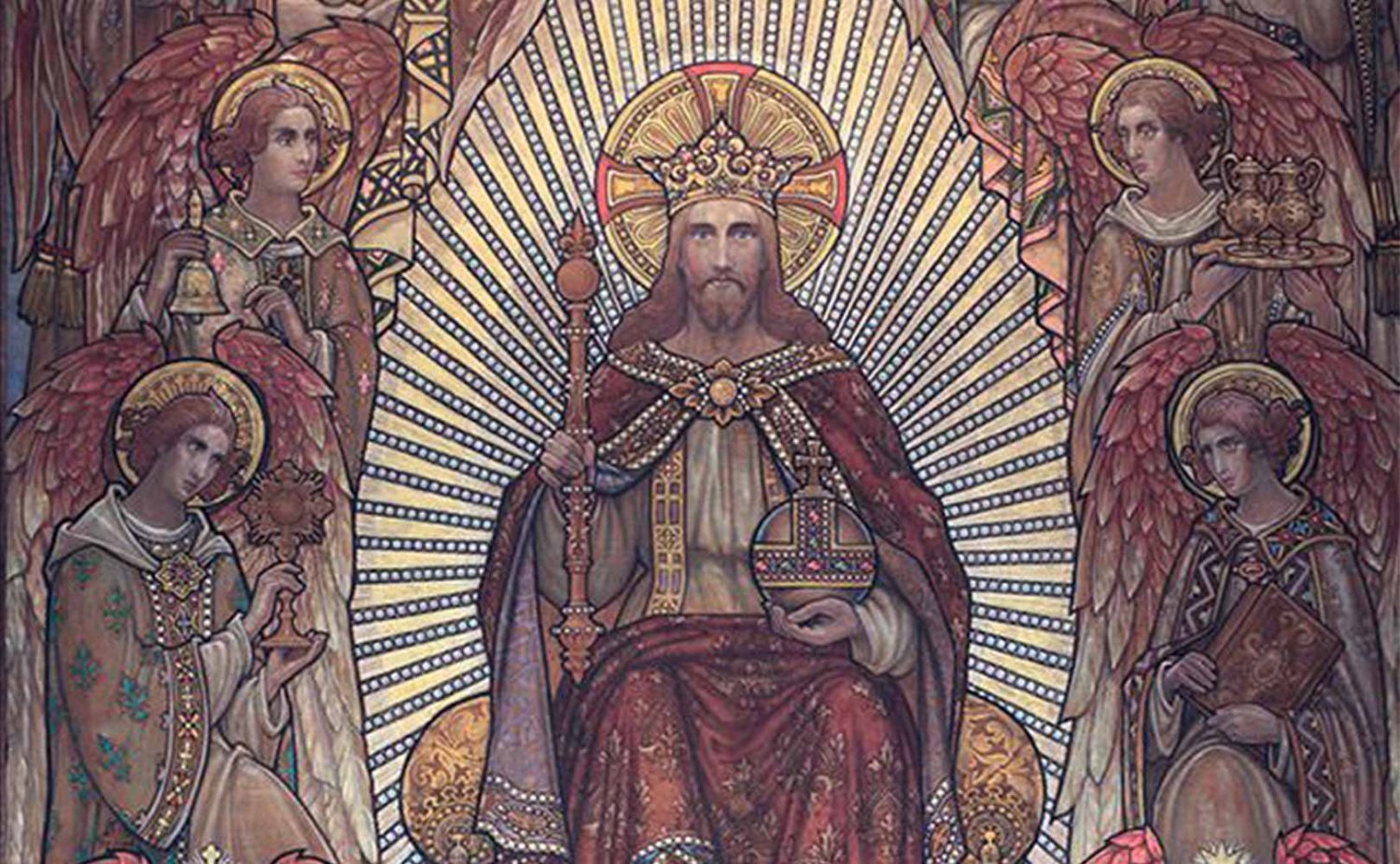
Nonetheless, for the great majority of Catholics who follow the Liturgical Calendar (promulgated by Pope Paul VI on February 14, 1969)…. and for those traditional Catholics who follow the traditional calendar (promulgated by Pope Gregory XIII in 1582, to which Pope Pius XI added the feast in 1925) Christ is still celebrated as …. The King of the Universe.
In other words, if we all know that the democratic-republican form of government under which we live (with apologies to the democratic socialists among us!) is the most suitable government for mankind, doesn’t this realization dampen our enthusiasm a wee bit for celebrating monarchy and kingship- and therefore, all that is entailed by the theme of the last Sunday of the liturgical year?
The fact that Pope Pius XI added this feast to the Roman calendar fairly recently makes me think that he knew it would come as a little bit of a shock to free-thinking and independent Americans. I am sure he meant to give a slap in the face to the rising and militant secularism of the time – and certainly, he was thinking about the aggressive and violent assault on religious liberty in Mexico. Is there a greater antithesis to the mind of the secularist than the concept of Christ as the king of the universe?

As a High-School teacher, it often befalls my lot to read Herodotus,’ The Histories, his legendary and not so succinct account of the “Persian War.” Herodotus details the rise and “worldwide” dominance of Persia until it was thwarted in its inexorable western expansion by a relatively small group of democratic free-thinking Greeks, at such places as Marathon and Thermopylae.
If there is a lesson to be learned from Herodotus, it is certainly this: As mighty as the Persian monarchs were, as massive as their armies grew, as multitudinous as were their servile and oftentimes sycophantic minions, they were nonetheless no match for the wits and bravery of a free-thinking democratic people. For heaven’s sake, Athens was the very cradle of democracy and yet according to Herodotus, Athens very nearly single-handedly put a stop to the seemingly all-powerful and haughty King Xerxes!

One cannot read Herodotus without feeling a twitch of exultation about the wit and resourcefulness and spunk that seems to arise when men think for themselves and agree by mutual compact to band together in a great cause. One cannot refrain from thinking that there is something beautiful about men who rule themselves democratically!
And so how is an American Catholic supposed to feel this Sunday? The very fabric of our society, our notions of law and reason and science and culture were bequeathed to us by the Greeks. Americans pride themselves on self-direction. If I remember correctly our War of Independence was directed against overthrowing the rule of a monarch.

And although the French were exceedingly helpful to us in our efforts, we have never been quite comfortable with them either for all of their aristocratic leanings. Many Americans like Thomas Jefferson were at first quite sympathetic about the overthrow of the Catholic monarchy in France during their so-called “Revolution.”
But again here we are, patriotic Americans confronted with celebrating the very thing, the defeat of which, provided a foundation for the American Republic- Monarchy!
If I were the church organist and the official “four hymn selector” for my parish, I would choose the following hymns:
- Alleluia Sing To Jesus, His The Scepter His The Throne!
- Crown Him With Many Crowns!
- The King of Love My Shepherd Is.
- To Jesus Christ Our Sovereign King.
I like these hymns and given the fact that I wouldn’t dare sing the “Gregorian Propers,” as I would with a little more courage, these hymns are the next best thing. But notice the unfamiliar-to-Americans trappings of monarchy!
We have sceptres!

And (gasp!) Crowns!
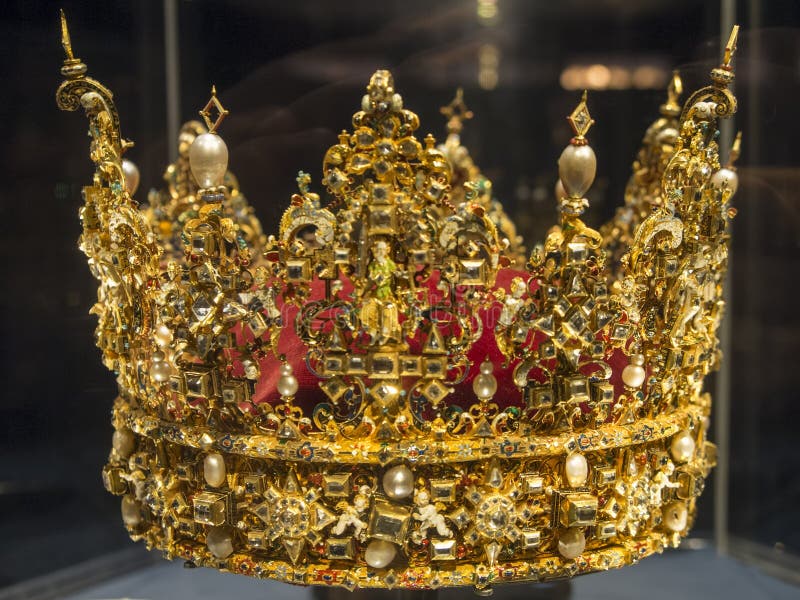
And thrones!

Oh the horror! How can Catholics celebrate such things if Monarchy is an unsuitable form of government?
I wonder if many Christians simply take in “Christ the King of the Universe” Sunday like many other things that the Faith proposes. After all the Church proposes all sorts of things for our belief which are simply not consonant with sound science and ordinary reason [Editor’s Note: This last statement, and several others, appear to have been made with a suggestion of irony]. So it’s perhaps best not to think about such things.
As if to say, perhaps there is a very real divide between faith and reason. When one goes to church or to worship, it is best to simply hang up one’s coat and hat and intellect on the rack outside the church to be donned only upon exit.

Could it be that Kingship or Monarchy is indeed the fitting rule for mankind? This is not to say that this or that specific group of humanity should adopt a monarchical form of rule immediately. This is not to say that the American representative form of government by which we govern ourselves is not, in fact, the very best form of government available to us right now on our own time and place. Perhaps that form of rule is best relative to the manners customs and mores of this or that people.
But if one had to choose the form of government that is simply best without qualification, what would one choose? What form of government did God Himself choose to rule his universe? Did he choose the best government? Is it relevant to our eternal happiness that He is a monarch? I guess the answer is obvious.
It is a fundamental rule of Christian living that the habits and affections that we develop on earth are significant in disposing our hearts towards heaven. As St. Thomas Aquinas was fond of saying “Grace perfects nature.” We are disposed towards the things of grace by the things of nature. Faith and reason are not opposed but rather the more we strive to reason aright, the more we provide an intellectual disposition for the gift of God’s grace.
That Christ is a monarch is a significant part of our faith. Insofar as we might identify various Christian monarchs that did not overstep their authority or abuse their power, perhaps every Christian might gather some lessons concerning how we ought to think, behave and feel in the presence of a monarch? Perhaps there are minor and major points of reverence and courtly behavior that are lost on the disciples of Democracy? Most importantly, perhaps there is a lesson to be learned about humbly and immediately adapting our will to that of his sovereign majesty, Christ the King; deference to a king is something a little more difficult for we rugged American individualists, who are accustomed to think it always right to have a say in our own affairs.
Notwithstanding any obstacles in our path ascribable to our own political custom, I suspect that our celebration of Christ The King of the Universe this weekend will strike most Christians with the fitting annual realization that “Yes! Christ is the King! Christ should be enthroned in the very center and principal place in our hearts. Every Christian will undoubtedly be struck with the fitting thought that inasmuch as we have earthly concerns and earthly rulers, nonetheless Christ is ultimately in charge and we are to do nothing except it be his will!
Viva Christo Rey!
[Editorial Note: In a previous discussion of this question, my very good friend, Dr. Andrew Seeley made some excellent “counter points” which I think should be inserted in italics below in full: He says:
“While I think you are right in some respects, allow me to suggest a few counterpoints.
Aristotle thinks that monarchy is only appropriate when some person is of a different order of virtue than the people (perhaps the philosopher). Otherwise, considerations of justice, affection, virtue and governance lead to a republican form of government in which all citizens have a role in governing and being governed:
Though St. Thomas simply argues for the superiority of monarchy in On Kingship, in the Summa quotes Augustine favorably when he says that a good people should be allowed to create magistrates for themselves. Only when the people becomes corrupt should that be taken away from them. (Summa, 1-2.97.1. See also 105.1.)
According to Tocqueville, American Catholics have no trouble worshiping Christ as King, because this guarantees that their rights are grounded in divine not human law, and emphasizes how no mere man can rightly claim divine rule. This attitude is expressed in a recent National Review article: http://www.nationalreview.com/article/453333/christ-king-catholic-churchs-alternative-secular-tyrants“
I agree with Dr. Seeley. there is not a necessary conflict between Christ’s kingship and the Democratic Republic form of government to which American Catholics are accustomed. Without a proper liberal education, however, I fear that they can’t escape their discomfort with monarchy. As the ancient Greek poet Pindar says, “Custom is King over all.”
Without a liberal education we suggest that those who oppose monarchy and kingship, ironically and unknowingly, serve at the throne of their own intellectual custom. Custom is a “tyrant” as Othello says.





 Classical Catholic Education